


For anyone weighing an office purchase, buying a Dubai office starts with a direct question: does this specific unit support the income and exit you expect? We start with the unit itself, then test the records behind every occupancy claim.
Key Takeaways
| What to check | Why it matters |
|---|---|
| Title and permitted use | A building-level claim cannot establish who owns the office or whether you can use it as intended. |
| Unit-level occupancy | Physical occupation, a current lease and rent collection are different things. |
| Lease and payment records | Signed agreements, expiry dates, arrears and incentives shape the income you can rely on. |
| Net income | Service charges, maintenance, insurance and vacancy costs reduce the return from collected rent. |
| Condition and reletting | Fit-out, building works and the time needed to prepare a vacant office affect income and resale. |
| Evidence reconciliation | Resolve inconsistencies across ownership, lease, payment and condition records before judging the purchase. |
Start with the office’s legal status and permitted use
Begin with the title deed and match its registered owner and unit details to the office being sold. A building’s occupancy rate tells you nothing about who owns a particular unit, and a mismatch between the deed and sale documents needs resolving before you assess the income.
Then compare the recorded permitted use and approved layout with the business you plan to operate or the type of tenant you expect to attract. An office can be occupied and still be unsuitable for another business’s licensing, access, space or operational requirements.
Review the approved plans alongside the current fit-out. Unapproved changes or a layout that does not suit your intended use can affect lawful occupation, reinstatement obligations and the cost of adapting the space.
If you are considering a unit before handover, our guide to buying off-plan property and information on off-plan property in Dubai provide context for that different purchase route. For an office still under development, assess the developer’s delivery record as part of your review, using our developer guides as a starting point.
Separate building occupancy from the unit’s actual status
A market-wide or building-wide occupancy rate is context, not proof that the office you are buying is leased or earning rent. Ask what area and period the rate covers, whether it measures physical occupancy or leased area, and how the figure was compiled.
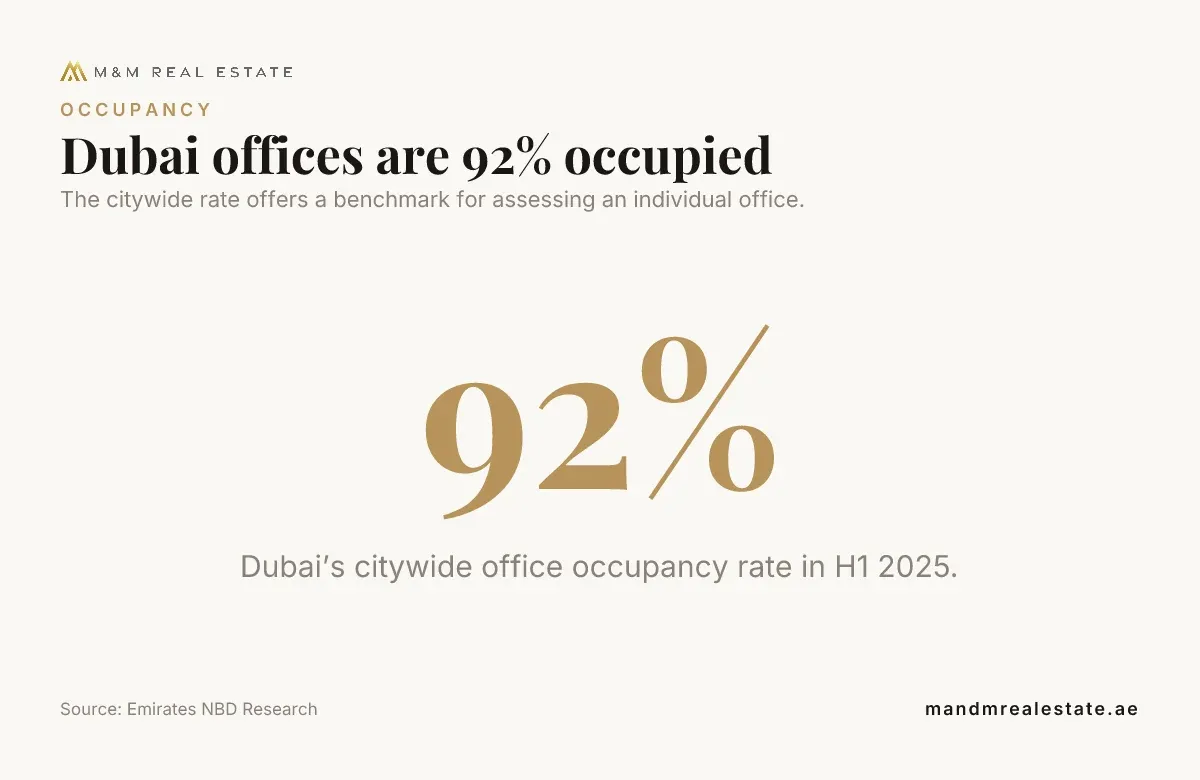
Emirates NBD Research reported a robust Dubai citywide office occupancy rate of 92% for H1 2025 Emirates NBD Research.
Source: Emirates NBD Research
Next, reconcile the office’s physical condition with the lease schedule and rent roll. A unit may be empty while a lease remains in force, or occupied without a current agreement that supports the income you expect.
Give more weight to recent, unit-level records than to an undated headline rate or a verbal assurance. Check who produced the occupancy figure, its coverage and definition, and whether the date still makes it useful for your decision.
Compare offices only after accounting for location, fit-out, lease terms and permitted use. Our guides to choosing a Dubai area for your investment goals and Dubai property locations can help frame the location comparison, but the unit’s own records still carry the weight.
A specific project can help you practise that distinction. M&M Real Estate’s The Yards Plaza: would we buy an office here?, a 14-minute video presented by Matthew Kimber, covers the project, its location, numbers, the commercial market and his verdict on buying an office there.
Audit the leases and test whether rent is collected
Match each lease to the correct unit, then reconcile the rent roll against signed agreements, payment records and deposit records. A signed lease establishes contractual terms, not that the tenant has paid.
Read the expiry and break dates alongside the rent history. Arrears, rent-free periods, incentives and other concessions can reduce or interrupt income even when an office appears occupied.
Look at tenant concentration and related-party arrangements as well. Income that depends on one tenant, or on a connected party whose agreement has not been independently supported, may be less resilient than a rent roll spread across separate tenants.
Keep contracted rent, collected rent and asking rent distinct in your assessment. Then allow for the gap between one tenant leaving and a replacement lease starting; the next rent payment may not begin immediately.
Our guide to Dubai rental yields, costs and tax offers further context for examining gross rent against the income that remains after expenses.
What foreign buyers get wrong in Dubai off-plan, what each mistake costs, and exactly what to do instead.
Download free→Turn occupancy evidence into a net-income test
Build the income estimate from rent supported by lease and collection records, then deduct recurring ownership costs. Gross rent is not your return.
Include service charges, maintenance, insurance and any known building works in the cost review. Use invoices, budgets and building records to distinguish recurring costs from one-off obligations that could fall due after purchase.
Stress-test a delayed re-let, a vacant period, leasing costs and any contribution needed to prepare the office for a new tenant. Our Dubai property investment guide and guide to property tax considerations can support the wider return assessment.
Worked example, using Emirates NBD Research’s H1 2025 figures: average citywide office rents reached AED 190/sq. ft., marking a 22% year-on-year increase Emirates NBD Research. First, AED 190 per sq. ft. × the office area in sq. ft. = rent at that average. Then subtract documented ownership costs to estimate net income.
This calculation is a framework, not a forecast. Replace every assumption with figures supported by the office’s agreements, payment history and cost records, then test how the result changes if rent stops for longer or reletting costs more.
Inspect the building and the practical cost of reletting
Review building operations, maintenance records and the physical condition of both the office and its shared areas. Outstanding or planned works can affect future costs, access and a prospective tenant’s view of the building.
Compare the fit-out with the needs of likely occupiers. A layout that requires substantial alteration can extend the time before the office is ready to let and increase the cost of securing a new tenant.
Estimate the actual preparation work, leasing costs and likely downtime for this unit. Vacant space can take time to re-let; the next occupier may need a different layout, finish or operational set-up.
Lease expiry patterns, vacancy and future demand also affect reletting and resale. A fully occupied building does not guarantee that one specific office will attract a suitable tenant or preserve its exit liquidity.
Our Dubai investment guides and resources offer further reading as you build the review around the building as well as the unit.
Bring the records together before judging the purchase
Cross-check the title and permitted-use records against the unit-level lease schedule, collection evidence, service-charge history and inspection findings. Resolve discrepancies instead of allowing a headline occupancy rate to outweigh conflicting details about the office.
Use comparable transactions only after adjusting for location, unit condition, permitted use and lease profile. A nearby office with a different fit-out or tenant arrangement may not offer a useful comparison for the unit you are assessing.
Base your decision on conservative net income and a realistic vacancy scenario as well as current occupancy. That gives a real investor a clearer view of how the office performs if tenancy changes, rather than relying on uninterrupted rent or an immediate re-let.
For buyers who are considering residency alongside property ownership, our Dubai Golden Visa property guide addresses that separate part of the decision.
When buying a Dubai office, treat occupancy as a claim to verify, not a substitute for unit-level proof. Match ownership and permitted use, audit leases and collections, inspect the building, and test net income against vacancy and reletting costs.
That is how we separate a strong occupancy headline from real evidence about the office, its income and its exit options. No noise, just a clear view of what the records support.

What is the best proof that the seller owns the Dubai office being sold?
Use the current title deed to identify the registered owner; if a company owns the office, confirm that the signatory is authorised to sell on its behalf.
How can a buyer check whether a Dubai office’s lease and rent payments are genuine?
Ask for the tenant’s contact details and seek confirmation directly from the tenant that the agreement and payment schedule reflect the current arrangement. Compare that confirmation with bank records or the managing party’s payment ledger, including any credits or adjustments.
What should a buyer do if the rent roll and the signed leases do not match?
Pause agreement on the income figure and ask the seller to account for each difference with amendments, side letters, credits or other supporting records. If the parties cannot reconcile the figures, negotiate on the basis of verified income or reconsider the purchase terms.
How can a buyer assess whether a vacant office is likely to attract a replacement tenant?
Ask commercial leasing professionals for a written view based on the unit’s floorplate, condition and intended occupier, and request examples of recent comparable letting activity. Their assessment should explain which businesses could use the office and what preparation would make it lettable.
What steps are involved in buying a commercial property in Dubai?
A typical purchase moves from agreeing commercial terms to legal and property checks, contract documentation, payment arrangements and registration of the transfer. The exact documents and sequence depend on the property and transaction, so the buyer’s conveyancing and property advisers should coordinate the completion requirements.


