


Choosing Dubai property by area means matching a location to the time you expect to hold the property. The right choice depends on your exit plan, the rental audience for the home and how much uncertainty you can carry.
Key Takeaways
| Your priority | What to test |
|---|---|
| Nearer resale | Ready condition, building-level sales activity and a clear next-buyer pool. |
| Rental income | Net rent after vacancy, charges, maintenance and other costs. |
| Balanced ownership | Whether the home can attract tenants now and has credible resale options later. |
| Longer-term plan | Handover timing, future competing supply and your ability to hold through change. |
| Any shortlist | Compare like-for-like homes in the same way, not area names in isolation. |
Start with your investment horizon and exit plan
Start with the exit, not the neighbourhood name. A near-term plan needs a credible resale route, an income-led plan needs time for rental cash flow to begin and settle, while a longer horizon depends on your ability to hold through changing market conditions.
Work backwards from the property you intend to buy. Ask who is likely to rent or purchase that specific home, then favour locations where that audience has a reason to look and where relevant resale activity exists.
For property investment in Dubai, a holding period is a planning framework, not a forecast. An emerging-community label does not promise capital appreciation, and a longer ownership period cannot remove market or delivery risk.
Our Dubai real estate investment guide sets out the broader decisions behind an investment plan, while our location guides help you compare communities against your own priorities.
Compare net income with potential resale value
Rental yield is only a starting point. Compare homes with the same property type, layout, condition and precise location, because service charges, maintenance needs and vacancy can make similar-looking rentals perform very differently.
Estimate the net return across your intended holding period. Count rent actually collected, then deduct vacancy, service charges, maintenance, financing where relevant, acquisition costs and sale costs.
Our guide to Dubai property rentals and yields explains why headline rent is not the same as income retained. For costs linked to ownership, read our guide to Dubai property tax and investor costs.
Hypothetical worked example: This illustration assumes the stated rent and sale proceeds, with no additional income or costs beyond those shown.
- Purchase price: AED 1,000,000.
- Add acquisition costs: AED 1,000,000 + AED 40,000 = AED 1,040,000 invested.
- Sale proceeds after sale costs: AED 1,100,000 - AED 22,000 = AED 1,078,000.
- Add rent collected: AED 1,078,000 + AED 240,000 = AED 1,318,000.
- Deduct the initial investment: AED 1,318,000 - AED 1,040,000 = AED 278,000 net gain.
This is a net gain under the stated assumptions, not a prediction. Financing, vacancy, maintenance or other costs would change the result if they applied.
For a nearer exit, assess readiness and resale demand
A ready property can start generating rent after transfer; an off-plan home has to reach handover first. Match that delay to your intended exit date; wider area attention alone does not establish an easy future sale.
Assess resale liquidity using activity for the specific building and home type, then identify the likely next buyer. Compare condition, layout, building charges and the home’s position within the neighbourhood against genuinely similar properties, since these shape both tenant appeal and resale competition.
The Jumeirah Village Circle area offers a completed-home example; assess building-level resale activity when comparing completed stock.
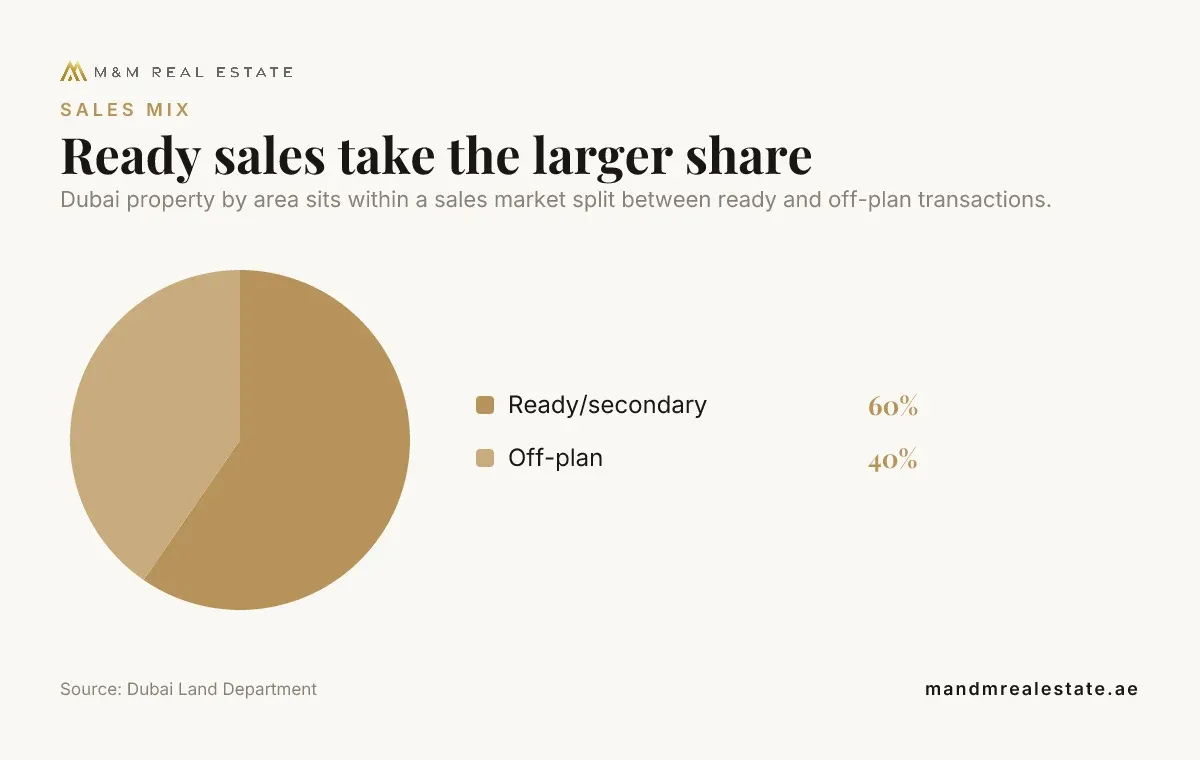
Dubai property by area sits within a sales market split between ready and off-plan transactions.
Source: Dubai Land Department, page accessed 13 October 2026.
For a nearer exit, the practical question is whether another buyer can see the same case you do: a usable home, clear ownership costs and evidence of transactions in comparable units.
Twelve chapters on what the regional war tested, the balance sheet and dollar peg behind the market, and how to pick the right side of this cycle.
Download free→For an income-led or balanced plan, test tenant demand
Match the home to the renter you expect to serve. Family homes, apartments and smaller units meet different household needs, so compare the likely tenant pool for the property type rather than treating area names as interchangeable.
Access to transport, employment, everyday amenities and leisure can influence whether a tenant considers a home and chooses to stay. Set those advantages against the competing homes available now and upcoming supply, since more similar rentals can mean more competition.
The Dubai South guide describes Emaar South as a golf community with townhouses, villas and low-rise flats, with most homes already completed. Assess the property mix against your intended tenant.
An established area and an emerging community can both suit an income-led strategy, but the evidence differs. In an established location, assess existing rental competition and building performance; in an emerging one, separate current tenant appeal from amenities or infrastructure that still depend on future delivery.
For a longer horizon, weigh off-plan timing against future supply
An off-plan property cannot earn rent before it is ready. Compare the expected handover schedule with your cash-flow needs and planned exit, and account for construction progress as well as the timing and volume of competing homes.
New development may add amenities, but it does not prove future tenant demand or price growth. Ask whether future renters or buyers will value the community’s actual features, rather than treating a planned facility as evidence of demand on its own.
The Dubai South guide describes Azizi Venice as a waterfront community of studios to three-bedroom apartments arranged around an 18 km swimmable lagoon. Weigh those features against your own timeline, not as a return or completion promise.
Before committing, consider the developer’s delivery record and project terms alongside construction status. Our developer reviews and profiles and off-plan buying guide provide further context, while our Dubai off-plan property listings show the range of projects to compare.
Shortlist areas with a consistent comparison
Use the same property type, holding period and measures for every shortlisted community. Compare entry cost, achievable net rent, sales activity, resale options and relevant supply; changing the measure from one area to another can make a weak comparison look persuasive.
- What exists now: homes, transport, amenities and rental choices already available.
- What is still to come: planned infrastructure, handovers and competing future homes.
- How the specific property fits: tenant or buyer audience, commute, lifestyle needs, building condition and ongoing charges.
- Whether the plan holds together: practical resale options for a nearer exit, net-income assumptions for a rental strategy, or the capacity to absorb delay and market change over a longer period.
Area-level figures help frame a shortlist, but they do not replace unit-level analysis. Our guide to Dubai investment areas offers further comparison, and our Dubai property insights and reports provide wider context for your decision.
If residency planning forms part of your ownership strategy, consider it alongside the property decision with our Dubai Golden Visa guide. It is a separate question from whether a particular home suits your income or resale plan.
Choose an area in Dubai by starting with the date and type of exit you need, then testing rental demand, net return, resale options and supply against the specific home. A clear holding plan does not predict the market; it helps you make a more considered choice and avoid treating an area label as an investment case.



What are some popular leasehold areas in Dubai?
Leasehold rights can vary by property and title, so an area name alone does not establish the tenure. Review the specific unit’s legal interest, remaining term and transfer conditions before comparing it with a freehold purchase.
Are Dubai property prices coming down?
Price movements can differ between communities, buildings and property types, so a citywide answer will not describe every home. Compare completed transactions for the specific type of property you are considering, rather than relying on asking prices alone.
Can an investor resell an off-plan property before handover?
That can depend on the sale contract, the developer’s transfer requirements and applicable registration procedures. Review the contract’s resale provisions and payment conditions before relying on a pre-handover sale as your exit route.
How does taking a mortgage affect the holding period needed for a Dubai property?
A mortgage adds regular repayments and financing costs, which can reduce the cash flow available while you own the property. Build the repayment schedule and any planned loan settlement into your exit calculation so the sale proceeds cover the outstanding balance.
How should an investor compare two buildings in the same Dubai neighbourhood?
Compare building-specific service charges, maintenance records, management quality and the condition of shared facilities. Then assess recent transactions and rents for similar layouts in each building, because neighbourhood averages can conceal meaningful differences.


