


For Dubai property for sale, the investment case changes with location: it is a question of income, growth and risk, not simply a neighbourhood’s reputation. We compare each location against the investor’s goal, then look closer at the building, street and costs.
Key Takeaways
| Investor question | What to compare |
|---|---|
| Which location suits my goal? | Rental income and capital appreciation are different objectives. Set the priority before comparing areas. |
| How do I compare neighbourhoods fairly? | Hold property type, rental strategy and intended holding period constant. |
| What affects tenant demand? | Look at daily convenience, transport, building condition, amenities and the likely tenant profile. |
| Which return figure should I use? | Gross rental yield is a starting point. Estimate net return after ownership and operating costs. |
| How do I judge future growth? | Separate existing infrastructure from planned projects, and weigh new supply against possible demand. |
| How can I manage location risk? | Compare buyer and tenant pools across areas, and test whether the investment still works if one objective weakens. |
Start with the return you want
Start by deciding whether you are prioritising rental income or capital appreciation. A location that supports one goal may not suit the other, so define the intended outcome before comparing Dubai property for sale.
Then compare like with like: keep the property type, rental strategy and holding period consistent across neighbourhoods. Comparing a long-term rental apartment in one area with a short-term holiday let in another tells you little about the effect of location itself.
Gross rental yield is annual rent divided by the purchase price. Net return is a more complete measure because it accounts for service charges, maintenance, vacancy, management, financing and transaction costs.
For a clear entry-price comparison, the Dubai Marina guide reports a median price of AED 1,996 per sq ft for Park Island and the Downtown Dubai guide reports AED 2,883 per sq ft for Burj Khalifa: AED 2,883 - AED 1,996 = AED 887 per sq ft. This is one comparison of entry prices, not a forecast of future returns.
Branded residences offer a different property proposition from a standard apartment, so compare the purchase price with the rental strategy and holding period you have set.
We set out more ways to judge income and entry price in our Dubai property investment guide and our analysis of rental yields, costs and tax. Use both as context, then run the same assumptions against the specific properties you are considering.
Look beyond the neighbourhood name
A neighbourhood name does not tell you what daily life feels like at a particular building. Assess walkability to shops, services and public transport, and consider whether residents can meet everyday needs without relying on a car.
Road access can make a commute easier, but traffic and road noise can reduce the appeal of a nearby home. Check the likely route at the times tenants would travel, not just the route shown on a map.
At property level, compare views, noise exposure, building condition and access to shared amenities. A well-known address cannot make two units in different buildings, or even different parts of the same building, equivalent.
For example, a tenant focused on access to employment and transport may value a different set of features from someone seeking resort-style facilities. Our locations offer area context; a visit and building-level review show how that context applies to a particular home.
Completed marina towers provide an established building and local setting to assess. M&M’s Dubai Marina guide reports 53 sales for Park Island, a median price of AED 1.99M and a median of AED 1,996 per sq ft.
Match tenant demand to the property and location
Ask who is likely to rent the property, then test whether its size, layout and amenities suit that group. A location can attract interest overall while a particular unit remains a poor fit for the tenants you intend to reach.
Long-term and short-term rentals also have different operating needs and vacancy patterns. A short-term rental depends on frequent guest turnover and active management, while a long-term rental uses a different leasing rhythm; neither strategy is automatically more profitable.
Local amenities can indicate convenience and potential tenant appeal, but they do not guarantee occupancy or a higher rent. Assess whether the property type has a deep enough pool of tenants and future buyers to support resale liquidity as well as leasing.
The Downtown Dubai guide reports 75 resales of Burj Khalifa residences and a median price of AED 2,883 per sq ft, giving investors resale activity to examine for that property type.
Twelve chapters on what the regional war tested, the balance sheet and dollar peg behind the market, and how to pick the right side of this cycle.
Download free→Judge infrastructure and growth prospects carefully
Assess transport, road links and daily services that operate now separately from projects that are planned. Existing infrastructure supports present-day usability; future plans can change or take time to arrive.
Give more weight to confirmed projects with clear delivery information than to rumours or broad expectations. Also consider new supply: further homes can add amenities and improve an area’s appeal, while increasing competition for tenants and buyers.
Past price rises and planned infrastructure do not promise future capital appreciation. Compare the case for an area’s existing access with the case for its future development, and decide how much of your expected return depends on each.
Assess current access and any longer-term growth case for Dubai South.
For a broader comparison of areas against different investment aims, see our guide to Dubai locations by investment goal. When considering an off-plan project, review the developer information alongside the site, delivery details and surrounding supply.
Include ownership costs and eligibility
Build service charges, maintenance, vacancy, management, financing and transaction costs into your net-return estimate. A headline rental yield does not account for these deductions, so it cannot stand in for the return you expect to keep.
Ready and off-plan properties have different timelines. A ready property may be available to rent after transfer, while an off-plan property involves a wait before rent can begin and uncertainty around future completion.
Our off-plan buying guide and Dubai off-plan property information help frame that comparison. Consider the purchase schedule, the period without rental income and how the building’s immediate surroundings may change as construction progresses.
Foreign buyers should establish whether the property sits in a freehold zone and understand the applicable ownership conditions before comparing it with other options. Treat residency eligibility as a separate question: owning property does not by itself establish qualification for a particular residency route.
We cover purchase and ownership considerations in our guide to Dubai property tax for new investors. The Dubai Golden Visa information is a separate starting point for residency questions.
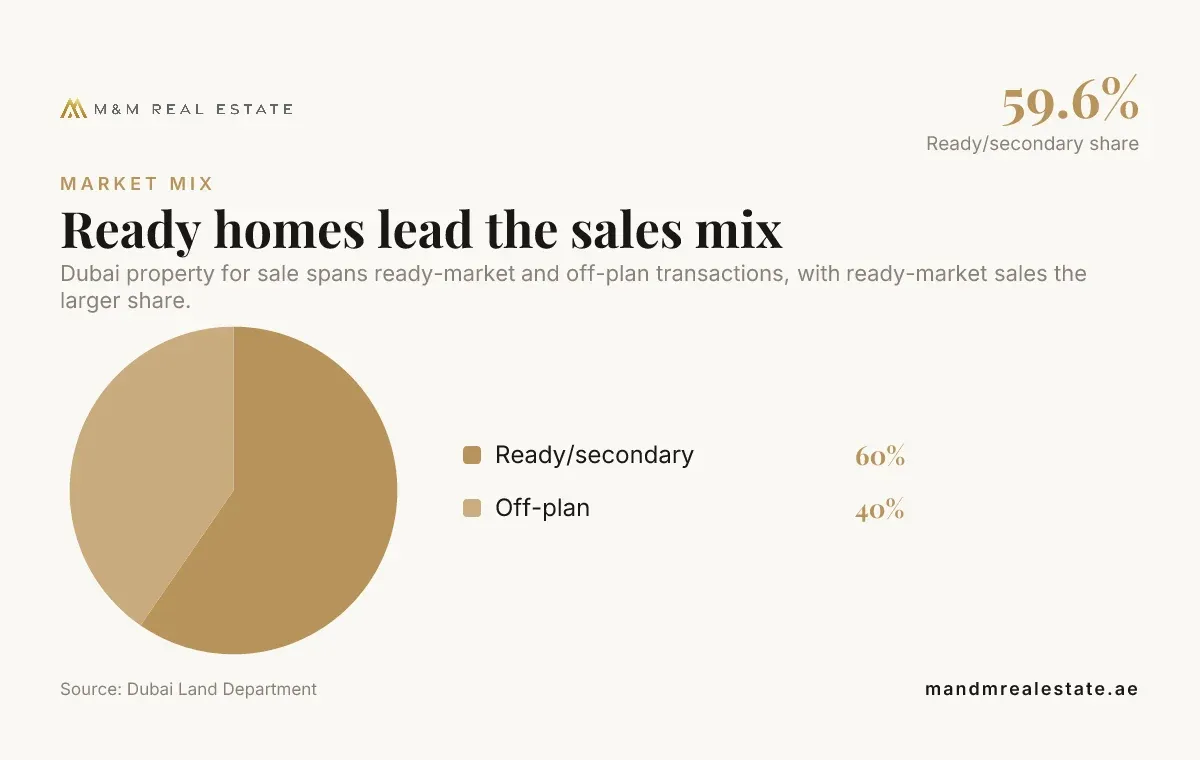
Dubai property for sale spans ready-market and off-plan transactions, with ready-market sales the larger share.
Source: Dubai Land Department
Manage location and portfolio concentration risk
Several properties in one neighbourhood can leave a portfolio exposed to the same local demand, new supply and infrastructure changes. The same risk can arise when properties across different areas depend on a single tenant segment or property type.
Compare locations using the same assumptions, then record where tenant profiles, property types and resale demand differ. Keep rental income and capital growth as separate parts of the decision, and test whether the investment still works if one objective is weaker than expected.
Area-level information gives context, but each property needs its own review of building condition, micro-location and likely buyer or tenant pool. For practical background and further Dubai property resources, use the same disciplined comparison rather than relying on a neighbourhood name alone.
Location changes the investment case through the rent a property can support, the buyers and tenants it can reach, its ownership costs and its exposure to local change. Compare areas against a clear goal, then test each building and micro-location on its own merits.
No noise, just a clearer view of the return you are pursuing and the risks you are taking.

Can a short-term rental strategy work in any Dubai neighbourhood?
No. A short-term rental needs a suitable guest market, an operating plan and compatibility with the building’s rules. In areas where visitor demand is limited, a different letting strategy may fit better.
Does proximity to a metro station guarantee stronger rental returns?
No. The practical walk from the building entrance to the station matters more than a map radius, as do the route’s comfort and the tenant’s destination. A nearby station cannot compensate for a unit that does not suit its likely renter.
How should an investor compare an off-plan property’s location with a ready property’s location?
Compare the surroundings that exist now with the surroundings expected when the off-plan home is delivered. Map which nearby facilities will already operate at that point and which depend on later construction phases.
What should an investor assess during a site visit before choosing a neighbourhood?
Visit at different times and note traffic, street activity and how easy it is to reach everyday services on foot. Inside the building, pay attention to lift access, parking arrangements, delivery access and the condition of shared spaces.
Can owning properties in different Dubai neighbourhoods reduce location concentration risk?
It can spread exposure across different local tenant pools and property types. It does not remove exposure to wider changes affecting Dubai’s property market, so assess both area-level and city-wide risks.
Which location is best for property investment?
There is no single best location for every investor; the right choice depends on whether you prioritise rental income or capital appreciation, as well as your risk tolerance. Compare areas using the same property type, rental strategy and holding period, then assess tenant demand, costs and local conditions.
Which properties in Dubai offer the highest investment returns?
No property type or location can be assumed to offer the highest returns in every case. Compare specific properties using net return after costs, and consider tenant demand, resale liquidity, entry price and the risks tied to the rental strategy.
Where is the best area to invest in real estate in Dubai?
The best area depends on your investment goal and the type of property and tenants you are targeting. Compare neighbourhoods on consistent assumptions, including current access, tenant demand, ownership costs, future supply and the specific building’s condition.


