


For a Dubai rental property, match the letting plan to the asset, the tenants it can serve and your capacity to manage it. Then test tenant demand, legal arrangements and net returns before committing.
- Start with the asset. An apartment, villa, furnished home and commercial space each serve different needs and require different operating arrangements.
- Test the location against a real tenant profile. Compare daily routines, competing homes and demand for the specific property type, not just the area’s general appeal.
- Choose a letting term you can operate. Short-term rentals bring guest turnover and permission requirements; a long-term tenancy usually means fewer handovers but still involves vacancy and ongoing obligations.
- Budget for the full operating cycle. Include maintenance, replacement, insurance, management and periods without a tenant, not only the initial fit-out.
- Stress-test the plan. Model weaker occupancy and longer vacancy, and consider how payment timing affects cash flow.
- Assess net rental yield. Compare income after ownership and operating costs with your investment goal and appetite for hands-on work.
Start with the property and the tenant it can serve
A property’s layout, facilities and maintenance needs help define the tenants it can serve. Start with the home itself, then consider the routines and expectations of a plausible tenant rather than choosing a letting term first.
| Asset | Potential tenant fit | Operating needs to assess |
|---|---|---|
| Apartment | Tenants seeking a manageable home and shared facilities | Building amenities, access, rules and unit condition |
| Villa | Households prioritising more space and privacy | Repairs, larger interior areas and any outdoor upkeep |
| Furnished home | Tenants seeking a ready-to-use place to live | Initial furnishing, cleaning and eventual replacement |
| Unfurnished home | Tenants who prefer to supply their own furniture | Condition, fixtures and the expectations of the intended tenant |
| Commercial space | A business whose activity suits the premises | Permitted use, fit-out needs and the tenant’s operating requirements |
A studio apartment in Dubai may appeal to someone who values a compact home, while a larger unit may suit a different household. In either case, shared facilities, building access and community rules shape the practical offer as much as the unit’s floor plan.
Furnished and unfurnished homes answer different tenant preferences. For a furnished letting plan, account for the initial setup and the later replacement of worn furniture and appliances; for an unfurnished home, assess whether its condition and fittings suit tenants bringing their own belongings.
Commercial letting needs a separate assessment. Match the proposed business to the premises, permitted activity and fit-out requirements before applying assumptions designed for residential letting.
Dubai Properties is a Dubai Holding developer whose communities include JBR, 1/JBR, Bellevue Towers in Business Bay, Jaddaf Waterfront, La Vie, Remraam, Mudon, Villanova, Serena and The Villa. This range of community settings makes the developer a useful reference when comparing how different property contexts may serve different tenants.
For a closer look at how area selection can follow an investment goal, read our guide to matching a Dubai area to an investment objective. If you are assessing a new-build purchase, our guide to buying off-plan property and off-plan property opportunities can help frame the acquisition decision.
Test the community against the intended tenant
Choose a community by the routines of the tenant you want to serve. A household may weigh access to schools, shops and leisure facilities differently from a professional whose daily routine centres on a workplace or transport connection.
Compare nearby homes competing for the same type of tenant. Look beyond broad asking-rent impressions and note differences in furnishing, amenities, condition, access and lease terms, because each changes the value a tenant sees.
Check tenant demand for the particular property type and tenant profile you have in mind. Interest in an area does not, by itself, show that every apartment, villa or commercial unit will attract a suitable tenant promptly.
Use area comparisons to narrow the search, not to replace an assessment of the individual property. Our Dubai and Abu Dhabi area guides can support that comparison, while a developer overview can help you understand the community context behind a property.
Choose a letting term that fits the asset and workload
A short-term rental can suit an owner prepared for guest turnover, cleaning, check-ins and active oversight. It also requires attention to applicable holiday-home permissions and licensing, as well as furnishing and management arrangements that support frequent stays.
A long-term tenancy can reduce guest handling and the frequency of handovers. It still requires a plan for vacancy between tenants and the responsibilities that continue throughout an occupied tenancy.
Compare expected occupancy across the year, including periods when enquiries may weaken. Do not budget as though every night or month will be occupied, and choose an operating model that the owner or appointed manager can run consistently.
Flexible rent payments are a payment arrangement, not a separate letting strategy. Consider how the agreed schedule affects cash flow and exposure to missed payments, then assess the full plan rather than selecting a term because its advertised rent looks higher.
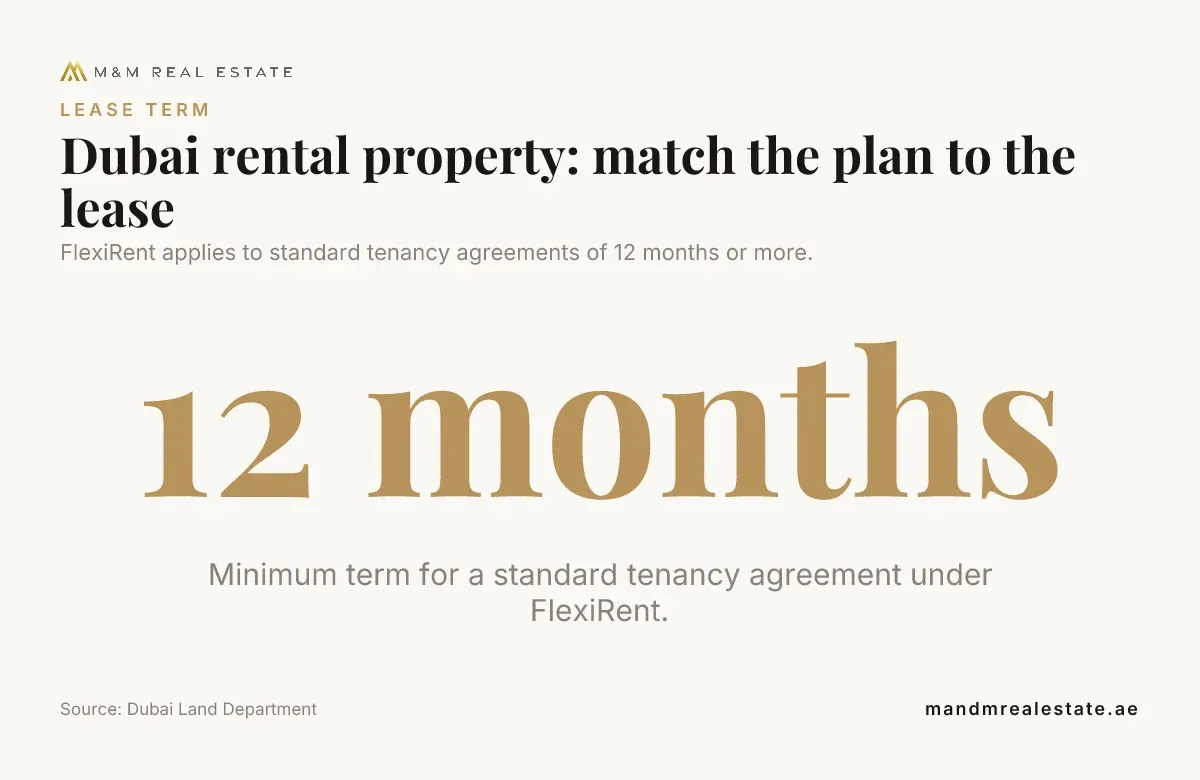
As at 15 October 2026, the Dubai Land Department says FlexiRent applies to standard tenancy agreements of 12 months or more.
Source: Dubai Land Department
Foreign capital is hesitating. The 3.9 million people inside the UAE have not. The asymmetry that defines 2026, and what it tells you to do about it.
Download free→Set the furnishing and management plan before estimating rent
For a furnished strategy, cost the full lifecycle of the furniture and appliances. The initial fit-out is only the starting point: regular use can bring repairs, cleaning and replacement needs that belong in the operating budget.
For either letting term, assess the home’s condition and practical amenities against competing homes aimed at the same tenant group. A ready-to-use property may need a different preparation and servicing routine from an unfurnished home offered to a tenant who brings their own furniture.
Decide who will arrange and oversee repairs, cleaning and routine maintenance. Frequent guest turnover calls for a different process from a tenancy with fewer handovers, so the management arrangement should reflect the work involved rather than the owner’s preferred label for the service.
Stress-test demand, occupancy and payment arrangements
Build a base case and a cautious case for occupancy and vacancy before committing. If the property remains empty for longer than expected, the plan should still show whether it can meet operating costs and how much cash the owner needs to carry the gap.
Compare demand with competing supply for the same property type, furnishing level and lease preference. If the evidence points towards a different tenant group or letting term, revise the plan instead of forcing the original assumptions to fit.
Flexible rent payments can change when income arrives without changing the nature of the letting strategy. Set out the payment dates and the steps that follow a missed payment, then consider whether the schedule leaves the owner able to meet costs as they fall due.
Assess rent, occupancy, expenses, management effort and payment timing together. A higher advertised rent does not by itself establish that a plan will deliver stronger net income.
Calculate net return, not just headline yield
Gross rental yield compares rent with the property’s acquisition cost. Net rental yield accounts for operating and ownership costs, along with periods without a tenant, and therefore gives a more complete view of what the investment produces.
Include service charges, repairs, furnishing replacement, insurance, financing, management and vacancy in the calculation. Leaving out any of these costs can make a headline return look stronger than the income the owner retains.
Worked example: Use symbolic inputs, not market data. Let annual rent be AED R, service charges AED S, repairs AED M, furnishing replacement AED F, insurance AED I, financing AED B, management AED P and vacancy allowance AED V.
- Annual rent less service charges: AED R - AED S = AED (R - S).
- Less repairs: AED (R - S) - AED M = AED (R - S - M).
- Less furnishing replacement and insurance: AED (R - S - M) - AED F - AED I = AED (R - S - M - F - I).
- Less financing, management and vacancy allowance: AED (R - S - M - F - I) - AED B - AED P - AED V = AED (R - S - M - F - I - B - P - V).
The final expression is the net income in this example. Compare that result with your investment goal and tolerance for hands-on work, rather than choosing a plan from gross yield alone.
Our Dubai property investment guide and article on tax considerations for property investors offer further context for assessing ownership costs. If residency planning also forms part of your objectives, consider it separately from the rental calculation with our guide to Dubai’s property-linked Golden Visa.
An advisory team can guide investors through Dubai Properties opportunities in line with their goals. We approach that decision as investment advice: the asset, the letting plan and the owner’s priorities need to work together.
Separate tenancy paperwork from purchase-option agreements
For an ordinary residential letting, set out the tenancy contract, rent schedule, payment dates, maintenance responsibilities and handover condition clearly. Complete the required tenancy registration process, including Ejari where applicable, as part of the arrangement.
Short-term letting calls for attention to applicable holiday-home approvals and operating obligations. A standard tenancy contract does not replace the permissions and procedures that apply to a short-term rental.
A lease option gives the tenant a right to buy later under agreed terms, while a lease-purchase arrangement generally commits the parties to a future purchase. Define what happens if either party does not proceed, and keep the purchase-option terms separate from ordinary rent and tenancy obligations.
Set out payment treatment, deadlines and each party’s responsibilities before agreeing to a purchase-option structure. Our Dubai investment guides and resources provide a starting point for further reading.
A Dubai rental property needs a letting plan built around the asset, the tenant it can serve and the owner’s ability to operate it. Compare community fit, demand, occupancy, paperwork and full costs before deciding whether a short-term rental or long-term tenancy suits the investment.
That is the difference between choosing a plan because it sounds attractive and choosing one that fits the real property.


What documents should a tenant prepare to rent a home in Dubai?
Prepare identification, proof of income or employment and contact details for references, so the landlord or agent can review the application efficiently. Keep digital copies of the information you provide and make sure the names and contact details are consistent across the application.
What are warning signs to look for when screening a prospective tenant?
Inconsistent application details, reluctance to provide verifiable information and pressure to proceed without written terms call for closer scrutiny. Ask direct questions about the intended occupants, property use and payment arrangements, then record the agreed answers in the tenancy paperwork.
Can hotel apartments in Dubai be rented by the month, and what should tenants compare?
A monthly stay can be arranged when the operator offers monthly terms. Compare the full charge, included utilities, housekeeping, deposit, cancellation terms and facilities, since these can change the value of the quoted price.
What should a landlord do if actual occupancy falls below the original plan?
Separate a shortage of enquiries from a high number of viewings that do not convert, since each points to a different issue. Review listing accuracy, viewing feedback and booking patterns, then adjust the offer or operating plan in response to the problem those records reveal.
How can an owner judge whether property management is worth the cost?
Compare the service scope and fee with the tasks the owner would otherwise handle, including tenant communication, arranging contractors and coordinating handovers. A clear service list makes it easier to judge whether the fee buys meaningful time back or leaves the owner managing the same work.
Can a landlord change the letting strategy after buying a property?
A landlord can reassess the plan when tenant enquiries, ownership costs or personal availability change. Before switching, map the practical steps involved, including any changes to furnishing, management, permissions or existing agreements.


