
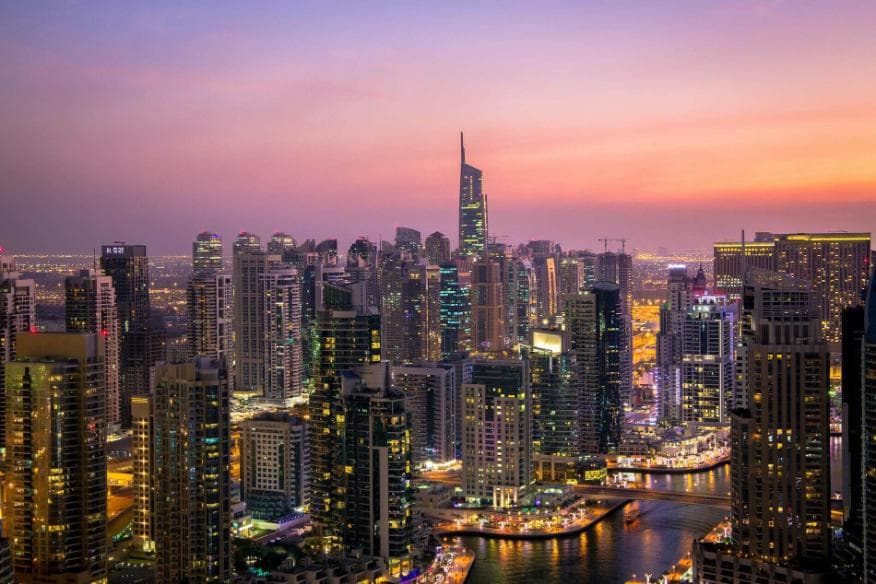
The UAE’s economic growth trajectory remains firmly intact, with Abu Dhabi projected to expand by 4.2% and Dubai by 3.3% in 2025, according to a recent IMF update covered by UAE Barq. The report attributes the country’s resilience to ongoing strength in the non-oil economy, with sectors such as real estate, finance, and infrastructure playing a leading role. These forecasts reflect a wider trend of divergence across the GCC, with the UAE continuing to chart a steady, investment-backed path in a recalibrating global market.
Key takeaways from UAE Barq’s coverage of the IMF’s 2025 outlook:
- Abu Dhabi’s economy is forecast to accelerate to 5.8% in 2026.
- Dubai’s economy is expected to expand by 3.5% in 2026.
- The UAE’s national growth rate is projected at 4% for 2025 and 5% in 2026.
- The country’s performance is credited to a sustained investment in real estate and finance.
The IMF’s latest figures affirm what many long-term investors already understand - the UAE economy continues to outperform expectations, even as global and regional projections undergo downward revision. In a world increasingly defined by volatility, this steady outlook matters, especially for real estate.
What stands out is the strength of the non-oil sector as a growth engine. While Abu Dhabi’s numbers are buoyed by energy-linked investment, its diversification strategy is showing real traction. Dubai, meanwhile, continues to expand at a more measured pace - but one anchored by consistent output from real estate, finance, and tourism. These aren’t speculative booms. They’re structural pillars that have proven durable through multiple cycles.
The report’s focus on the UAE’s infrastructure and financial ecosystem further reinforces the market’s maturity and investability. Capital flows, institutional interest, and international migration have all contributed to sustained demand in prime sectors - particularly in Dubai’s residential and mixed-use real estate, where supply-demand dynamics remain firmly underpinned.
Importantly, the commentary highlights the asymmetry within the GCC, reminding investors not to treat the region as a single economic story. While Abu Dhabi’s 2026 acceleration suggests renewed fiscal expansion, Dubai’s moderate but consistent growth offers a different value proposition - one built on scale, liquidity, and adaptability.
For property investors, these projections signal continued confidence in UAE fundamentals, even in the face of global recalibration. It’s not just about numbers on a chart - it’s about long-term positioning in a market that’s proving it can grow through uncertainty, not just in spite of it.
Original article reference: UAE Barq
