
As Etihad Rail enters a new phase of national visibility and near-term passenger readiness, its implications for Dubai’s property market are becoming increasingly clear. More than just a transport breakthrough, the network is reshaping how cities are connected, how people move, and where long-term investment opportunities are beginning to concentrate.
With districts like Dubai South, Jebel Ali, and Al Furjan now positioned on the country’s most strategic infrastructure line, a new geography of value is emerging – one shaped by speed, accessibility, and long-range planning. This article breaks down what Etihad Rail is, where it’s headed, and why its path is redrawing Dubai’s investment map.
What Is Etihad Rail And Why Does It Matter?
Etihad Rail is the UAE’s federal railway project – an ambitious, 900-kilometre network designed to connect all seven emirates by both freight and passenger lines. First launched in 2009 under Federal Law No. 2, the project forms a core part of the country’s long-term national infrastructure strategy, with future expansion into the wider GCC expected.
Development has progressed in defined stages:
- Stage One began operations in January 2016, focusing on freight transport from key inland sites to Ruwais Port in Abu Dhabi.
- Stage Two, launched in February 2023, extended the network across 605 km from Ghuwaifat on the Saudi border to Fujairah, linking major population centres and industrial hubs in Abu Dhabi, Dubai, and Sharjah.
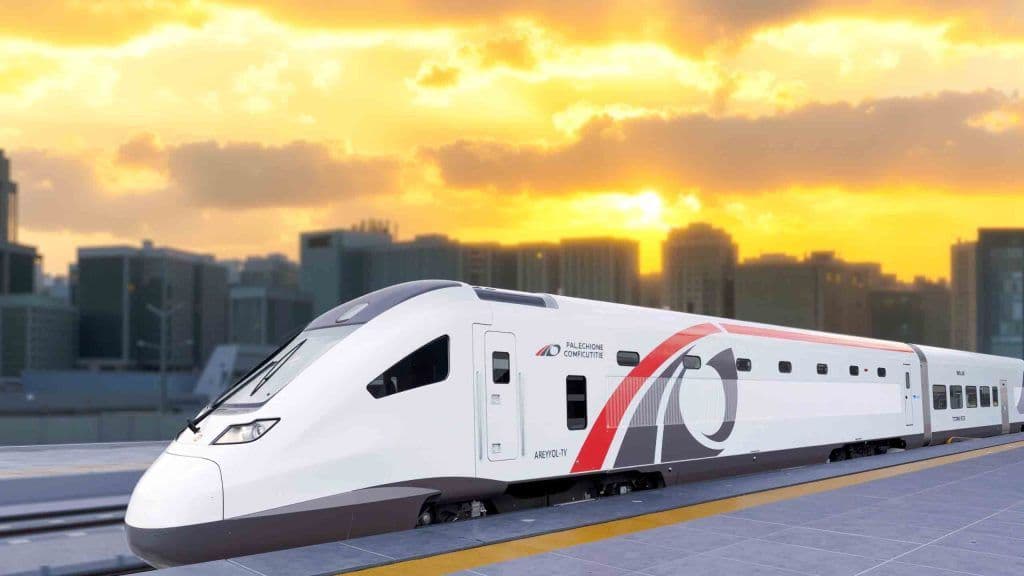
While the freight services are already active, investor and public attention is now shifting to the network’s passenger phase – set to begin commercial operations by 2026. That milestone was reinforced in August 2025 when Sheikh Mohammed bin Rashid Al Maktoum boarded a passenger train from Dubai to Fujairah, offering a public display of leadership backing and project readiness. His ride further exemplifies the rail’s growing importance as a nation-building asset – described by the Prime Minister himself as a “vital economic artery” supporting sustainable growth, logistics efficiency, and inter-emirate mobility.
Etihad Rail represents a structural transformation in how people and goods will move across the country – cutting journey times, easing traffic on highways, and integrating with metro, taxi, and bus systems to create a multi-modal future. With its core infrastructure now largely in place, the network is moving from planning to real-world impact, opening the door to new patterns of urban development, land value, and investor strategy.
The Bigger Picture: Infrastructure And Investment At Scale
Etihad Rail is shaping up to be one of the most consequential infrastructure investments in the UAE’s post‑oil era. Experts estimate that by 2030, the railway network will contribute approximately AED 3.5 billion annually to the national economy, delivering a compelling economic return of 15.5 percent. Beyond that, projections suggest a long‑term GDP boost of up to AED 145 billion, especially when including the Abu Dhabi–Dubai high‑speed corridor.
This transformation will serve as a powerful engine for job creation and economic diversification. Over 9,000 new roles are expected to emerge by 2030, ranging from engineering and construction to operations, logistics, and maintenance. That doesn’t even account for broader supply‑chain and service‑sector impacts that are already materialising during the construction phase.
From a sustainability standpoint, Etihad Rail’s capacity to shift freight from road to rail will help the UAE reduce its carbon footprint dramatically. It’s estimated the network could eliminate up to 8.2 million tonnes of CO2 emissions annually by 2050, and take thousands of trucks off the road for each train journey. Additionally, the launch of the region’s first CO2 Emission Avoidance and Reduction Certificates provides transparency and accountability, reinforcing rail’s role in achieving the UAE’s Net Zero by 2050 ambitions.
All of this combines to make Etihad Rail far more than a transport milestone – it’s a foundational lever that will reshape infrastructure-led investment, urban expansion, and long-term value creation across the Emirates.
Connectivity Is Creating New Centres Of Value
As Etihad Rail’s passenger phase approaches its 2026 launch, its integration with Dubai’s broader transport network is starting to reshape how and where real estate value is concentrated. For investors, the shift is material – not just because of where the trains will stop, but because of what those stops will unlock.
The network will connect directly with the Dubai Metro, RTA bus system, taxis, and even the unified nol card payment system – allowing for seamless, end-to-end mobility between emirates and within the city itself. This level of integration repositions multiple zones that were once considered peripheral, turning them into credible residential and mixed-use hubs for a far broader demographic of buyers and tenants.
Several areas are already drawing investor attention. Dubai South, Jebel Ali, Al Ghadeer, Emaar South, and Al Jaddaf are all expected to benefit from their proximity to confirmed or projected stations. Property analysts are forecasting up to 30% price growth in selected corridors tied to both Etihad Rail and the Metro Blue Line, citing improved access to employment clusters, airports, and central business zones as key drivers.
One of the most closely watched nodes is Al Jaddaf, where a future Etihad Rail station is likely to connect directly to the Dubai-Abu Dhabi line. Its adjacency to Al Maktoum Airport and position between old and new Dubai make it a prime candidate for long-term demand, especially among tenants and buyers who value rail-based commute options over road dependency.
The broader effect is a reshaping of investment logic across the city. Where once property value was largely dictated by geography or prestige, mobility and infrastructure are now becoming the dominant lenses. Accessibility is starting to outperform address – and for serious investors, it’s a signal to reassess the map. This also reflects a growing preference for lifestyle-led location decisions, with villa communities like Meydan and DAMAC Hills benefiting from new transport access that softens the trade-off between space and commute.
Investment Zones To Watch
Dubai South
Dubai South is one of the most closely watched investment corridors in the UAE – and for good reason. With connectivity to Etihad Rail, Al Maktoum International Airport, and major highway upgrades, it’s shifting from a long-term masterplan into an active growth zone.
Rental demand here has surged in 2025, with reported increases of up to 10% in recent months, and surrounding zones like Dubai Festival City seeing rises as high as 23%. At the same time, Dubai-wide residential sales rose by 22.4% year-on-year in Q1 2025, with total value up nearly 30% – a trend largely driven by growing interest in infrastructure-led districts like Dubai South.
Ellington’s upcoming launch in the area only reinforces its trajectory, signalling that developer confidence is now aligning with long-term investor appetite. For buyers focused on future upside, Dubai South offers a rare combination: affordability, infrastructure access, and positioning within a multi-modal transport network that will define mobility in the decade ahead.
Jebel Ali & Logistics Corridors
Positioned between Dubai’s major ports and industrial hubs, Jebel Ali is expected to benefit from Etihad Rail’s freight and passenger presence in equal measure. Its proximity to the Logistics District, Expo site, and new rail corridors is shifting it from a commercial hub to a viable mixed-use investment zone.
Reports are noting broad momentum across communities near upcoming stations. In particular, commercial plots have registered up to 15% appreciation year-on-year following the announcement of station locations, with areas like Jebel Ali, DAMAC Hills, and Town Square positioned for further uplift. The shift is being driven by improved transport access, activation of underused land, and developer movement toward logistics- and transit-connected zones.
For investors, this part of the city offers flexibility: it’s positioned to benefit from both residential yield and logistics-related value uplift.
Al Furjan, Dubai Investments Park & Peripheral Zones
Micro-markets like Al Furjan, Dubai Investments Park (DIP), and neighbouring communities are gaining renewed momentum as Etihad Rail expands the reach of Dubai’s existing infrastructure. Al Furjan’s inclusion in Metro Route 2020 had already positioned it as a high-access area, but the arrival of national rail is now amplifying its value proposition across both owner-occupier and investor segments.
Properties within walking distance of both Metro and Etihad Rail corridors are already showing solid year-to-date gains. Across these connected zones, average residential values are up by around 13%, with Dubai Festival City leading at 18%, and Dubai South and DIP up by 17%. Concurrently, rental values have increased by 9% on average, with Festival City again posting a standout 23% rise. Etihad Rail is reinforcing this trend, with price forecasts pointing to up to 25% appreciation in these areas as passenger operations near completion.
For investors targeting mid-range yield, resale flexibility, or family tenancy appeal, these peripheral zones are offering city-grade transport access without inner-core pricing. With both Metro and Rail converging here, the case for long-term growth is getting harder to ignore.
What Investors Should Be Watching as Etihad Rail Expands
Etihad Rail is entering a critical phase – not just in terms of engineering progress, but in how it reshapes forward-looking investment logic. For buyers with a longer horizon, the next 12-18 months could present a rare inflection point.
Passenger services are slated to begin by 2026, with full integration into Dubai’s multimodal ecosystem – including Dubai Metro, RTA buses, taxis, and the unified Nol card payment system. This creates seamless, cross-emirate mobility that’s already being priced into many of the zones along its projected corridors.
Dubai’s transport authority has also confirmed that Etihad Rail stations will be linked directly to public transport infrastructure, meaning every node will serve as a high-access cluster from day one. For investors, this reduces uncertainty and accelerates demand viability.
Looking slightly further ahead, a dedicated high-speed line between Abu Dhabi and Dubai – capable of reaching speeds up to 350 km/h – is under development. Travel time between the cities is expected to drop to around 30 minutes, significantly altering regional investment dynamics and potentially elevating demand in communities previously seen as “in-between” zones.
For smart investors, now is the time to watch for three things:
- Launch clusters forming around confirmed or leaked station zones
- Price momentum in areas previously overlooked but now gaining mobility access
- Developer moves into fringe markets that are becoming newly viable due to rail
Early entry into these corridors has always been one of the most consistent signals of outsized long-term returns in Dubai real estate, and Etihad Rail may be one of the strongest catalysts yet.
Want to understand which areas are set to benefit most – and why?
Get in touch with the team at M&M. Our market intelligence covers every rail corridor, infrastructure cluster, and developer strategy in motion, giving you the foresight to act ahead of the curve.
