


The real impact of Al Maktoum Airport on logistics-linked housing starts with jobs, not price forecasts. We look at which roles may bring new households into the southern corridor, what those residents need, and how to distinguish real rental demand from a development announcement.
- Airport and logistics growth can support housing demand when it creates local jobs that lead people to relocate or form households nearby.
- Workers may choose homes across Dubai South and the wider southern corridor, rather than in the closest neighbourhood.
- Shift-based staff, office teams, technical employees and families have different budgets, schedules and housing needs.
- Housing decisions should account for commute options, freight traffic, aircraft noise, everyday services and competing residential supply.
- Property transactions and business announcements do not prove that homes have tenants. Look for evidence of occupancy, leases and tenant absorption.
- We assess the link between employers and homes as a set of practical questions, not as a guaranteed investment story.
What Al Maktoum International Airport is used for, and where its expansion stands
Al Maktoum International Airport, also known as Dubai World Central or DWC, serves passenger aviation and air cargo within Dubai’s southern transport and logistics network. Its wider commercial activity connects with freight forwarding, warehousing and distribution, and related airport services.
The airport is operating, while its planned expansion remains a future development programme. That distinction matters: an expansion announcement can influence expectations, but it does not show that new employees have arrived or that nearby homes have tenants.
Is DWC going to replace DXB? Dubai’s long-term plans give DWC a larger role, but investors should not treat DXB as already replaced or assume that all airport activity will transfer at once. The practical housing question is where people work and live under current commuting patterns, as well as how those patterns may change over time.
Who is the contractor for the expansion? For a property decision, the relevant issue is whether the infrastructure and employment milestones behind the housing case are progressing.
The image below summarises the airport’s planned role in residential, commercial and logistics demand. We treat that outlook as context, not as proof of rental absorption.
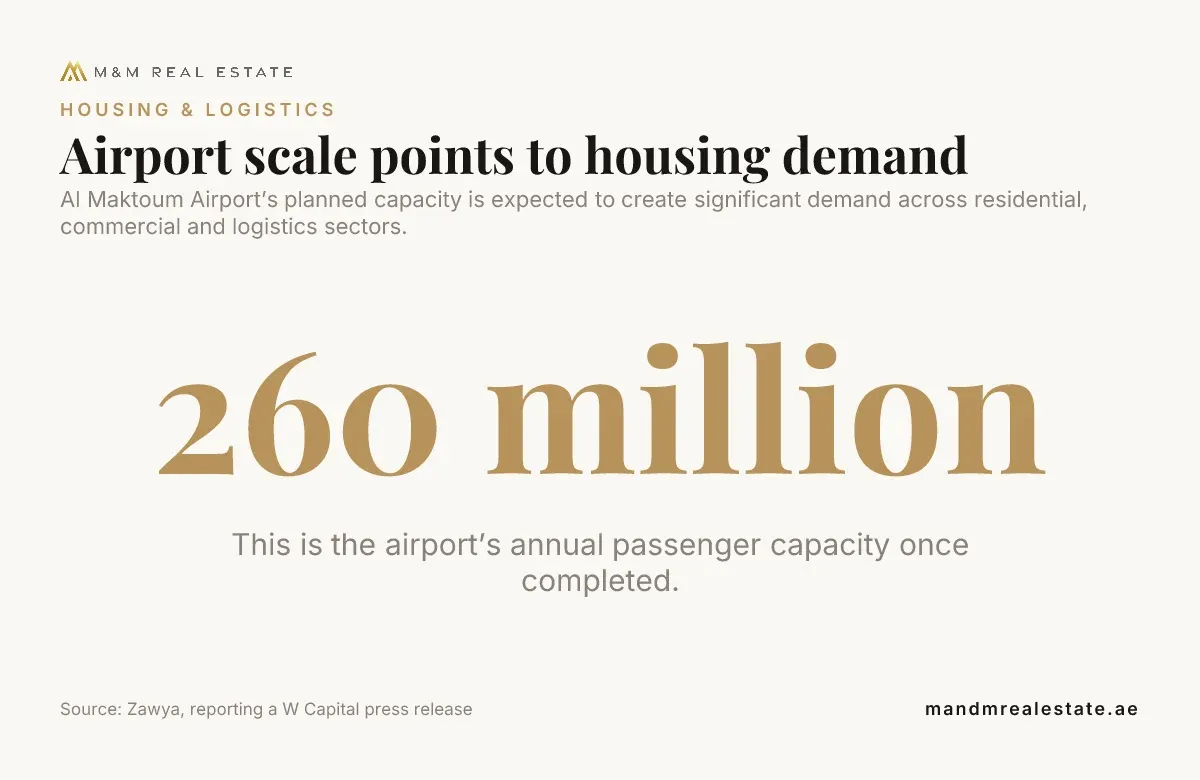
A visual summary of W Capital’s airport outlook, reported by Zawya and accessed on 12 October 2026.
Source: Zawya, reporting a W Capital press release
How logistics and aviation jobs can become housing demand
Airport activity supports housing demand when employers hire people who relocate, stay near their workplace or establish a separate household. Relevant roles can include cargo handling, freight forwarding, warehouse operations, e-commerce fulfilment, fleet dispatch, inventory control, aircraft maintenance, ground services, aviation security and supply chain management.
Headcount alone does not tell us how many homes the workforce will need. Some employees may already live elsewhere in Dubai, commute from another emirate, share accommodation, or receive employer-provided housing; others may bring a partner or family and look for a longer-term home.
We translate a hiring announcement into a housing question by asking who the roles are for, where the worksite sits, which staff are likely to relocate, and what household arrangements they expect. Local recruitment can strengthen demand without creating an equal number of new resident households.
We also separate airport employment from the wider logistics ecosystem. A job based in a warehouse, freight-forwarding office or distribution centre may be closer to a different part of the corridor than to the passenger terminal, which changes the sensible commute catchment.
Which communities may serve workers across the southern corridor?
Our Dubai South area guide describes a mix of residential communities around the airport, Expo City and the surrounding employment districts. For workers, the right choice depends on the actual job location, shift time, road access, public transport and the services they use outside work.
Dubai South is a natural area to examine, but proximity does not make it the automatic choice for every employee. Homes in Emaar South or Expo City may suit residents looking for a different mix of transport, housing and community facilities, while workers connected to Jebel Ali Port or Dubai Investments Park may prefer another part of the southern corridor.
Our guide to Dubai locations can help compare areas by transport, tenant profile and stage of development. We look beyond distance to the airport and ask whether a home works for the employee’s full commute and daily routine.
Jebel Ali Port also matters to this housing discussion because airport-related logistics do not operate in isolation. Our Jebel Ali area information helps place port-linked employment within the wider commute catchment, rather than treating every job as an airport job.
Match housing to the workforce, not to a single tenant profile
Logistics-linked housing serves several types of residents. The most suitable home depends on work schedule, household size, budget, commute mode and access to everyday amenities, not simply on an employee’s industry.
| Potential resident | Housing priorities | What to assess |
|---|---|---|
| Shift-based logistics staff | Practical rental costs, dependable transport, secure access and suitable parking | Travel at shift-change times, late-hour access to food and services, and quiet interiors for daytime rest |
| Supervisors and office teams | Private apartments, convenient road or public transport links, and nearby shops | Whether the location works for both the employment site and regular errands |
| Technical and aviation professionals | Comfortable homes with reliable access to work, parking and building services | Commute options, maintenance standards and the home’s suitability for different working hours |
| Families | More internal space, schools, healthcare, play areas and established daily services | School and work journeys, family amenities and whether the community meets longer-term needs |
For households looking at larger homes in Dubai South, South Bay includes townhouses, villas and mansions. M&M’s South Bay page lists a starting price of AED 1,900,000.
Using the starting price shown on M&M’s South Bay page, one illustrative calculation with a hypothetical 10% deposit is: AED 1,900,000 × 10% = AED 190,000 deposit; AED 1,900,000 - AED 190,000 = AED 1,710,000 remaining. This is a simple budgeting illustration, not a forecast of financing terms or property performance.
A family home and a compact apartment answer different needs. A property can sit near a logistics district and still miss its likely tenants if it is too costly, poorly connected or short on the services that matter to their household.
Twelve chapters on what the regional war tested, the balance sheet and dollar peg behind the market, and how to pick the right side of this cycle.
Download free→Transport, aircraft noise and everyday liveability
Road and public transport access affect whether a home is practical for airport and logistics workers. Test the route to the actual employment site at the times a shift begins or ends, and consider whether the resident can reach shops, healthcare, schools and other daily services without relying on a single commute option.
Airport proximity can also bring aircraft noise, while freight routes may add heavy vehicle traffic and affect the feel of nearby streets. Conditions vary by location and operating pattern, so assess the home itself, its orientation, window performance, indoor comfort and exposure to busy roads rather than relying on a map radius.
Shift workers may need to sleep during the day, making noise control and dependable building services important. Families may place greater weight on schools, outdoor space and road safety, while office staff may favour a straightforward connection to both work and retail.
We recommend viewing the neighbourhood at different times and paying attention to the route between the home, transport stops and employment sites. The airport commute and the logistics-corridor commute are not always the same route.
How to test rental demand against residential supply
Signs that company growth is turning into tenant demand include new staff actually working at local sites, employers leasing nearby accommodation, occupied homes, completed tenancy contracts and repeat renewals. Announced business activity is an early signal; resident households and signed leases show whether that activity is feeding through to housing.
Keep property sales separate from rental evidence. A transaction count records buying and selling, not how many homes are occupied, how long they remain tenanted or whether tenants accept the advertised rent.
Compare likely new households with the homes available to them across the wider commute catchment. Include completed residential supply, homes approaching handover, competing rental listings and the mix of studios, apartments and family homes, then ask whether those options match the budget and needs of the workforce.
Our guide to Dubai rentals and yields provides a wider framework for thinking about tenant strategy. A forecast yield does not replace local evidence of occupancy, asking rents, lease renewals and competing homes.
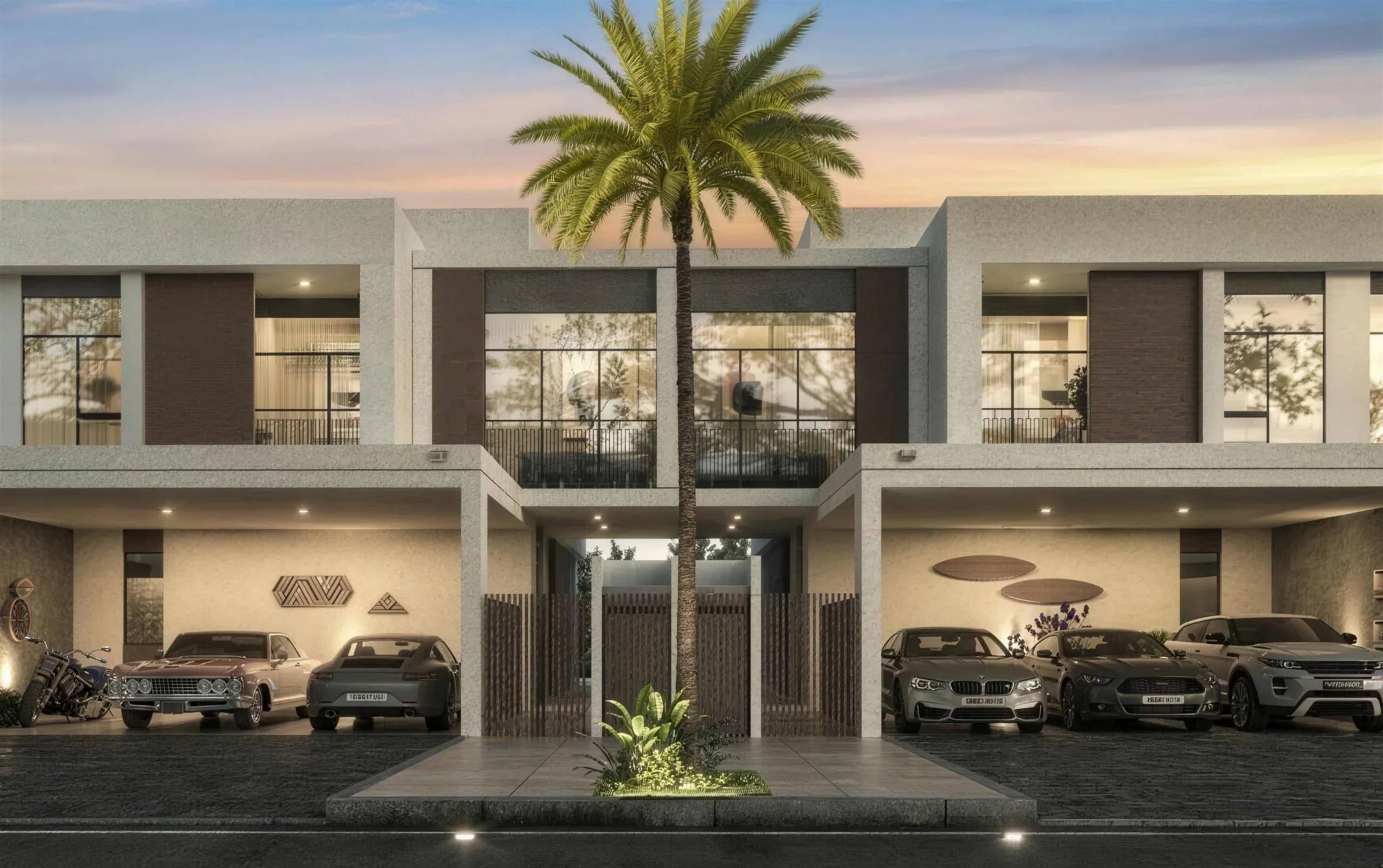
These South Bay images show the kind of residential stock that investors should place alongside job announcements and competing supply when assessing absorption. A new home adds to the pool of options; it does not establish that the pool of tenants has grown at the same pace.
A practical investment test for airport-linked housing
Start with existing demand. Identify current employers, active work locations and the types of households already renting in the area before adding future airport activity to the case.
Then test the growth pathway. Ask which employers are expanding, which roles they expect to add, whether those employees are likely to live locally, and when the homes they could rent will be ready.
We also assess the competing residential pipeline and the property’s use beyond one tenant group. A home with broader appeal to local professionals and families may have a more resilient case than an asset that depends entirely on one employer or one future project milestone.
For buyers comparing development stages, our off-plan buying guide and Dubai off-plan property options help frame delivery timing and the available choices. We also consider who is building the project, using our developer profiles as part of a wider assessment of delivery and location.
Our area comparison for Dubai investors and Dubai property investment guide support that broader review. Ownership costs also matter, so we include our guide to property tax considerations for new investors when assessing the full holding decision.
For buyers whose plans include residency as well as property ownership, our Dubai Golden Visa guide covers that separate consideration. Residency goals and tenant demand answer different questions, so we assess them independently.
Use our property investment resources to organise the questions you want to answer about location, tenancy and ownership. For an airport-linked purchase, pair that wider reading with site visits and evidence of actual local occupancy.
The practical effect of Al Maktoum Airport on logistics-linked housing depends on the path from business activity to resident households. Jobs, commute patterns, housing affordability, everyday services and available homes all shape whether airport and logistics growth becomes sustained rental demand.
We separate existing activity from future expectations, then test tenant absorption against residential supply across the wider corridor. That is the real work behind a housing decision: clear Market Intelligence, practical comparisons and no noise about guaranteed outcomes.
Can airport noise affect the resale appeal of a nearby home?
Yes, noise can influence who considers a property and how comfortable they find it. For resale, keep a record of the home’s orientation, window features and the surrounding environment, and make sure the property’s appeal does not rely on buyers overlooking those conditions.
Should I buy off-plan near Al Maktoum Airport before new jobs arrive?
Only if the purchase also works for you under a slower employment and occupancy scenario. Consider how you will manage the property before handover and whether its location and housing type can attract residents beyond airport-linked workers.
Can an employer lease guarantee occupancy for a logistics-linked property?
A company lease can provide a clear tenant arrangement, but it concentrates demand in one organisation and may change when staffing or accommodation policies change. Review the lease term, renewal conditions, responsibility for maintenance and the plan for reletting if the company leaves.
What should shift workers look for in a home near Dubai South?
Useful features include secure access, dependable cooling, sound control, convenient parking where needed and a practical route to the worksite at unusual hours. Nearby food shops and basic services can also make a home easier to use between shifts.
How can landlords reduce vacancy if airport hiring slows?
Choose a home that can serve more than one tenant group, keep it well maintained and price it against comparable available rentals. Flexible, clear tenancy arrangements can also help attract residents whose jobs sit elsewhere in the southern corridor.


