


When we compare Dubai investment areas, we start with the person the property must serve and the evidence that fits their objective. Popularity is not a buying strategy, and an area-wide headline does not prove that a specific building or unit will perform.
- Set the investment objective first. Decide whether the priority is rental income, future resale, family use, premium positioning or a combination.
- Compare like with like. Separate ready and off-plan property, and match property type, size, condition and location before drawing conclusions.
- Keep an evidence record. Note the source, date, property type and area boundary for every comparable so you can reproduce and refresh the comparison. Our property investment resources provide a starting point for that work.
- Use completed transactions and achieved rent. Asking prices and advertised rents show what owners hope to achieve, not what buyers or tenants have agreed to pay.
- Include the full ownership picture. Service charges, maintenance, management, vacancy and financing can change the comparison between otherwise similar properties.
- Move from area evidence to the actual unit. Check the building, project, layout, tenant profile, competing supply and likely resale audience before committing.
Start with the investor, resident and objective
An area comparison works only when we know who might live in the property and what the investment needs to deliver. A buyer seeking rental income has different priorities from a family planning to use the home or an investor seeking premium positioning and a particular resale audience.
Write down the intended resident’s practical needs before comparing neighbourhoods. Consider their commute, access to daily services, preferred property type, parking requirements, tolerance for construction activity and likely length of stay.
Then define the investment objective in plain terms. For an income-focused purchase, assess the likely tenant pool and realistic rent; for family use, prioritise the daily route to work, school and services; for premium positioning, consider the property’s condition, setting and plausible future buyer.
Residency may form part of a buyer’s plan, but it should not replace the investment test. We explain the relationship between property and residency in our Dubai property and Golden Visa guide.
Compare completed sales and rents on a like-for-like basis
Begin with completed transactions and achieved rent, then check whether each comparable property genuinely resembles the one under consideration. A ready apartment and an off-plan unit should not sit in the same comparison without a clear adjustment for their different status, timing and risks.
For each comparable, record the property type, approximate size, layout, condition, furnishing, building and precise location. Also note when the sale or rental took place and whether the figure is an achieved price, an asking price or an estimate.
Those labels matter. A listing price may reveal competition between sellers, but it is not a completed sale; an advertised rent is not an achieved rent; and a modelled estimate is an assumption rather than a tenancy outcome.
Record provenance in a simple comparison log: the source, access date, transaction or rental date, property type and the boundary used for the area. Define that boundary on a map or by named streets and buildings, because broad district labels can conceal meaningful differences in access, surroundings and resident experience.
When completed evidence is sparse or inconsistent, do not disguise the weakness with a single average. Separate unlike properties, give greater weight to the closest matches, note how many relevant examples support the conclusion and mark the result as lower confidence when the evidence does not support a firm view.
Match the area to its competing supply and strategy
Area activity can help identify where to investigate, but it does not establish demand for a particular unit. Assess the existing stock, new projects, expected completion timing and the type of tenant or buyer each property is likely to attract.
For an income strategy, compare the unit with nearby alternatives that a tenant could realistically choose. For family use, test whether the area and building suit the household’s everyday routines. For premium positioning, identify the future buyer or tenant who would value the property’s particular setting, design and features.
Do not treat future supply as a single area-wide number. Consider whether new stock competes directly with the property by type, layout, price point and likely handover period. A wave of similar units may affect rent and resale options differently from new stock that serves another resident profile.
For off-plan property, separate the purchase case from the ready-property case. Consider the construction and handover timeline, payment commitments, project characteristics and the rental plan after completion; a unit that is not ready cannot serve an immediate rental need. Our off-plan buying guide sets out points to assess, while our developer reviews can support project-level investigation.
Translate area indicators into a real daily route
A map can make an area look convenient while concealing the route the intended resident will actually use. Test the route from the specific building entrance to work, school, public transport, shops and other regular destinations at the times that matter to that resident.
Look beyond straight-line distance. Check walking routes, road access, parking, transfers, crossings and whether nearby facilities sit on a usable route or merely within the same broad district.
Suitability also depends on the resident’s pattern of life. A location that works for a household travelling by car may not fit someone who relies on walking and public transport; an investor should compare the property’s access with the tenant profile they expect to attract.
We use this practical test to challenge area reputations rather than accept them. The question is not whether an area sounds convenient, but whether the exact building works for the person who would live there.
Twelve chapters on what the regional war tested, the balance sheet and dollar peg behind the market, and how to pick the right side of this cycle.
Download free→Calculate ownership costs and stress-test rental assumptions
Gross rental yield is a starting comparison, not the investor’s take-home return. Build a full cost view that includes service charges, maintenance, management, insurance, vacancy, financing and any costs associated with preparing or furnishing the unit.
Worked example: Assume a purchase price of AED 600,000 and gross annual rent of AED 48,000.
- Divide the assumed annual rent by the assumed purchase price: AED 48,000 ÷ AED 600,000 = 0.08.
- Convert the result to a percentage: 0.08 × 100 = 8% gross rental yield.
This calculation is before costs. The net result changes when you include ownership expenses, vacancy and financing, so compare net outcomes using the same assumptions for each property.
Use sensitivity analysis to test whether the investment case survives less favourable conditions. Model lower achieved rent, longer vacancy, higher operating costs or financing pressure, and compare the result with your required return and holding plan.
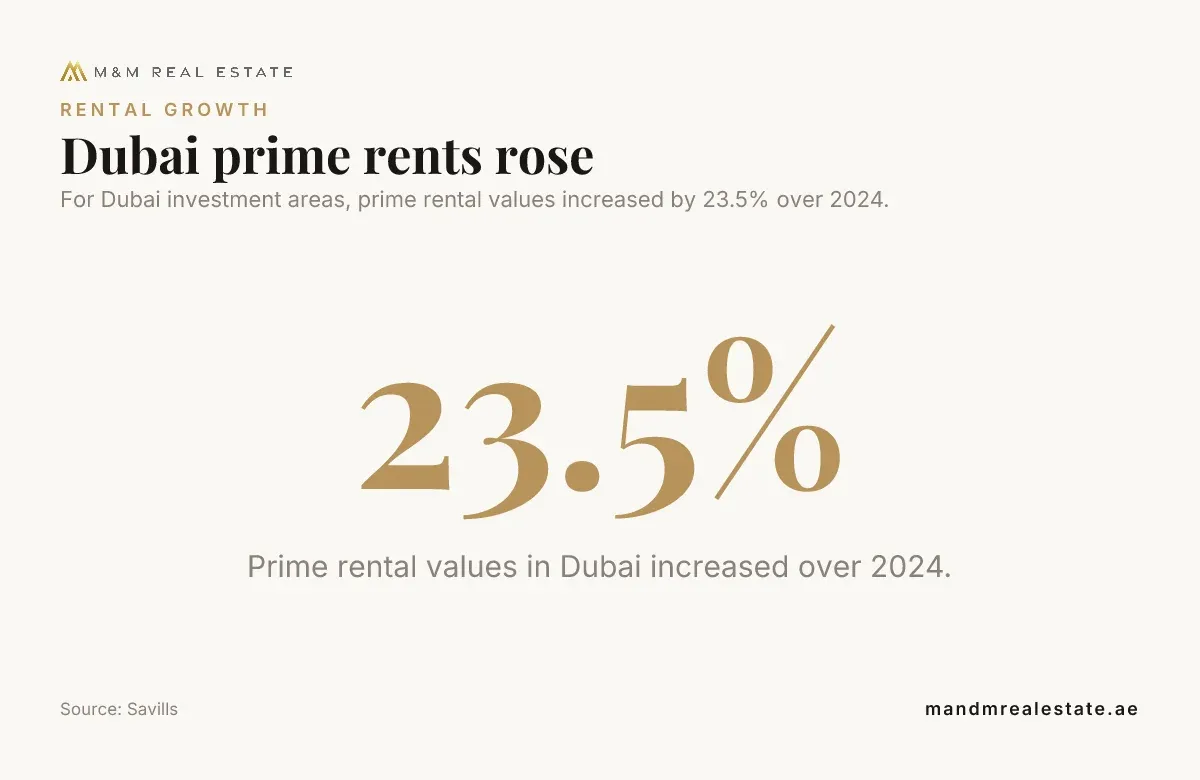
Savills reports that prime rental values in Dubai increased by 23.5% over 2024, as shown in its Dubai prime rental research.
Source: Savills
Move from the area shortlist to building and unit checks
An area shortlist is a filter, not a verdict. Once an area passes the initial test, examine the specific building, project and unit before deciding whether the numbers and resident profile still fit.
At building level, assess management, maintenance, access, shared facilities, service charges and the condition of comparable units. At unit level, review the layout, natural light, outlook, noise, storage, privacy and the condition that a tenant or future buyer will encounter.
For a ready property, inspect the actual unit and compare it with recent transactions in the same building where possible. For an off-plan property, examine the project documentation, delivery plan, unit specification and developer track record; our Dubai location guides can help organise the area stage of the comparison.
Then assess exit options for that property type. A studio, family apartment and villa may attract different future buyers, even within the same area, so area-wide transaction activity should not stand in for likely resale liquidity at unit level.
Know when to pause or reject an option
Pause when the investment case depends on advertised rent, one unusual transaction or an area label that hides substantial differences between buildings. Rebuild the comparison with closer matches and mark any assumptions that still lack strong support.
Reject an option when the intended resident cannot use the location in practice, the building’s condition or costs undermine the plan, competing stock weakens the tenant or resale case, or the investment only works under optimistic assumptions. A clear reason to walk away is useful evidence too.
Keep the shortlist small enough to investigate properly.
See also: What Investors Need to Know About Tax on Dubai Property, Off Plan Properties in Dubai.
A strong Dubai area comparison starts with a defined objective, comparable completed evidence and a clear view of the intended resident. Then test ownership costs, competing supply, building-level evidence and the exact unit before you commit.
Dubai investment areas deserve a property-by-property assessment, not a universal ranking. We help investors build a practical shortlist around real objectives, transparent assumptions and evidence they can review again as conditions change.
Can I compare properties in different areas if they have the same asking price?
You can use price as an initial filter, but it does not make the properties comparable. Compare their size, condition, building costs, resident appeal and likely exit audience before deciding whether the similar asking prices represent similar value.
Should I compare short-term and long-term rental plans in one yield estimate?
Keep the operating models separate. Short-term and long-term letting can involve different occupancy patterns, management needs and operating costs, so combining their assumptions can produce a misleading comparison.
What should I do if two reliable sources give different rental figures?
Check whether they cover the same property type, location boundary, time period and rent measure. Record the difference rather than blending the figures automatically, then favour the evidence that most closely matches the unit and tenancy plan under review.
How can I tell whether a property suits a future buyer as well as a tenant?
Write a separate profile for each audience and identify the features each would value, such as layout, access, building condition and ongoing costs. If the unit only appeals to a narrow audience, reflect that in your resale plan and assess tenant demand separately.
Should I include residency goals in my property comparison?
Yes, if residency forms part of your personal plan, but assess it separately from rental performance and resale prospects. Keep the eligibility question and the investment case distinct so one does not create a false sense of strength in the other.


