

The question of a Dubai property bubble deserves a measured answer: rapid price growth can signal overheating, but it cannot by itself prove that a crash is imminent. We assess the market through real transactions, supply, rents, occupancy and financing risk, not noise.
- A price rise alone does not establish a bubble. Compare sale prices with rents, buyer incomes, transaction activity and the supply pipeline.
- Announced projects are not the same as homes under construction, completed homes or available homes. Measure each stage separately.
- Population growth and international buyer demand can support housing demand, but neither guarantees continued price appreciation.
- Risk varies by property type, location, price segment and buyer finances. Our area-by-area investment guide helps frame location comparisons.
- Rental income and resale liquidity matter as much as the asking price. See our guide to Dubai rentals and yields.
- Test whether the investment still works if prices, rents or occupancy weaken. Our Dubai real estate investment guide provides a wider framework for that decision.
What a property bubble looks like in practice
A property bubble is not simply a period when homes become more expensive. Concern rises when prices detach from the income properties can earn, buyers rely increasingly on resale to make a profit, and new supply outpaces the market’s ability to absorb it.
No single index can settle the question. A search for the UBS bubble index Dubai should be a starting point for analysis, not a verdict: combine any valuation measure with rents, transaction volumes, lending conditions and actual delivery and occupancy.
Past growth shows why the question deserves attention, but it does not predict the next move. M&M’s August 2025 report recorded a 2.4 percent month-on-month increase to AED 1,664 per square foot; that reporting period does not establish today’s market direction. Read the December 2023 report and M&M’s market reports.
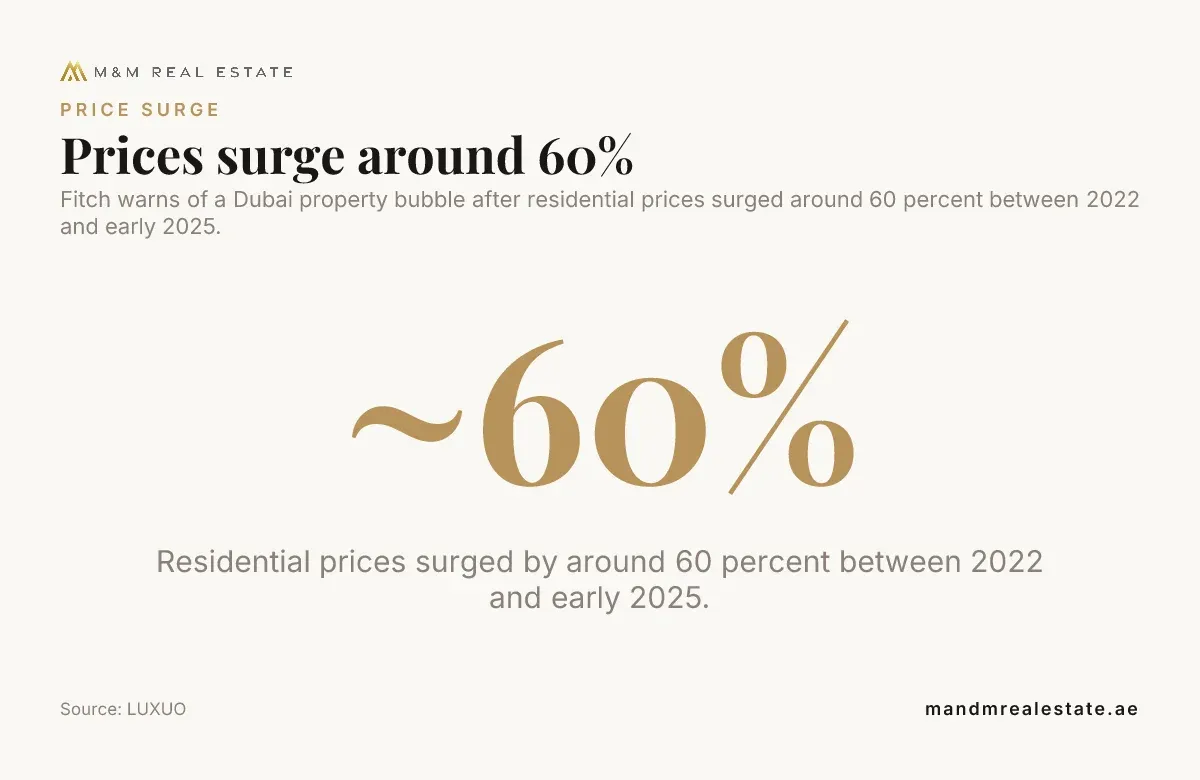
LUXUO reported that Fitch raised concerns after Dubai residential prices rose around 60 percent between 2022 and early 2025, as described in LUXUO’s report.
That increase is a warning to investigate, not proof that values must fall.
How to assess Dubai oversupply and the housing pipeline
Dubai oversupply is best judged by separating the housing pipeline into stages. An announced project may take years to reach the market; a construction start is not a completed home, and a completed home does not necessarily become an immediate rental or resale competitor.
- Announced: Check whether the project has moved beyond a public plan into a credible development process.
- Under construction: Track visible progress and delivery milestones, rather than counting every announcement as future stock.
- Completed: Consider whether the homes suit the budget, location and needs of likely buyers or tenants.
- Available and occupied: Compare homes offered for sale or rent with take-up, leasing activity and actual occupancy.
For off-plan property, we assess the developer, construction progress, payment schedule, location and the likely alternatives a buyer will have at handover. Our developer reviews can support that comparison.
Before committing to an off-plan purchase, compare the contractual milestones and delivery plan with the property’s intended use. Our Dubai off-plan properties page and off-plan guide can help buyers organise that review.
We do not treat Dubai as one uniform market. Compare each area’s existing housing, new supply, access to employment and services, and the depth of its buyer and tenant pool; the Dubai locations directory is a useful starting point.
How demand, international buyers and economic risks affect prices
Population growth can support housing demand when new residents form households, rent homes or buy property. It does not guarantee price growth: affordability, household size, employment and the match between new homes and residents’ needs all influence market absorption.
International buyers add another source of demand, but they do not all buy for the same reason or hold property for the same period. Some seek a home, some rental income and others a store of value, so a change in travel, employment, global confidence or access to finance can affect buyer groups differently.
Is Dubai property falling because of war? A war headline alone cannot establish that prices are falling or explain a market move. To test the claim, compare completed transactions, buyer activity, rents and leasing demand over time, while separating genuine sales from asking prices.
Geopolitical disruption can affect confidence, travel, business activity and financing decisions. Other risks include weaker employment, a tighter lending environment, higher borrowing costs and a mismatch between the type of homes delivered and what buyers or tenants can afford.
Residency plans can form part of a buyer’s decision, but they should sit beside, not replace, an investment case. Our Dubai property and Golden Visa guide explains the residency-related side of property ownership.
For broader investor perspectives on Dubai and its place in international property decisions, explore M&M’s market resources.
What separates a slowdown, a correction and a crash
A slowdown means activity or price growth loses pace. A correction means prices fall in some parts of the market, while a systemic crash involves wider financial stress, distressed selling and pressure across multiple segments.
Watch how several indicators move together. A quieter month of sales may reflect seasonality or fewer available properties; a more serious warning would be sustained weakness in completed transactions alongside falling rents, rising vacancy, delayed deliveries or more sellers accepting lower offers.
Transaction volume and asking prices tell different stories. Asking prices show what sellers hope to receive, while completed sales reveal what buyers actually paid; resale times and the size of negotiated discounts add context about liquidity.
Comparisons with an earlier downturn can help investors test their assumptions, but the past does not dictate the same trigger or outcome. Compare debt exposure, the amount and type of incoming supply, buyer demand and the capacity of owners to hold through a weaker period.
Twelve chapters on what the regional war tested, the balance sheet and dollar peg behind the market, and how to pick the right side of this cycle.
Download free→Why risk differs between apartments, villas and price segments
A market-wide average can hide local weakness. The supply pipeline, buyer profile and rental base can differ between apartment districts, villa communities, established centres and newer development zones.
Apartments may face direct competition when many similar units reach the market in the same area. Villas can respond differently because layout, plot, community facilities and the availability of comparable homes shape buyer and tenant choices.
Price segment matters too. A luxury sale can attract attention without describing conditions for mid-market buyers, and a strong entry-level segment does not prove that every premium property has the same demand. Compare like with like: similar property type, condition, location and intended use.
We assess whether a property can attract a tenant or buyer beyond the current cycle. An investor comparing districts can use our Dubai area investment guide alongside direct checks of competing supply and local demand.
Rental yield, resale liquidity and mortgage exposure
Rental yield measures annual rent against the property’s purchase price, but gross yield is not the same as money left after costs. Include service charges, maintenance, management, vacancy and transaction expenses when testing net income.
Worked example, using illustrative assumptions: A property bought for AED 1,000,000 earns assumed annual rent of AED 60,000, so AED 60,000 ÷ AED 1,000,000 = a 6 percent gross yield. If rent falls by 10 percent, annual rent becomes AED 60,000 - AED 6,000 = AED 54,000, and AED 54,000 ÷ AED 1,000,000 = a 5.4 percent gross yield before costs.
Resale liquidity is the ability to sell within a reasonable period without accepting a steep discount. If an investment depends on a quick resale, a slower market can create pressure even when the property remains occupied and earns rent.
Mortgage exposure increases the importance of testing both income and timing. If property values fall while a mortgage remains outstanding, the owner’s equity can shrink; if rent also weakens, the gap between housing income and financing costs can widen.
Before buying, model a lower rent, a longer vacancy and a delayed sale, then decide whether your cash reserves and financing can carry the property through that scenario. Our guide to Dubai property tax can help you consider how tax treatment fits into a wider ownership-cost assessment.
Is it worth buying property in Dubai now?
It can be worth buying when the property suits your purpose, the purchase price makes sense against comparable homes, and the investment remains workable under less favourable rent and resale conditions. It is not a sound decision simply because prices have risen or because a forecast predicts further growth.
We advise buyers to set a holding period, assess the real tenant or resale market, and understand the complete ownership costs before making an offer. A strong case rests on the property’s fundamentals, not on an assumption that another buyer will pay more.
Dubai’s housing market cannot be labelled a bubble or declared safe on the basis of one price trend, one forecast or one headline transaction. We look for agreement between valuation, supply, rents, occupancy, transaction activity and financing conditions.
For buyers and investors, the practical test is resilience: can the property still serve its purpose if rent softens, resale takes longer or competing supply arrives? That is a more useful basis for a decision than trying to time a market turn.
Does a Golden Visa protect a property investment if prices fall?
No. Residency eligibility and property performance are separate questions, and residency status does not prevent market values or rental income from changing. Assess the investment on its own income, costs, location and resale prospects.
Should I choose an off-plan or completed property if I am concerned about a correction?
A completed property lets you inspect the existing home and assess its current rental or resale market, while an off-plan purchase depends more on delivery, future competition and the contract terms. Compare the timing and risks of each against your cash flow and intended holding period.
Can service charges make a property with a strong gross yield unattractive?
Yes. High ongoing charges reduce the rent retained by the owner, so compare net income after building and management costs rather than relying on the advertised gross yield.
What should an overseas buyer consider if their income is in another currency?
Consider how exchange-rate movements could affect the funds you use for the purchase, mortgage payments and future sale proceeds. Keep a separate buffer for currency conversion costs and avoid relying on a single exchange-rate assumption.
How should a seller respond when buyers take longer to make decisions?
Review recent completed sales for comparable homes and price against the competition that a buyer can actually choose from. A realistic asking price and clear information about the property’s condition and costs can support negotiations when buyers have more time to compare.


