

Our guide analyses Dubai’s rental market in 2026 through contract activity, local housing choices and practical decisions for tenants and landlords. The useful signals are not just headline rents: they include the type of tenancy, comparable homes, new supply and the terms of each contract.
Key takeaways
| What to assess | What it means for your decision |
|---|---|
| Contract activity | More registered contracts show activity, but do not prove that rents rose at the same pace. |
| Asking and transacted rents | Compare advertised prices with rents agreed in completed contracts. They measure different things. |
| Location and property type | Compare like with like: an apartment and a villa, or two different neighbourhoods, are not direct substitutes. |
| Renewal decisions | Use the RERA Rental Index and current official guidance alongside the contract and notice terms. |
| Local comparisons | Use our Dubai location guides to compare communities rather than relying on a citywide average. |
| Owner strategy | Assess rent alongside costs, vacancy and the property’s wider investment role. Our guide to Dubai investment areas offers a broader location comparison. |
How to read rental activity and rent movements
Registered rental contracts indicate how much leasing activity has taken place. They do not, by themselves, show what tenants paid for comparable homes or whether asking rents are rising.
The Dubai Land Department reported that total rental-contract value during Q1 2026 reached AED32.2 billion.
New tenancy contracts and renewals also describe different kinds of activity. A new contract can reflect a move, a newly occupied home or a change in household needs, while a renewal records a continuing tenancy; neither measure gives the rent agreed without transaction-level price information.
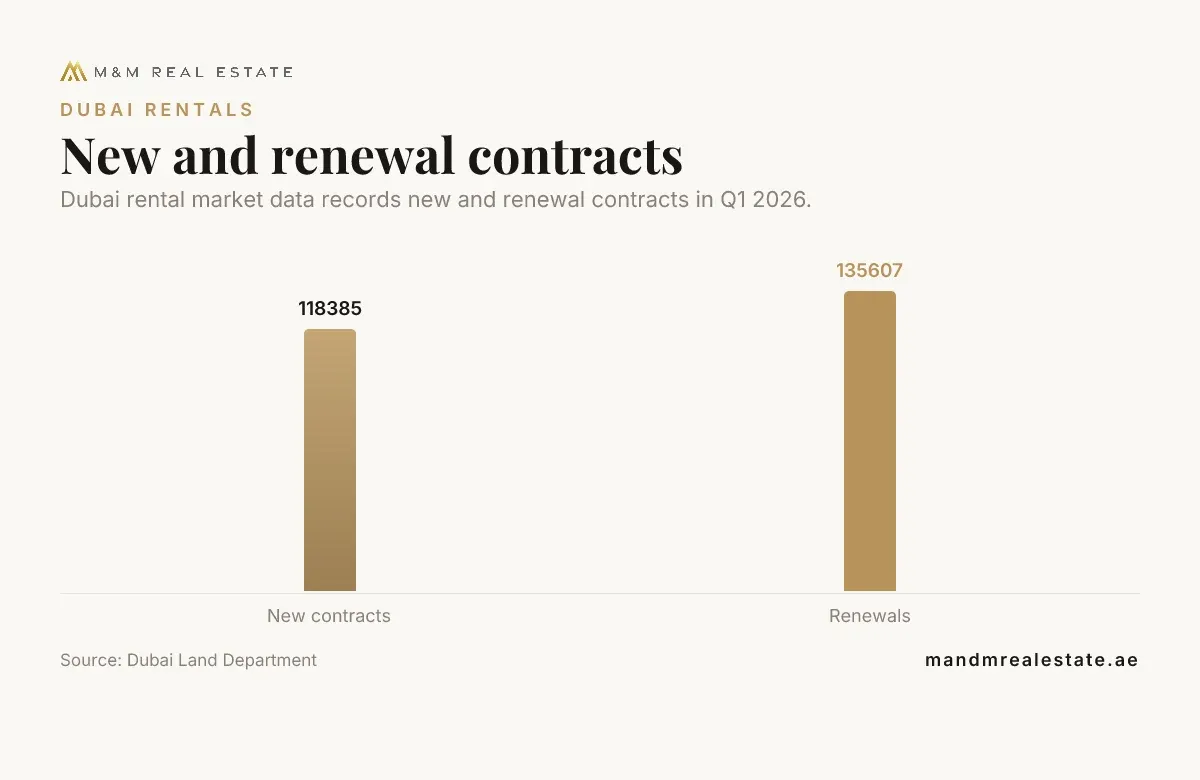
Dubai rental market data records new and renewal contracts in Q1 2026.
Source: Dubai Land Department
To assess rent direction, separate asking rent from transacted rent. Advertisements show what landlords hope to achieve; completed rental transactions show what tenants and landlords agreed, making them a stronger comparison when the property, building and contract type are similar.
Our rental options and yield analysis considers why a landlord should look beyond an advertised figure and assess the property’s actual letting context.
Why rental demand and supply differ by neighbourhood
Rental demand is local. A tenant choosing a home near work may value a shorter commute, while a household may put more weight on space, schools, parks or access to daily services.
That creates different comparisons across areas. Jumeirah Village Circle and Arjan have a substantial apartment focus, while a community such as Dubai Hills Estate offers a different mix of apartments, villas and family amenities.
Dubai Marina and Downtown Dubai attract a different set of location priorities, including central or waterfront living. These characteristics help explain why a citywide average cannot tell a landlord what a particular home should rent for or tell a tenant whether two listings offer equivalent value.
For a more useful comparison, our area analysis looks at location as part of a wider property decision. Compare homes within the same area first, then widen the search if the available options do not meet your budget or needs.
Apartment rent, villa rent and the features that matter
Apartment rent and villa rent should be compared within their own property type and area. A useful comparison matches bedroom count, usable space, condition, furnishing, building or community facilities and the terms included in the rent.
Features inside the home can shift its appeal even when two properties sit in the same neighbourhood. Layout, natural light, storage, balcony or garden space, maintenance condition, parking and the quality of shared facilities all affect how a tenant weighs one home against another.
Location within a community matters too. A home’s access to transport, shops, schools and parks can influence its convenience, while road noise, construction nearby or a longer walk to shared facilities may count against it.
Tenants should also compare the full cost of renting, not just the headline rent. Depending on the contract and property, the budget may need to account for a security deposit, agency fee, Ejari registration, utilities, cooling, moving expenses and parking.
Landlords can use the same checklist when positioning a home. Accurate photographs and a clear description help set realistic expectations, while a clean, well-maintained property gives tenants a stronger reason to choose it over a similar listing.
Foreign capital is hesitating. The 3.9 million people inside the UAE have not. The asymmetry that defines 2026, and what it tells you to do about it.
Download free→How new housing supply can change local conditions
New homes can give tenants more choice, but the effect is not automatically the same across Dubai. Supply matters most when a new property competes for the same tenants as existing homes in the same area and price bracket.
For a landlord, a nearby handover can mean more listings competing for attention. Compare the features and condition of those homes with your own, and watch how long comparable properties remain available before deciding whether your asking rent needs to change.
For tenants, new supply can widen the choice of layouts, facilities and move-in dates. It can also make older homes more attractive when they offer a better location, more space or a stronger overall fit for the household.
Owners considering new-build property should distinguish an expected future rental market from the rent their home can achieve when it is ready. Our off-plan guide and developer reviews support a broader assessment of the project and the team behind it.
Setting asking rents and managing vacancy
A landlord should lower an asking rent or wait for another tenant based on evidence from comparable listings and completed contracts, the home’s viewing response and the cost of a vacancy period. If similar homes are letting at lower prices and enquiries remain weak, a realistic adjustment may protect occupancy better than holding out for an unsupported figure.
If the property attracts enquiries but few viewings, the listing may need clearer information or better presentation. If viewings take place but offers do not follow, revisit the rent, condition and features together.
Check the RERA Rental Index when assessing a proposed increase at renewal. It is a reference point for rent changes, not a reason to skip the agreement: landlords and tenants should verify the applicable rules, notice requirements and contract terms against current official guidance before acting.
Asking rent and transacted rent serve different purposes here. Use advertised prices to understand the competition a tenant can see now, and completed agreements to test whether those asking prices reflect deals being made.
Renew, negotiate or move: a practical comparison
For tenants, compare the renewal proposal with the likely cost of moving, not just another home’s advertised rent. A move can involve deposits, agency fees, transport, time away from work and the effort of setting up utilities and services.
Start a rent negotiation with comparable homes that match the property’s size, condition and location. A clear case is stronger when it explains the comparison, the tenant’s preferred terms and the date by which both sides need to agree.
Landlords should consider the reliability of an existing tenant alongside the rent on offer from a new one. A renewal can avoid marketing and preparation time, while a new tenancy may suit a property that needs repairs or a change in presentation before re-letting.
Keep the decision grounded in the contract. Neither party should assume an existing rent agreement can change without checking its terms and the rules that apply.
Where a tenant plans to stay in Dubai for the long term, housing decisions may sit alongside wider residency planning. Our Dubai Golden Visa guide addresses that separate part of the decision.
Rental yield and the landlord’s wider costs
Rental yield helps an owner compare rent with the property’s purchase price, but gross yield is not the same as the return left after costs. Vacancy, maintenance, service charges, management and financing can all affect the result.
When reviewing an investment, assess the expected rent using comparable completed leases, then account for the costs of keeping the property available and in good condition. Our guide to property tax considerations and Dubai property investment guide add wider context to that review.
For wider market reading, our property resources bring together further analysis for buyers and owners.
See also: Off Plan Properties in Dubai.
Dubai’s rental market in 2026 rewards careful comparisons, not broad assumptions. Contract activity, asking rents and completed rents each tell a different part of the story, and the useful answer depends on the property type, neighbourhood, supply nearby and tenancy terms.
Tenants should weigh renewal, negotiation and relocation against the full cost of moving. Landlords should price against relevant completed agreements, review the competition and check current RERA and DLD guidance before changing a rent agreement.
Does gross rental yield account for service charges and vacancy?
No. Gross yield compares rental income with the property’s purchase price before costs such as service charges, maintenance, management and periods without a tenant. A landlord should assess those costs separately to understand the net return.
Can a furnished flat command more rent than an unfurnished one?
Furnishing can make a home more convenient for some tenants, but it does not guarantee a higher rent. Compare furnished homes with similar furnished homes, and consider the quality and condition of the furniture as well as the tenant profile.
Why do similar flats in the same building have different rents?
Floor, view, layout, natural light, condition, furnishing and parking can all affect a tenant’s preference. Compare the homes on those details before treating one advertised rent as a direct benchmark for another.
Should I pay rent in fewer cheques if the landlord offers a lower total?
Compare the saving with the effect on your available cash and other upcoming costs. Make sure the agreed payment schedule and total rent appear clearly in the signed contract.
Is it sensible to rent in an area before buying there?
Renting can help you test the commute, daily amenities, noise levels and community feel before making a purchase decision. It also gives you direct experience of the property type and neighbourhood rather than relying only on an investment forecast.
What is the current rental demand in Dubai?
Rental demand in Dubai remains active, but it varies by neighbourhood, property type and the needs of tenants. Demand is shaped by factors such as access to work and daily services, space, amenities and the availability of comparable homes nearby.


