


Dubai vs New York property investment comes down to more than headline rent: the right choice depends on entry cost, net income, tax position, currency exposure and the exit you can execute.
Key Takeaways
| What to compare | Investor takeaway |
|---|---|
| Purchase price | Use comparable homes and neighbourhoods, then add transaction and financing costs before judging affordability. |
| Rental return | Compare net rental return after vacancy, management, maintenance, financing and applicable taxes, not just headline yield. |
| Ownership costs | Dubai and New York have different tax and fee structures. Model the full holding period rather than relying on one favourable tax headline. |
| Property rights | Check the title type, ownership rules and letting restrictions for the specific building and neighbourhood. |
| Growth and risk | Assess supply, demand and the market cycle at property level. Citywide averages cannot tell you whether one building will perform. |
| Investor fit | Choose the market that matches your budget, income needs, currency position, time horizon and exit plan. |
Dubai vs NYC Real Estate: Purchase Prices and Entry Costs
Start with like-for-like homes. Compare the same property type, usable area, condition, building quality and neighbourhood, then separate the purchase price from the full cash required to buy and hold the asset.
A 2022 paper in Behavioral Sciences reports the housing price per square metre as USD 5,918 in Dubai and USD 17,191 in New York (Jung et al.). It is a broad comparison, not a current valuation for a particular neighbourhood, building or apartment.
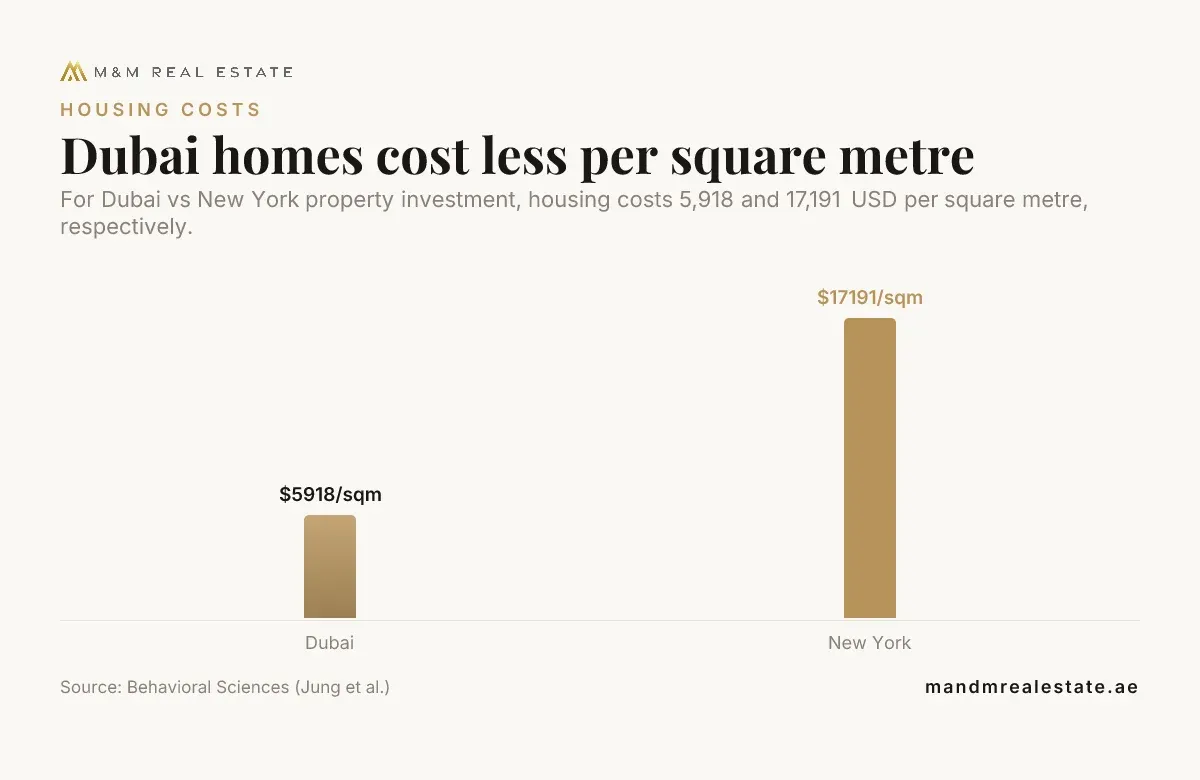
A 2022 paper in Behavioral Sciences reports housing price per square metre at USD 5,918 in Dubai and USD 17,191 in New York (Jung et al.).
Purchase price is only one part of the entry cost. Include legal and transaction fees, inspections, building charges, initial repairs, mortgage costs and any period when the property sits empty before tenants move in.
Worked example: The Dubai Golden Visa through property guide gives a property-value threshold of AED 2,000,000. Step one: set the illustrative purchase price at AED 2,000,000; step two: subtract the AED 2,000,000 threshold; step three: AED 2,000,000 - AED 2,000,000 = the threshold, with no amount above it.
This is a threshold comparison, not a return forecast or a guarantee of visa eligibility. For a property under construction, assess the payment schedule and delivery exposure as well as the headline price; our off-plan buying guide sets out the questions to ask before committing.
Rental Yield and Net Income in Each City
Neither city is automatically better for rental income. New York vs Dubai rental yield only becomes a useful comparison when you test the rent, vacancy, costs and financing for a specific property against the same holding period.
Start with realistic rent from comparable homes in the same area and building type. Then subtract expected vacancy, property management, repairs, insurance, building or service charges, financing costs and applicable taxes to estimate the net rental return.
Long-term rentals and short-term stays call for different assumptions. A long-term tenancy depends on resident demand and lease terms, while a short-term rental requires you to assess visitor demand, operating intensity, building rules and local permissions.
In Manhattan, compare the likely tenant pool and rent evidence for the exact building and unit type. In Dubai, test whether the area’s resident, business or visitor demand fits the rental strategy you intend to operate; our Dubai rental and yield guide covers tenant strategy and rental considerations.
Do not treat an advertised gross yield as income in your pocket. Ask how the estimate accounts for vacancy, management, maintenance, financing and tax, then compare the remaining cash flow with the total capital you have tied up.
Taxes and Recurring Ownership Costs
A favourable tax headline does not mean a cost-free investment. In New York, include recurring property tax, insurance, maintenance and building charges, alongside the tax treatment of rental income and any later sale.
For Dubai, include service charges, management, maintenance, insurance, transaction fees and financing. Tax treatment can depend on the property, the investor’s residency and the rules that apply in their home jurisdiction, so compare the full tax position rather than one local headline.
Capital gains tax and rental-income treatment can change the net result of a cross-border purchase. We advise investors to model local property costs alongside their personal tax position, and to take qualified tax advice before settling on an ownership structure; our Dubai property tax guide explains the local considerations.
For a fair comparison, set out the cash flows in order: money paid to acquire the property, expenses during ownership, rental income received, loan repayments and costs on sale. This makes it harder to mistake a low transaction cost or tax rate for a strong net rental return.
Foreign capital is hesitating. The 3.9 million people inside the UAE have not. The asymmetry that defines 2026, and what it tells you to do about it.
Download free→Foreign Ownership, Neighbourhoods and Property Types
Foreign ownership rules are not interchangeable between cities or even between buildings. In Dubai, check whether the property is in a permitted freehold area and confirm the title and any building restrictions; in New York, distinguish a condominium from a co-operative, since the ownership structure and approval process can differ.
Match the property to the tenant and exit plan. A central apartment near employment, transport and services may suit a long-term rental strategy, while a home aimed at visitors needs a viable short-term letting route and must comply with local and building rules.
In Dubai, compare established areas such as Downtown Dubai and Dubai Marina with neighbourhoods at earlier stages of development. In New York, compare the specific block, building and unit because Manhattan, Brooklyn, Queens and the wider city can differ.
Evidence should be local and recent enough to reflect the asset you are assessing: comparable rents, completed sales, asking prices, building charges, tenant demand and competing supply. Our Dubai locations help investors consider location alongside property type and investment purpose.
Before buying overseas, review the title, building documents, service-charge history, letting rules, financing terms and any approval requirements. If the property is off-plan, examine the developer’s delivery record and the contract’s payment and completion terms; our Dubai off-plan opportunities page explains how we assess projects.
Supply, Market Cycles and Capital Appreciation
Capital appreciation depends on the specific property and the supply and demand around it. A city can attract tenants and still have neighbourhoods where new competing homes put pressure on rent or resale prices.
In Dubai, assess how much planned or under-construction supply could compete with a building, and whether transport, employers and resident services support demand. In New York, focus on local development, building condition and neighbourhood demand because broad city trends do not establish how every property will perform.
Off-plan and ready property carry different exposures. With off-plan, delivery, construction progress and future competing supply matter; with a completed home, you can inspect the asset and assess its current rental position, but you still face changes in demand and market cycles.
We look at the developer, micro-location, comparable evidence and exit liquidity together, not as separate selling points. Our developer profiles support that assessment, while our Dubai investment guide sets out the risks investors should weigh.
Financing, Currency Risk and the Exit Plan
Financing changes the return on the cash you invest. Compare deposit requirements, interest costs, lender fees, repayment terms and how vacancies affect your ability to meet payments, as borrowing conditions differ between the two markets.
Currency risk matters when rent, debt and your personal finances use different currencies. Dubai property is commonly priced in AED, which is pegged to the US dollar, while New York property and rent are denominated in US dollars; if your income or reporting currency differs, exchange-rate movements can change your realised return.
Plan the sale before you buy. Compare likely buyer demand for the property type, the sale process, outstanding debt, agent and legal costs, taxes and the time needed to transfer proceeds through the banking system.
For an overseas investor, repatriating proceeds also involves bank checks and documentation. Keep clear records of purchase funds, rental income, financing and sale proceeds so the source of funds is easy to evidence at exit.
Our Dubai market resources add context, but the decision still turns on your own return target, risk tolerance and timeline.
See also: Best Areas Invest Dubai 2026.
There is no universal winner in a Dubai and New York property comparison. Dubai may suit an investor seeking a different entry point and exposure to a growing international city, while New York may fit a strategy built around its own neighbourhoods, tenants and ownership structures.
We recommend deciding on net rental return, total ownership cost, currency exposure, supply risk and a credible exit plan before choosing a city. Real comparable evidence beats lifestyle appeal alone, and a clear strategy keeps the decision focused on what matters to you.
Can I buy Dubai property if I live overseas?
Overseas buyers can purchase in Dubai areas where foreign ownership is permitted, subject to the property’s title and applicable rules. Owning property and holding a UAE residence visa are separate matters.
Is a New York co-op as straightforward as a condominium for a foreign buyer?
No. A condominium owner holds title to an individual unit, while a co-op buyer usually purchases shares in a company that owns the building and receives a right to occupy a unit. Co-op boards can apply their own financial review and approval requirements.
Should I buy an investment property personally or through a company?
Compare the tax, financing, reporting, succession and future transfer consequences before choosing a structure. A company can add administration and affect lender terms, so the right choice depends on your wider circumstances.
Does an off-plan payment plan replace a mortgage?
No. A developer’s payment schedule sets out when purchase instalments fall due, while a mortgage is a separate loan with its own underwriting, interest and repayment terms. Keep enough liquid capital to meet the contract schedule even if your financing plans change.
What documents should an overseas buyer prepare before making an offer?
Organise identification, proof of funds, financing information, tax-residency details and any documents required for the chosen ownership structure. For the property itself, review title and building records, service charges, letting rules and the sale contract before committing.
Is it worth investing in Dubai property now?
It can be worthwhile if a specific property’s expected net income, ownership costs, risks and exit prospects fit your investment goals. Assess current local supply, demand, comparable rents and completed sales before deciding, since conditions vary by property and neighbourhood.

