

When we assess the top investors in UAE real estate, we first ask what “top” means: investment value, transaction activity, portfolio size or the number of properties owned. Those measures describe different kinds of prominence, and a useful comparison keeps them separate.
- Start with a clear measure. M&M’s Dubai real estate investment guide and investor resources provide a starting point for assessing a purchase strategy.
- Separate Dubai from the wider UAE. A Dubai transaction ranking does not automatically describe investor activity in Abu Dhabi or another emirate.
- Check ownership eligibility by area. For neighbourhood comparisons and ownership options, turn to M&M’s locations.
- Assess the developer, not just the launch. Project and delivery records are the focus of M&M’s Dubai developer reviews.
- Compare investment formats. Review available Dubai off-plan property opportunities alongside ready homes that can produce rent sooner.
- Consider the wider decision. M&M’s guides to areas to invest in Dubai and property and Golden Visa eligibility address location and residency considerations.
What makes someone a leading real estate investor?
There is no single definition of a leading investor. A ranking by transaction count favours frequent buyers, while a ranking by spending favours those making larger purchases; neither one reveals the size or composition of an investor’s complete property portfolio.
It also matters who is being counted. Individual buyers, families, institutional investors, investment companies and funds may all acquire property, but they are different categories. Managing investments or facilitating purchases does not establish that a company owns the underlying property.
Property developers belong in a separate category. Launching a project and selling homes demonstrates development and sales activity, but does not establish that the developer itself is among the largest property investors.
Angel investors are another commonly confused group. They typically invest in early-stage businesses, which is different from buying residential or commercial property as a real estate asset.
Named individual investors and private portfolios can be difficult to compare through public claims alone. For a meaningful ranking, look for a defined period, a stated geography and a clear measure, such as recorded transactions or disclosed holdings.
Who invests in Dubai and the wider UAE?
Investor activity should be read in its stated geography. Dubai is one emirate within the UAE, so a Dubai-focused account of transactions should not be presented as a complete picture of the country’s property investors.
Nationalities also need careful treatment. A report that groups buyers by nationality answers a different question from one that divides investors into residents and non-residents, and neither measure alone identifies who owns the most property.
M&M publishes investor guidance for people buying from the UK, India, Bahrain and China. These guides describe investor routes the advisory supports, not a ranked list of the most active nationalities.
In its report on Dubai’s 2025 real estate market, the Public Debt Management Office said resident investors accounted for 56.6% of the total; this is useful context, not a ranking of individual buyers or nationalities.
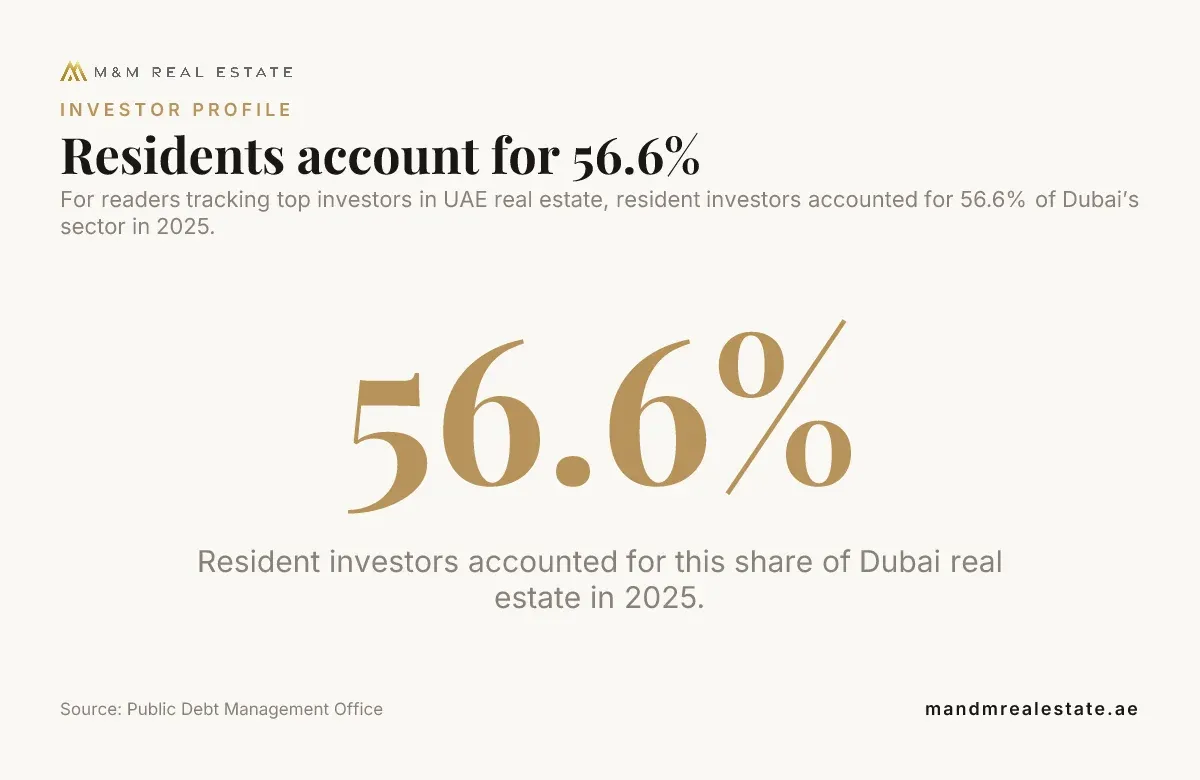
This graphic presents resident investors’ share of Dubai’s real estate market in 2025, as reported in the Public Debt Management Office’s 2025 release.
Foreign ownership and eligible areas
Foreign buyers can purchase property in designated freehold areas in Dubai, but that does not mean every buyer can purchase every property or that every location has the same ownership arrangements. Check the title and ownership structure for the specific property rather than relying on a city-wide assumption.
Keep ownership and residency separate in your decision. Buying property does not, by itself, mean a buyer has secured a residence visa; visa eligibility follows its own rules and application process.
International buyers should also consider how ownership fits their wider arrangements. Funding transfers, legal structure, succession planning and tax obligations in a buyer’s country of residence can affect the practical value of an investment.
Twelve chapters on what the regional war tested, the balance sheet and dollar peg behind the market, and how to pick the right side of this cycle.
Download free→How to compare Dubai property locations
Start with the likely occupier or buyer, then compare each location against that demand. A home suited to long-term tenants may not appeal to the same group as a short-stay apartment, while commercial property depends on the needs of businesses and their staff.
Look beyond a neighbourhood’s name. Assess access to workplaces and transport, nearby services, the type and quality of competing homes, building maintenance and the amount of comparable supply. A popular address is not a substitute for checking whether the particular property meets a real use.
Compare the same kind of asset across locations. A small apartment and a family villa serve different needs, with different purchase prices, rental prospects and resale audiences.
What to check when comparing property developers
A developer’s reputation is only one part of due diligence. Review completed projects, construction and handover performance, the quality of building management, how the development is positioned for its location and whether the project’s details suit your investment plan.
Do not confuse a high-profile launch with proof of investment quality. Project sales tell you that buyers have committed to units; they do not establish rental demand, future resale value or the developer’s own property holdings.
For a practical comparison, study the asset and the developer together. The examples shown below include a residential community by Nakheel and a commercial development by BEYOND, two different property types with different potential occupiers.
Off-plan or ready property: which suits an investor?
Off-plan property can suit buyers who can wait for completion and who understand the payment schedule, construction and resale conditions. The attraction of a new development should be weighed against the time before occupation, changes in market demand and the possibility that the completed property will compete with similar homes.
Ready property lets an investor assess the existing building and, where a tenant is in place, the current rental arrangement. It can produce rental income sooner, but the buyer still needs to examine condition, service costs, tenancy terms and the likely resale audience.
Neither format is automatically superior. Match the purchase to your time horizon, available capital, appetite for delivery risk and intended return, and compare the full cash flow rather than focusing on a headline payment schedule.
A worked example can clarify how a payment plan affects cash flow. The Bay Estate case page linked above, reviewed on 8 October 2026, lists an indicative AED 5.9 million townhouse price and a 60/40 payment structure.
- Using the price and plan published in M&M Real Estate’s Bay Estate case page, reviewed on 8 October 2026: AED 5,900,000 × 60% = AED 3,540,000 across the first portion of the plan.
- Using the same case page and review date: AED 5,900,000 × 40% = AED 2,360,000 at handover.
This is a cash-flow illustration, not a forecast of profit or rental income. Compare the payment dates with your available capital and the expected timing of any income.
Investment risks, rental income and due diligence
Property returns depend on more than the purchase price. Account for vacancy, maintenance, building service charges, leasing and management costs, financing and the time it may take to find a buyer when you want to sell.
Ask whether the investment still works if rent is lower than expected or the property remains empty for a period. Rental income and capital appreciation are different sources of return, and neither should be treated as certain.
For off-plan purchases, review the payment milestones, contract terms, project registration and delivery conditions. For ready property, examine the tenancy, physical condition, building management and resale demand. In both cases, look at the total costs and downside scenarios before committing.
Cross-border investors should include their home-country tax position in the decision. Ownership arrangements and tax rules differ, so a return that appears attractive before costs may look different after local obligations, operating expenses and currency movements.
The leading UAE real estate investors cannot be identified responsibly without a clear measure, a defined geography and a comparable time period. Separate investor types from developers, distinguish nationality from ownership and assess each property on its own costs, demand and risks.
We believe good investment decisions start with real evidence, not sales headlines.

Who owns most of the real estate in Dubai?
A reliable answer needs ownership records that identify beneficial owners and define what counts as a portfolio. Transaction activity or investor nationality alone cannot establish who owns the greatest share of Dubai property.
Are the most active buyers also the biggest investors?
No: transaction frequency and investment size measure different things.
Can I invest in UAE property without living in the country?
Non-resident buyers can consider property in eligible ownership areas. They should plan for remote property management, document handling and funds transfers as part of the purchase process.
Does buying property automatically give me a Golden Visa?
No. Property ownership and residency are separate processes, and an application must meet the applicable eligibility rules. Treat any residency objective as a separate part of due diligence, not as an automatic feature of a purchase.
Should I buy property personally or through a company?
The right ownership structure depends on financing, succession plans, tax residence and the costs of maintaining a company. Compare the legal and administrative consequences before choosing, especially when more than one country is involved.
How can I judge whether a property will be easy to resell?
Consider the likely buyer pool, the number of comparable properties, the unit’s layout and condition, and whether the location serves a clear residential or commercial need. A resale plan should also allow for changes in buyer demand and the time required to complete a sale.


