


This is our month in review for September 2026, focused on Dubai residential property rather than an all-purpose news digest. We separate confirmed market reporting from wider economic context and investor interpretation.
- Start with the scope. Confirm the month, year, location and type of report before using a figure to inform a property decision.
- Do not treat a historic report as a current one. M&M’s September market report is for September 2023, not September 2026.
- Read property indicators together. Transactions, prices, rents, yields and property types each describe a different part of the market.
- Separate results from expectations. A recorded transaction or price movement is not the same as an outlook or prediction.
- Use a review to sharpen questions, not replace due diligence. Our investment guides and resources offer further reading for evaluating a property decision.
First confirm what the September review covers
“Month in review” can mean a monthly magazine, an economic review, a market recap or a current-affairs digest. The title alone does not tell you which one you have, the publisher, location, reporting period and subject determine how to interpret a headline.
Here, the intended focus is Dubai residential property. M&M’s September market report is explicitly for September 2023, so it cannot be presented as a September 2026 result. Historical reporting can help show how a report is structured, but it is not evidence of later prices or activity.
The archive’s historical figures illustrate indicators used in Dubai property reviews, but they cannot establish September 2026 transactions, prices or rental yields.
Which indicators belong in a property monthly review?
A focused Dubai residential review should distinguish between the number of transactions, the prices recorded, the rent being achieved and the supply of homes available. Those indicators answer different questions: activity, sale values, income potential and choice for buyers or tenants.
Check what each measure represents before comparing it with another month. A price index may track a broad movement, while a per-square-foot average expresses a price relative to property size; neither tells the whole story on its own.
M&M’s September 2023 report recorded an average property price of AED 1,232 per sq ft; the date and figure refer to that report, not September 2026. For one worked illustration, a hypothetical 1,000 sq ft home at that reported rate gives AED 1,232 per sq ft × 1,000 sq ft = AED 1,232,000, before other purchase costs.
Rental yield needs its own definition. Gross yield compares annual rent with the property’s price, while an investor’s net position also reflects costs such as maintenance, management and periods without a tenant. A monthly review should state which version it reports rather than letting one stand in for the other.
Property reports also need a clear unit of analysis. An overall average can conceal differences between apartments and villas, property price bands, established homes and off-plan stock. We look for those distinctions before applying a citywide headline to an individual investment question.
Separate market movement from economic performance
A property market recap focuses on housing activity; a wider economic review may examine output, inflation, trade and employment.
Those broader indicators can help explain the setting in which a property market operates, but they do not substitute for property transactions, prices or rents.
For Dubai, wider economic context can sit alongside property reporting as context, not proof of a particular real estate outcome. Visitor figures, for example, are not transaction data, rental data or a measure of home prices.
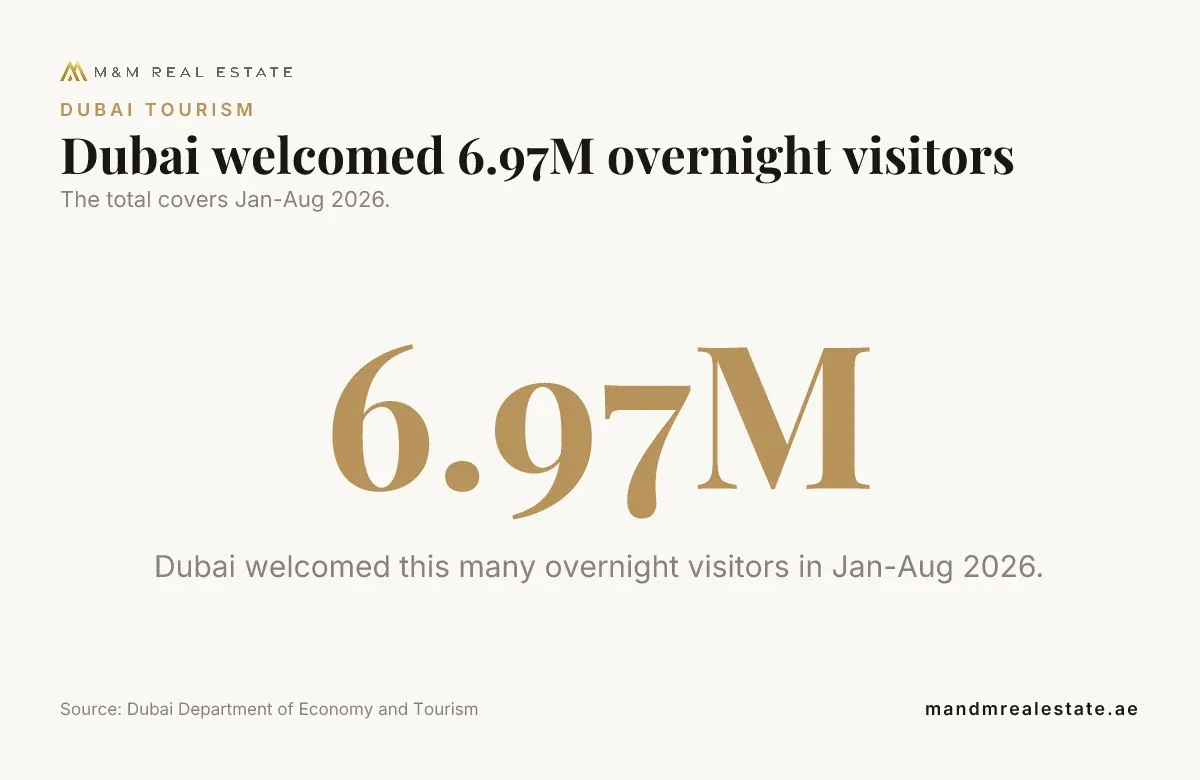
The total covers Jan-Aug 2026.
Source: Dubai Department of Economy and Tourism
Read the period and subject attached to each figure. A visitor total for a stated span of months is not a September-only measure, and it does not establish what happened to residential prices or rents during that period.
Twelve chapters on what the regional war tested, the balance sheet and dollar peg behind the market, and how to pick the right side of this cycle.
Download free→Connect headline figures to individual Dubai areas
Citywide figures are a starting point, not a neighbourhood-level conclusion. A useful review shows whether reported changes apply across the market or sit within particular areas, property types or price bands.
When comparing locations, consider the property’s intended use and the evidence relevant to it. A buyer assessing a home to occupy may focus on different features from an investor comparing rental demand, resale prospects or access to employment and services.
Do not infer an area’s performance from its name or reputation. Compare like with like: similar property types, comparable periods and clearly defined measures. Where an area-level figure is absent, the citywide result should remain a citywide result rather than being assigned to a neighbourhood.
Our Dubai area guide can help frame that comparison, while the report itself should provide the actual evidence for any monthly claim. An area page offers context; it is not a replacement for dated sales or rental data.
Distinguish recorded results from outlooks
Monthly reviews often place reported performance beside commentary about what might happen next. Keep those categories distinct: a completed sale is an event, an average is a summary measure, and a forecast is an expectation rather than a confirmed result.
Look for the period attached to every measure. Month-on-month comparisons can show short-term change, while year-on-year comparisons use a different baseline; neither automatically explains why a movement occurred.
We also separate market themes from conclusions about an individual purchase. Developer launches, buyer interest and changes in available stock may help explain the discussion, but they do not prove that a particular property suits a specific investor.
For off-plan decisions, compare the payment structure, delivery timeline, developer track record, location and intended exit strategy. Our Dubai developer reviews can support that due diligence, while our Dubai off-plan property selection provides a route to examine available project options.
Use the review to frame an investment decision
A monthly recap is most useful when it narrows the next question. It can point an investor towards an area, property type or income measure for further analysis, but the decision still depends on the individual’s budget, holding period, financing and appetite for risk.
For buyers comparing a completed home with a future delivery, keep the risk and cash-flow profiles separate. Off-plan purchases involve construction and delivery considerations; ready properties offer a different set of questions around condition, occupancy and current income.
Our off-plan buying guide sets out considerations for assessing a project, while our Golden Visa property information addresses a separate residency question. Neither should be treated as a substitute for checking whether the property itself fits the investment plan.
For a broader location comparison, use the linked guide to Dubai investment areas alongside the relevant market evidence. We take an advisory approach: real figures first, clear assumptions next, and no noise between the two.
Investors can also read our Dubai property investment guide for a broader decision framework. The review provides market intelligence; a personal strategy connects that information to the investor’s objectives.
See also: Locations.
A useful September 2026 review must keep its date, geography and property indicators explicit. Historic results and wider economic headlines provide context, not verified reporting for September 2026.
Can a September 2023 Dubai property report stand in for September 2026?
No; use it to understand the earlier period and the indicators reported, not to infer what happened in September 2026.
Which indicators should a Dubai property monthly review cover?
Include transaction activity, sale values, rental measures and supply; compare them only when their periods and definitions match.
What highlights did a September roundup cover in Bahrain’s finance sector?
This review concerns Dubai residential property, not Bahrain’s finance sector. For a Bahrain roundup, use a publication that identifies Bahrain and its finance sector as its scope.
Does a Dubai property review explain India’s economic performance?
No. An India-focused economic review should be read on its own terms, with indicators such as output, inflation, trade and employment interpreted for India. Those results do not describe Dubai’s property market.
Why can gross rental yield differ from an investor’s net income?
To compare yields, first check whether both use gross rent or account for ownership costs.
Should one month of market movement determine whether I buy?
Use the monthly recap as a prompt to test a specific property against area-level evidence and your own costs before deciding.


