

We compare rental yield with capital appreciation in Dubai by asking a straightforward question: do you need income during ownership, a potential gain when you sell, or a considered balance of both? The answer depends on cash flow, costs, risk tolerance and how long you plan to hold the property.
Key Takeaways
| What to compare | What it means for your decision |
|---|---|
| Rental yield | Measures rent against a property’s price; net yield accounts for ownership costs, vacancy and management. |
| Capital appreciation | Shows how the property’s value changes over time, with a gain realised only when you sell. |
| Total return | Combines net rental cash flow and sale proceeds, then accounts for purchase, operating, financing and resale costs. |
| Location and property type | Compare local tenant demand, competing supply, resale activity and the costs of the specific building or home. Browse our locations to explore different communities. |
| Personal finances | Stress-test vacancy, ongoing costs and loan payments against your own income needs. Our guide to property tax considerations covers another part of an investor’s cost assessment. |
| Further reading | For wider investor context, see our Dubai property resources. |
What rental yield and capital appreciation actually measure
Rental yield measures income in relation to property value. It gives an investor a way to compare potential rent with the purchase price, but a gross figure does not show how much cash the owner keeps.
Capital appreciation measures a change in value. That increase remains unrealised until a sale, and the amount an owner ultimately receives depends on selling costs, any outstanding loan and the price a buyer will pay at the time.
Neither measure tells the whole story on its own. We compare the property’s net income during ownership with its potential resale proceeds, while testing how costs, market conditions and the holding period affect the result.
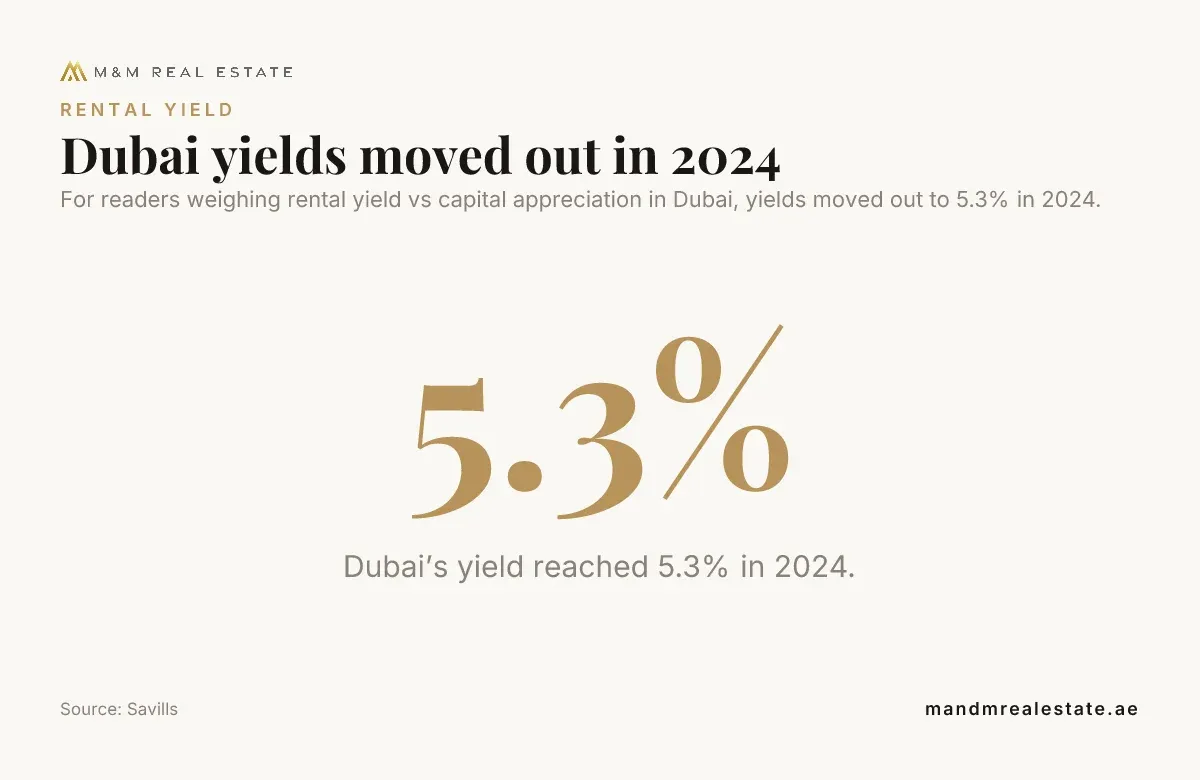
Savills reported that Dubai yields moved out to 5.3% (+60 bps) in 2024.
Source: Savills
This is a market-level measure, not a promise about an individual home. A building’s rent, service charges, vacancy and resale demand can produce a different result from a wider market figure.
How to calculate gross and net rental yield
Gross rental yield is the property’s annual rent divided by its purchase price, expressed as a percentage. Net rental yield uses rental income after relevant operating expenses, so it offers a more useful view of the income available before personal tax and financing considerations.
M&M’s Dubai property rentals and yields guide, published 7 August 2023, uses illustrative assumptions of a JVC one-bedroom purchase price of AED 1,100,000 and annual rent of AED 75,000.
For this example, divide annual rent by the purchase price to calculate gross yield, then account for operating costs to estimate net income.
- Calculate gross yield: AED 75,000 ÷ AED 1,100,000 × 100 = 6.82%.
- Estimate net income: AED 75,000 minus the owner’s actual annual service charges, maintenance, management, insurance, leasing costs and vacancy allowance.
- Calculate net yield: net rental income ÷ AED 1,100,000 × 100.
Include costs that apply to the specific property and ownership arrangement. A mortgage also changes cash flow, so assess loan payments separately from the property’s operating yield rather than treating gross rent as money in your pocket.
For rental details and tenant considerations, see our analysis of Dubai property rentals and yields.
How Dubai areas differ for income and growth
Yield or growth in Dubai is not a choice between two fixed sets of neighbourhoods. Compare the actual building, tenant profile, competing supply, service charges and resale activity, then decide which return matters more to your plan.
Dubai Marina is a completed waterfront district with an established resale market, while Dubai Islands and Dubai Harbour include development-led opportunities where delivery, future supply and buyer demand matter to the investment case. Our Dubai Hills guide offers another community to consider when assessing apartments and family homes.
For income-focused research, examine comparable rents and the expenses attached to the exact building. For a capital-growth thesis, investigate planned development, the pace of competing supply and the depth of demand at resale; an attractive area name alone does not establish value.
Use our area-by-area investment analysis to support that comparison, not replace it. The best fit depends on the property’s own numbers and the investor’s intended exit.
Foreign capital is hesitating. The 3.9 million people inside the UAE have not. The asymmetry that defines 2026, and what it tells you to do about it.
Download free→Ready property or off-plan property?
A ready property can generate rent once it is available to tenants, and its existing condition, rental history and building costs can help an investor assess cash flow. It still carries vacancy, maintenance and resale risks.
An off-plan property does not provide rental income before handover, so the buyer must fund the commitment during construction without relying on rent from that unit. Payment milestones, possible completion delays, the developer’s delivery record and the time needed to find tenants all affect the return profile.
Our Dubai investment guide sets out considerations for comparing these routes, while our developer directory can support a closer look at delivery history. The off-plan guide explains payment mechanics and buyer protections, and the off-plan property selection shows the type of opportunities to assess.
Do not treat a projected price increase by handover as cash already earned. A project’s eventual rent and resale value depend on delivery, comparable supply and demand when the property becomes available.
Compare total return, costs and downside risk
To compare two properties fairly, include rental income, operating expenses, purchase and resale costs, financing and the change in sale value. A simple unleveraged view is net rent collected plus resale proceeds, less the purchase price and transaction costs; a financed investment needs a separate cash-flow view that also accounts for debt service and the loan balance repaid at sale.
Build a downside case as well as a base case. In the downside case, test weaker achievable rent, longer vacancy, higher costs, softer resale value and, for off-plan, a later handover; in the base case, use rent evidence and comparable sales that support your assumptions.
Service charges, maintenance, insurance, property management and leasing costs reduce rental income. Add mortgage interest and fees when assessing financing, along with acquisition costs and the costs of preparing or improving the home.
Mortgage finance can increase the investor’s exposure to both gains and losses. Rent may not cover the required payments during vacancy or disruption, so model your obligations against other available funds.
Keep nominal and inflation-adjusted returns distinct. Nominal appreciation is the change in the property’s sale price, while a real return adjusts for inflation over the same holding period; comparing different time windows can also distort the apparent result.
For an overseas investor, calculate the outcome in both AED and the home currency. Exchange-rate movement and conversion costs can increase or reduce the value received at purchase, during income transfers and when sale proceeds return home.
Choose a strategy that fits your holding period
Rental income may suit an investor who values cash flow during ownership and can manage leasing, vacancy and ongoing costs. Capital appreciation may better fit someone who can leave money invested for longer and accept that the expected gain depends on the resale market.
Property type changes the assessment. Apartments, villas, townhouses and commercial units can differ in tenant demand, maintenance, leasing patterns and resale liquidity, so compare like with like rather than applying one area’s rent assumptions to another kind of property.
A balanced portfolio can combine an income-producing ready home with a development-led asset, if the investor has the resources to carry both and can tolerate different timing and risks. Diversification does not remove market risk, but it can prevent the whole plan from depending on rent or a single future sale.
If residency is also part of your decision, keep it separate from the return calculation; our Dubai Golden Visa guide covers that subject.
Rental income and capital appreciation serve different purposes. Compare net cash flow, realistic resale proceeds, financing and costs across the full holding period, then choose the balance that fits your finances and tolerance for uncertainty.
For Dubai investors, neither strategy wins in every case. We focus on real property-level analysis, clear assumptions and a plan for both the income years and the eventual exit.
Can a property with negative rental cash flow still make sense as an investment?
It can, if the investor has a clear reason to expect the total return to justify the shortfall and can comfortably fund it. Set a limit on how much cash you are prepared to contribute and review the case if the assumptions behind future value weaken.
Should I renovate a Dubai property to improve its rental return?
Compare the renovation cost with the rent increase you can reasonably support and the time the property will be unavailable during the work. Include ongoing upkeep and any required approvals in the decision, not just the hoped-for rent.
How should I assess rental income from a holiday home?
Model occupancy and nightly income separately from a long-term tenancy, then subtract furnishing, cleaning, guest turnover and management costs. Short-stay operations also require compliance with the applicable rules and permissions.
Can I use an increase in property value to fund another purchase without selling?
Only if a lender agrees to provide finance against the property and the resulting payments fit your cash flow. An increase in estimated value is not cash by itself, and borrowing against it adds repayment and interest obligations.
When should I review my original investment plan?
Revisit it when the rent, service charges, financing terms, project delivery or resale evidence changes enough to alter your expected return. Keep a written record of the assumptions that would prompt you to hold, refinance or sell.
What is the difference between rental yield and capital growth?
Rental yield measures the rental income a property generates relative to its value or purchase price. Capital growth is the increase in the property’s value over time, usually realised as a gain when it is sold.
Is capital appreciation a good investment?
Capital appreciation can be a suitable investment goal if you can hold the property for the longer term and accept that its eventual resale value is uncertain. Assess it alongside rental income, ownership and financing costs, and your ability to manage a weaker resale market.


