


For Dubai waterfront areas, comparing established and emerging locations means assessing daily suitability, property quality, rental demand and delivery risk, rather than treating the shoreline as one market.
- Established does not mean automatically suitable. Judge the individual building and home, not only the community’s reputation.
- Emerging does not mean guaranteed growth. Separate operating facilities from works in progress and planned amenities.
- Test real journeys. Check the route from the building to the places residents or tenants visit, including the walk to transport.
- Compare net income, not just rent. Include service charges, furnishing, maintenance, vacancy and the time before a home is ready to let.
- Match the property to your timeline. A ready home may suit immediate use; an off-plan property brings construction and handover considerations.
- There is no universal best area. The right choice depends on the buyer’s plans, risk tolerance and the specific property.
What makes a waterfront area established or emerging?
We compare waterfront communities by what residents can use today, not by the promise of a future skyline. A mature area usually has completed homes, daily amenities, usable transport links and a record of completed resales and lettings.
An emerging waterfront may already have residents and services, while other facilities remain under construction or on a plan. We separate those stages because a proposed amenity does not establish when it will open, how residents will use it or whether it will drive capital appreciation.
| What to assess | Established community | Emerging community |
|---|---|---|
| Homes | Completed homes offer a basis for viewing buildings and comparing resales. | Check what has been handed over and what remains under construction. |
| Daily services | Assess which shops, services and transport connections operate now. | Separate open facilities from works in progress and planned amenities. |
| Rental evidence | Review actual comparable homes and lettings at building level. | Account for the supply that is ready to rent and the time before future homes reach the market. |
| Risk | Established demand does not remove building, unit or price risk. | Potential growth does not guarantee delivery dates or appreciation. |
Established areas can still contain poorly maintained buildings or homes that do not suit their intended tenants. An emerging location can suit a buyer prepared to wait for services and demand to develop, provided that timeline fits the buyer’s plans.
For a wider comparison of investment goals and Dubai neighbourhoods, see our guide to choosing a Dubai property area by investment goal. The useful question is not which label sounds stronger, but what the property can deliver within your holding period.
Compare community character and daily living
Dubai Marina has a dense, urban waterfront character, while Palm Jumeirah offers an island setting with a more resort-oriented feel. Neither description tells you whether a particular building, street or home suits your routine, so assess the immediate surroundings as well as the address.
These area guides help illustrate the contrast: the Dubai Marina community guide covers prices, yields and property selection, while the Palm Jumeirah property guide provides a separate view of its market. Use them to frame your comparison, then bring the decision back to the building and the home.
Dubai Creek Harbour and Dubai Islands are developing contexts, so examine current residential services separately from public spaces and amenities still being delivered. A planned waterfront promenade may shape the future character of an area, but it does not replace a nearby shop or an open route today.
Start with the resident’s ordinary week. Consider the route to shops, schools, healthcare and work, then weigh recreation such as a promenade, beach or marina against the time and effort needed to reach it.
Test transport and everyday accessibility
A location can look close on a map and still produce an awkward door-to-door trip. Trace the route from the specific building to places the resident or tenant visits regularly, including the walk to the stop, road access and the entrance or exit they will actually use.
Separate operating transport from proposed or anticipated infrastructure. A future connection can inform a longer-term plan, but current convenience depends on what residents can use now.
Check the route at the times the resident would travel. A nearby road or stop does not, by itself, tell you how long the full trip takes or whether the walk works comfortably in everyday conditions.
For a developing community, consider how residents will reach services during construction as well as after planned phases finish. Construction access, changing routes and the sequence of surrounding works can affect the experience before the final plan takes shape.
Apply the same test to a planned rail station or road connection: distinguish what is operational from what is anticipated, then judge the home on its usable access today. The distinction matters most when a buyer’s work, school or regular appointments depend on a reliable route.
Twelve chapters on what the regional war tested, the balance sheet and dollar peg behind the market, and how to pick the right side of this cycle.
Download free→Compare rental prospects and net income
Rental demand is a property-level question as well as an area question. Compare similar homes in the same building where possible, and look at layout, access, competing rental supply and whether the property is ready to let.
Gross rent is only a starting point. Include service charges, furnishing, maintenance, vacancy, financing and, for an off-plan home, the time before it can produce income; our guide to Dubai rental yields and ownership costs covers the distinction between gross returns and the costs that affect them.
Hypothetical worked example: If annual rent is AED 120,000, subtract AED 18,000 in service charges: AED 120,000 - AED 18,000 = AED 102,000. Subtract AED 6,000 in maintenance: AED 102,000 - AED 6,000 = AED 96,000; subtract AED 6,000 in vacancy costs: AED 96,000 - AED 6,000 = AED 90,000.
The illustrative net amount is AED 90,000 before financing and tax; it is not a market figure. For a separate discussion of tax considerations, read our guide to tax on Dubai property.
Dubai Creek Harbour shows why rental comparisons in an emerging waterfront should account for development stage as well as the home itself. Our Dubai Creek Harbour community guide brings together price, yield, sales-mix and transport context to support that area-level assessment.
Use the guide as context, then test a specific unit against completed, comparable homes and the competing supply likely to be available to tenants. A location’s future appeal does not create rent before a property is handed over and ready for occupation.
Assess the building, unit and waterfront upkeep
Compare like-for-like homes by size, layout, floor, view, natural light and access. A community average cannot show whether a particular unit works for the resident or tenant you have in mind.
Inspect the building’s condition and maintenance history, including façades, metalwork and building systems. Moisture and salt-laden air can increase the upkeep demands on exposed materials, so a waterfront outlook should come with a close look at how the building is cared for.
Assess service charges alongside the facilities and maintenance they support, rather than treating the view as a proxy for value. Also investigate local drainage, flood resilience and the condition of public waterfront areas, as well as the building’s own maintenance arrangements.
For a comparison of different waterfront settings, see the Dubai Harbour property guide and the Emaar Beachfront guide. Use them to identify the areas you want to inspect, then compare buildings and units on the same practical criteria.
Weigh ready, resale and off-plan choices against your time horizon
A ready or resale home can support earlier occupation or letting, but readiness does not settle the decision. Assess its condition, layout, view and competing supply, and compare those features with the tenant or resident you expect to attract.
With off-plan property, examine construction progress, handover arrangements and the order in which surrounding infrastructure will arrive. Treat projected dates and amenities as planning assumptions, not as completed services.
Compare future supply with homes already available and those planned for delivery, especially when estimating demand in a developing community. A large pipeline can affect the alternatives available to tenants and buyers when your property reaches the market.
Rashid Yachts & Marina is an evolving central waterfront area with marina facilities and planned transport infrastructure. Our Mina Rashid waterfront community guide provides context for comparing its delivery stage and waiting time with your intended holding period.
We also recommend examining the developer’s delivery record and the project’s construction information as part of the decision. Our Dubai developer directory, off-plan buying guide and Dubai off-plan property listings support different parts of that review.
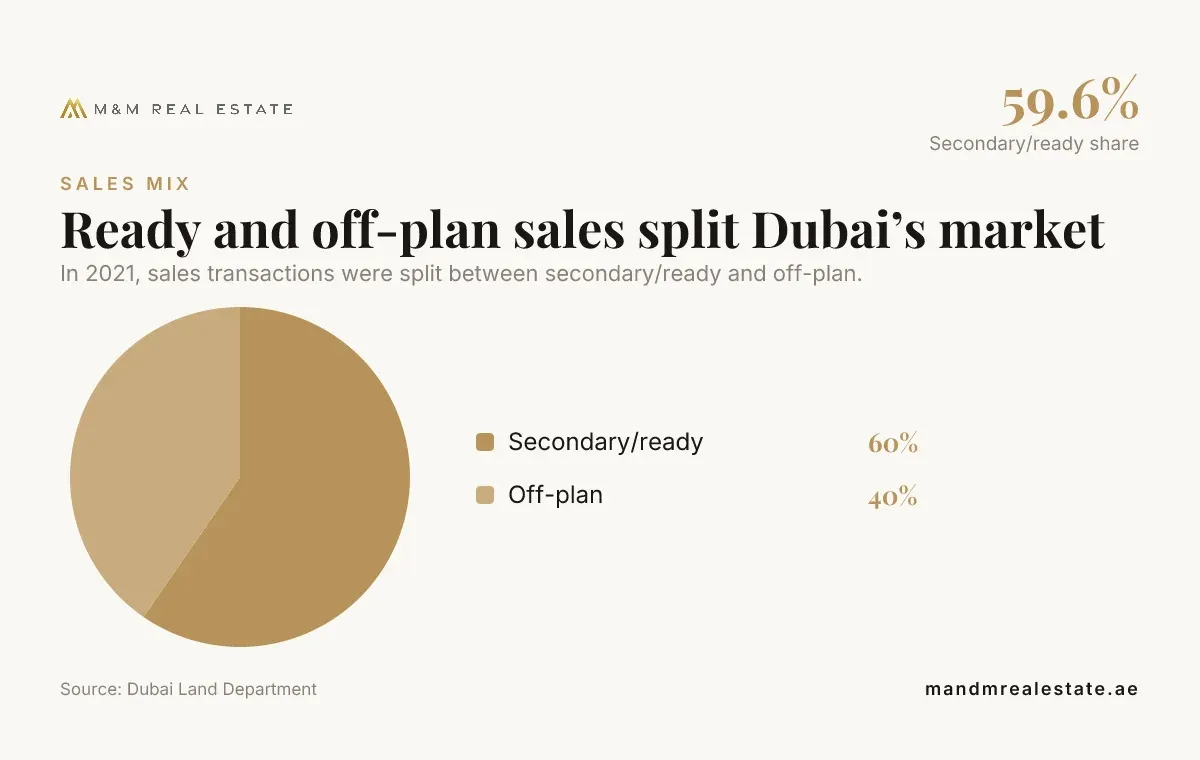
In 2021, sales transactions were split between secondary/ready and off-plan.
Dubai Land Department data for 2021 provide the transaction split shown above. Source: Dubai Land Department.
Choose the area that fits your priorities
For immediate use and an established urban setting, compare Dubai Marina and Palm Jumeirah at building level. Their different community characters can guide the shortlist, but the right fit still depends on the home, its surroundings and the resident’s routine.
For a developing waterfront, compare Dubai Creek Harbour, Dubai Islands and Rashid Yachts & Marina by current services, delivery progress, access and competing future supply. Check how much of the daily experience exists now, then decide whether the remaining timeline suits your plans.
If occupation or rental income needs to begin soon, prioritise a ready, well-matched unit. A developing location may suit a buyer with a longer horizon, provided the delivery uncertainty and income timing fit the wider investment plan.
Where is the best area to invest in real estate in Dubai? The better fit depends on your time horizon, when you need income, your tolerance for development risk and the specific property. Our Dubai and Abu Dhabi area guides and Dubai property investment guide offer additional ways to frame that decision.
For buyers weighing residency alongside property plans, our Dubai Golden Visa guide addresses that separate consideration. Our Dubai investment resources bring the related guides together.
Dubai’s established and emerging waterfront areas call for the same disciplined comparison: what works today, what the specific property can deliver and what remains dependent on future construction. Match the neighbourhood, building and unit to your intended use, income timing and holding period.
We look beyond the shoreline label. Real Market Intelligence starts with real homes, real access and a clear view of development risk.
Does a waterfront address guarantee direct beach access?
No. A waterfront home may face a marina, canal or landscaped edge rather than a beach, and access can depend on the building and the adjoining land. Check the route and access arrangements for the particular property.
Does a higher-floor apartment always have a better view?
No. A higher floor can still face another tower, a service area or an outlook that changes direction across the unit. Window placement and the apartment’s orientation shape the view as much as floor height.
Can two buildings in the same waterfront community have very different service charges?
Yes. Buildings with different shared facilities, common areas and maintenance needs can have different cost profiles within the same community. Compare the charge against the services and upkeep the building provides.
What should a buyer consider when a property’s view could change as nearby development continues?
Review the surrounding plots and the development framework for the area, then consider how different future building heights or uses could affect the outlook. A decision should still make sense if the current view changes.


