


Real estate crowdfunding in Dubai lets investors pool money towards a property investment, but a contribution does not automatically give them direct ownership of part of a property. Before committing, understand who owns the asset, what rights your investment gives you, how costs affect returns and when you could exit.
- A crowdfunding platform may arrange a pooled investment without owning the property itself.
- An SPV may hold the property while investors hold shares or other interests in the company. Those interests are not automatically direct title ownership.
- Compare the property, strategy, assumptions, fees and reporting, not just the advertised yield or minimum contribution.
- Rental receipts are not the same as investor distributions. Expenses, vacancy and reserves can reduce the cash paid out.
- Platform authorisation, title records and investor rights are separate issues to examine.
- Plan for a holding period and restricted resale. You may not be able to sell an investment whenever you need cash.
How fractional property investing is structured
Real estate crowdfunding pools contributions from multiple investors to fund a property investment. A platform may source the opportunity, arrange subscriptions and provide updates, while a separate company owns the property.
A common structure uses a special purpose vehicle (SPV). The SPV may appear on the property title, while investors own shares or another legal interest in the SPV; that is different from each investor holding a registered share of the property directly.
Find out which entity appears on the title and what legal interest you acquire. Then read the governing documents for your voting rights, entitlement to income, and say in a property sale.
Marketing language such as fractional ownership does not establish those rights. The company documents, subscription terms and any shareholders’ or members’ agreement do.
We focus on the real asset and the real investor rights behind an offer. Our Dubai property investment guide offers context for assessing an opportunity, but the rights in a crowdfunding structure must come from its own legal documents.
Compare the investment and the platform before committing
Start with the property: assess its location, condition, intended use and rental demand. Then decide whether a buy-to-let plan, which relies on rent, or a resale-led strategy such as property flipping fits the stated holding period and your tolerance for uncertain sale proceeds.
Ask whether an advertised return is projected or realised, and examine the assumptions behind it. A projection should explain its treatment of vacancy, operating expenses and the planned holding period, rather than presenting a headline yield without the costs behind it.
Compare the minimum contribution, eligibility rules, payment methods, fees and investor reporting together. A low entry amount may improve access, but it does not establish that the asset or terms suit your aims.
Assess diversification across distinct properties, locations and strategies. Several investments in the same building or market segment can still leave you exposed to the same local or property-specific risks.
When assessing an off-plan property, examine the development, location and delivery plan as well as the proposed investment structure. Our off-plan buying guide, off-plan property opportunities, developer reviews and guide to Dubai areas by investment goal can help frame that asset-level review. You can also browse our Dubai investment guides and resources.
Bay Estate is a Nakheel development on Dubai Islands, with townhouses and villas around two swimmable lagoons. This project profile helps illustrate the property-level questions to ask about a location, intended use and delivery timeline.
The figure below provides context about interest in direct land purchases, not evidence of demand for crowdfunding. Knight Frank’s Destination Dubai 2025 report states that 83% of global HNWIs surveyed expressed interest in purchasing land in Dubai to build their own homes.
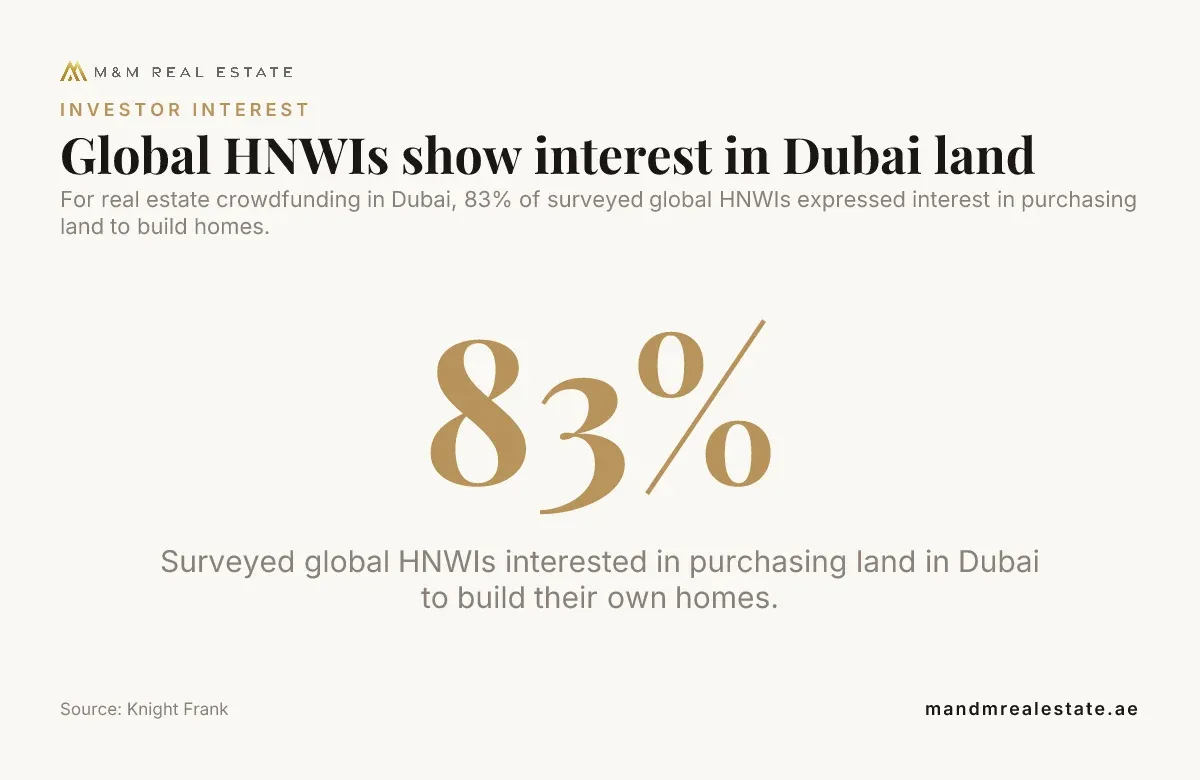
Knight Frank’s Destination Dubai 2025 report states that 83% of global HNWIs surveyed expressed interest in purchasing land in Dubai to build their own homes.
Source: Knight Frank
There is no universally best real estate crowdfunding site for every investor. Compare the legal structure, property case, fees, reporting, eligibility and exit terms against your own objectives.
Twelve chapters on what the regional war tested, the balance sheet and dollar peg behind the market, and how to pick the right side of this cycle.
Download free→Follow the route from selection to rental income
The usual process starts with reviewing an opportunity and its documents, then completing identity and eligibility checks. You fund the investment, receive confirmation of the interest acquired and follow property and investor updates.
Before subscribing, understand how the property will be let and managed, who pays for repairs and operating costs, and how the platform calculates distributable rent. Ask whether a property manager, the SPV or another party makes those decisions, and where that responsibility appears in the documents.
Check the distribution policy and schedule in the investment terms. Rent received by a property can differ from cash distributed to investors: expenses, reserves and periods without a tenant can reduce or delay payments.
Identify the records that evidence your interest, such as a subscription confirmation, share or membership register and the relevant SPV documents. Make sure the records identify the correct legal entity and investment class, since those details can determine which rights attach to your holding.
Our guide to Dubai rental yields, gross returns and costs takes a closer look at rent calculations and property-level costs.
Work out net returns, not just the advertised yield
Separate rental income from capital appreciation. Rent may generate cash flow during ownership, while appreciation becomes a realised gain only if the property sells for more than its purchase cost after expenses.
Compare projected and realised performance on the same basis. Account for platform charges, management costs, maintenance, insurance, vacancy and sale expenses where they apply; otherwise, a property’s advertised investment yield may not represent the investor’s net return.
For a hypothetical calculation, assume an investment of AED 10,000 produces AED 600 in allocated gross rent and incurs AED 150 in fees and property expenses for the example period:
- AED 600 - AED 150 = AED 450 net income.
- AED 450 ÷ AED 10,000 = 4.5% net cash return for that example period.
These figures are hypothetical. The calculation shows why the investor’s net return can differ from the property’s gross yield: each fee and expense reduces the amount available to distribute.
Our Property for Sale in Dubai service provides research-led guidance on off-plan, waterfront, luxury and commercial property opportunities. It gives readers a direct-property comparison when considering what an underlying asset may involve, rather than a pooled share.
Understand regulation and what protections apply
Is crowdfunding legal in Dubai? The answer depends on the investment structure and the regulated activities involved, so identify the contracting entity, the activity it carries out and the regulator responsible for that activity.
The Dubai Financial Services Authority (DFSA) and the Dubai International Financial Centre (DIFC) are important terms when assessing a platform’s stated regulatory position. Establish whether the particular entity and activity fall within the authorisation claimed, rather than relying on a general reference to regulation.
Property title and transaction records within Dubai’s land-registration framework answer different questions from investor rights in an SPV or platform product. A title record for the property does not, on its own, establish what shares, voting rights or income entitlements an investor holds.
Read the investment documents alongside the platform’s legal and regulatory disclosures. Where the structure or rights are unclear, obtain independent legal advice before subscribing.
Our guide to Dubai property tax for new investors covers related questions about tax treatment. Tax outcomes depend on the investor’s circumstances and the structure used.
Plan for risk, holding periods and exit limits
Projected rental income and property appreciation are uncertain. Vacancy, repairs, higher operating costs or weaker sale proceeds can reduce returns, while a sale at a lower value can result in a loss.
Read the holding period, sale process, exit windows, transfer restrictions and any secondary-market rules before investing. An interest in a platform or SPV may not be sellable on demand, and a ready buyer may not be available when you want to exit.
Find out how a property sale is approved, how sale expenses are allocated and how proceeds flow through the SPV to investors. The documents should also explain how the investment is handled if a sale takes longer than planned or achieves less than expected.
Do not commit money needed for near-term spending. Spreading exposure across distinct assets or strategies can reduce concentration in a single opportunity, but diversification cannot remove property-market risk.
Check eligibility and cross-border practicalities
If you live outside the UAE, establish the platform’s eligibility rules, accepted identity documents, payment routes and source-of-funds requirements before choosing an opportunity. These checks can affect whether you can subscribe and how long the process takes.
Account for currency conversion and transfer charges when funding an investment or receiving income in another currency. Ask how the platform handles investor updates, identity checks and distributions for people living abroad, and keep copies of investment and payment records.
Seek tax advice in your country of residence as well as relevant UAE advice, because treatment depends on your personal circumstances and the investment structure. Our locations helps you explore the areas that may underpin a property opportunity, while our information on the Golden Visa route for property investors is relevant to a separate question: residency eligibility.
Pooling money with other investors can provide a way to participate in a property investment, but the platform’s label does not define your legal rights or your eventual return. Read the SPV and subscription documents, assess the underlying asset and full costs, verify the regulatory position, and plan for a holding period that may limit your ability to sell.

What happens to a crowdfunding investment if the platform shuts down?
The outcome depends on the contracts, ownership structure and continuity arrangements for the investment. Look for provisions covering who administers the SPV, maintains investor records and communicates with investors if the platform stops operating.
Can I invest through a company rather than in my own name?
Some structures may accept a company, but eligibility and documentation depend on the platform and offering. A corporate investor may need to provide company registration records, beneficial ownership details and evidence that the person signing has authority to act.
Are Dubai property crowdfunding investments automatically Sharia-compliant?
No. A property-based investment is not automatically Sharia-compliant because its financing, leases, fees and governance also affect the assessment. Investors seeking Sharia-compliant investing should review the structure with a qualified adviser and request the relevant screening documentation.
What records should I keep after investing in a property SPV?
Keep dated copies of any amendments to the investment terms, investor notices and statements, as well as correspondence about decisions affecting the SPV. Store digital copies securely so you can access them if your account or platform access changes.
Does holding a property crowdfunding interest automatically qualify me for a Golden Visa?
No, an interest in an SPV does not by itself establish immigration eligibility. The relevant authorities determine the current requirements and acceptable evidence, so treat visa eligibility as a separate assessment from the investment decision.
Is property crowdfunding a good idea?
It can suit investors who want to participate in a property investment without buying a whole property, but it is not right for everyone. Returns are uncertain, costs can reduce income, and you may not be able to sell your interest when you need cash, so weigh the risks and terms against your goals and time horizon.
How does crowdfunding work for real estate?
Before investing, check the offering documents to identify which entity receives your contribution and what legal interest you will hold.


