

Dubai off-plan payment plans can make a purchase easier to stage, but a low booking amount does not tell you what the full commitment will require. We compare the instalment dates, amounts, contract terms and buyer protections, not just the headline plan.
- Read the complete Sales and Purchase Agreement (SPA) schedule; a headline split may not show each instalment’s trigger or due date.
- Map every payment against expected income, savings and a cash buffer before committing.
- Milestone-linked payments and calendar-based payments create different timing risks.
- A post-handover plan defers part of the purchase price, but it does not prove rental income will cover the instalments.
- Check the developer track record, escrow arrangements, Oqood registration and late-payment clauses.
- Budget for transaction costs as well as instalments, and do not rely on mortgage finance until a lender has assessed your case.
How off-plan payment plans work
An off-plan property is purchased before construction is complete. The buyer commits to a unit under a contract and pays the agreed price according to a schedule set by the developer.
Most schedules divide payments across three broad stages: an initial booking or down payment, instalments during construction, and a balance at handover. The percentages and timing vary by project, so the plan’s label is only a starting point.
The booking deposit reserves the unit under the developer’s process and may be credited towards the purchase price. Whether it can be refunded, and in what circumstances, depends on the reservation terms, the SPA and applicable rules; get the refund conditions in writing before paying.
Our
Compare the schedule, not just the headline split
A payment plan might be described by the share due at booking, during construction and at handover. That shorthand can hide the detail that matters most: when each instalment falls due and what event triggers it.
| Plan structure | How it works | What to examine |
|---|---|---|
| Construction-linked | Payments fall due as specified construction milestones are reached. | How each milestone is defined, documented and certified. |
| Time-linked | Payments fall due on stated calendar dates or at set intervals. | Whether a payment remains due if construction progress slows. |
| Handover-heavy | A larger share of the price is due when the completed unit is handed over. | How you will fund the balance, including whether a lender will finance it. |
| Post-handover | Some of the price is paid after the buyer receives the property. | The post-handover due dates, total price and consequences of missed payments. |
A construction-linked payment plan can connect instalments to progress, while a time-linked plan follows dates on the calendar. The SPA must state the trigger for every payment; sales material that refers to construction does not by itself make a plan milestone-based.
As a worked example, the

This calculation shows how to translate a percentage schedule into amounts you can plan around. The SPA still determines when each payment is due, and you should compare its full schedule with any brochure or reservation form.
Choose instalments that fit your cash flow
Which off-plan payment plan is best in Dubai? The right plan is the one whose due dates fit your finances and ownership goals, while leaving room for unexpected costs. A smaller initial payment can still leave you with an unaffordable purchase.
Map every instalment against your expected income, savings and available cash buffer. Include any large payments due around handover, and make sure your plan still works if an expected bonus, asset sale or other source of funds arrives late.
Be realistic about your timeline. An investor who plans to hold the property may weigh payment timing differently from a buyer who expects to sell before handover or move into the home after completion. A resale plan should account for transfer restrictions and market liquidity, not just the instalments paid so far.
Is buying off-plan worth it? It can suit buyers who accept construction and timing risk in exchange for a staged payment schedule and a property that is not yet complete. It is a poor fit when the purchase depends on uncertain income, a hoped-for resale or rental income that has not started.
What foreign buyers get wrong in Dubai off-plan, what each mistake costs, and exactly what to do instead.
Download free→Post-handover, deferred payment and rent-to-own options
A post-handover payment plan moves part of the purchase obligation beyond handover. M&M’s guide describes plans where a balance is paid after the buyer receives the property and notes that these arrangements may carry a higher price; compare the total contract price with the alternative schedule, not just the instalment timing.
A deferred payment plan also postpones some of the cost, but the contract must clarify whether the deferred amount is interest-bearing, included in the stated price or subject to other charges. Ask for the amount and due dates in the SPA rather than relying on a sales label.
Rent-to-own is a different arrangement from a standard off-plan purchase. The contract should set out how rent is treated, whether any portion counts towards a future purchase, when the buyer can exercise that option and what happens if the purchase does not proceed.
Do not treat a post-handover schedule as proof that rent will cover the payments. Compare expected occupancy, running costs and realistic rental assumptions with the contractual instalments; our guide to Dubai property rentals and yields can help frame that assessment.
Check financing and extra costs before handover
Can a buyer get a mortgage for the balance at handover? A lender may consider financing, but approval depends on its criteria, the buyer’s finances, the property and the valuation. Speak to lenders early, ask what documentation they need, and do not treat an informal estimate as confirmed funding.
Build a separate budget for costs outside the instalments. Depending on the transaction, these may include DLD and Oqood registration charges, trustee or administration fees, mortgage-related costs, service charges, utilities and furnishing.
Ask when each cost falls due and who pays it. Our overview of Dubai property tax and other ownership costs provides additional context for investors planning their budget.
Look at the overall investment as well as the payment schedule. Our Dubai real estate investment guide covers the broader questions to consider, while our property guide to Dubai’s Golden Visa can help buyers assess visa-related questions separately from a developer’s payment terms.
Understand escrow, registration and delay protections
Before signing, read the SPA for payment triggers, due dates, late-payment penalties, notice periods and the developer’s remedies if an instalment is missed. Also look for the rules on assignment or resale, amendments, cancellation and dispute resolution.
For off-plan purchases, buyer payments are routed through a project escrow account, with funds released according to the applicable construction controls. The buyer should understand how the project’s escrow arrangements work and how the contract connects payment obligations to progress.
Oqood is the interim registration process for off-plan property. Make sure the purchase and registration steps are clear, and keep copies of the SPA, payment receipts, reservation documents and registration records.
What happens to scheduled payments if construction is delayed? The answer depends on the contract and the type of schedule: a milestone payment and a calendar-based payment may be affected differently. Check whether the SPA changes due dates when progress slips, what notice the developer must provide and which remedies apply.
Ask a UAE property lawyer to review the relevant clauses if the developer changes dates, misses a milestone or issues a demand you believe conflicts with the SPA.
Late payments can trigger contractual penalties and affect the buyer’s rights. Read the default clause before signing, including any cure period, notice requirement, suspension of services, cancellation process or restrictions on transfer.
Before choosing a project, assess the developer track record alongside location, delivery history, contract clarity and the quality of project information.
Use our Dubai developer directory to consider the developer, and compare areas using our guides to areas to invest in Dubai and locations.
Compare current projects and market context
Payment terms should be assessed alongside the property itself. Compare location, layout, handover expectations, developer history and the likely resale or rental audience, rather than selecting a unit solely because its first instalment looks manageable.
Use the image below to open M&M’s off-plan property selection in Dubai and compare the available developments with your brief.
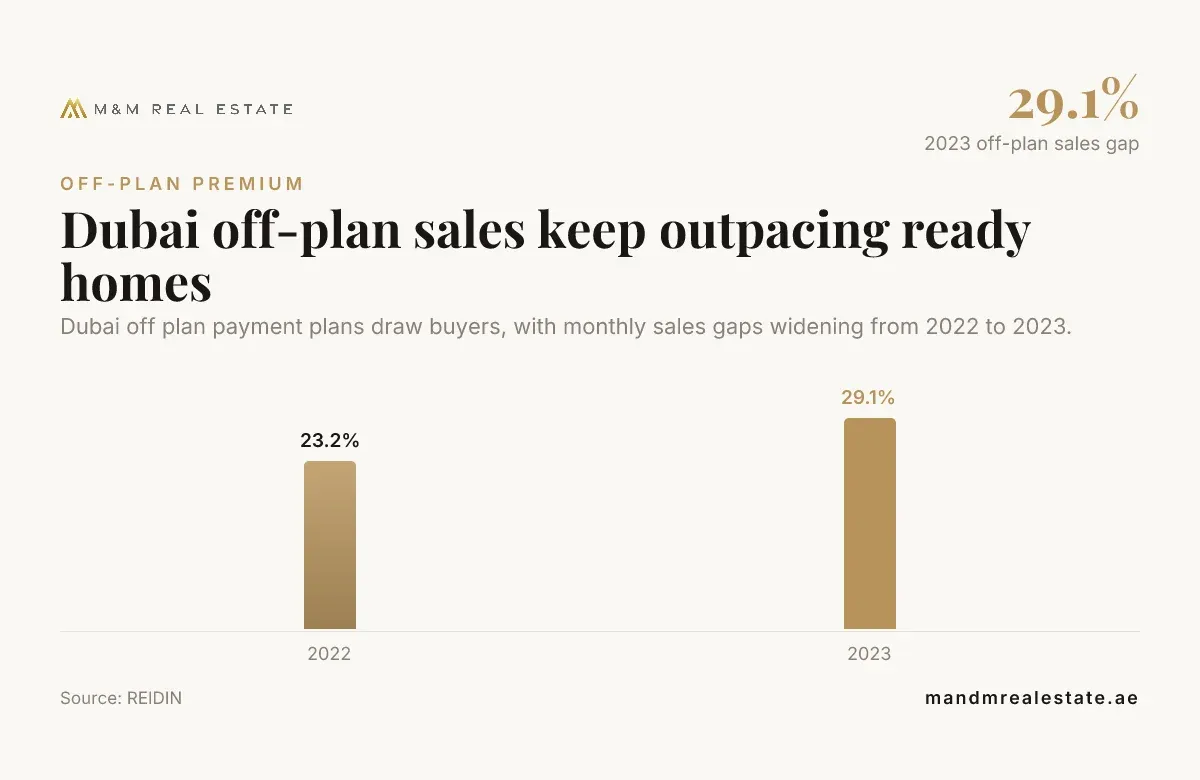
REIDIN reports that off-plan sales were 23.2% higher on an average monthly basis in 2022, and that the difference climbed to 29.1% in 2023, in its comparison of off-plan and ready sales.
Source: REIDIN
Market context can inform a decision, but it cannot replace a project-level review. For more background, explore M&M’s market resources.
A sound Dubai off-plan purchase starts with the full payment schedule, not the headline offer. Match every due date to your cash flow, understand the SPA and escrow protections, assess the developer and plan for handover costs before committing.
We believe real advisory begins with clear questions and a real understanding of the buyer’s timeline. Compare the property, payment terms and risks together, then choose the off-plan payment structure that supports your ownership or investment plan.

Is there a standard monthly percentage payment plan in Dubai?
No single monthly schedule applies across Dubai developments. Treat any monthly-payment description as project-specific and review the full amount, due dates and default terms in the SPA.
Can I pay an instalment early?
Ask the developer how it handles early payments and whether the payment will be credited against a particular instalment or the outstanding balance. Get the allocation and any effect on later due dates in writing.
What should I do if an off-plan project is cancelled?
Keep the SPA, payment evidence and developer notices, then request a written statement of the project’s status and your account. The next steps depend on the cancellation circumstances, escrow arrangements and applicable rules, so obtain independent legal advice before accepting a settlement.
Can the developer change the unit’s layout or specifications?
The SPA should explain which changes the developer may make and how material changes are handled. Compare the signed specifications and plans with any revised documents, and get advice if a change affects a feature that mattered to your decision.
When should I budget for service charges?
Include service charges in your ownership budget alongside instalments and handover costs. The SPA and building arrangements determine how the charges are assessed and when the owner becomes liable.
Can I transfer an off-plan property to a family member?
A transfer may require developer approval, registration steps and payment of applicable charges. Check the SPA’s assignment provisions and obtain written instructions before agreeing to transfer the property.


