

When people ask who leads property investment, they may mean a firm that owns buildings, a fund manager that invests clients’ capital, or a REIT whose shares trade publicly. We explain how to tell these players apart, compare investment routes, and assess where Dubai fits.
- Start with the measure. Assets under management, property owned and capital raised describe different things, so a firm’s apparent size depends on which measure a list uses.
- Separate investors from service providers. Asset managers, REITs and property-owning companies deploy capital; developers build and sell property, while brokers advise or arrange transactions.
- Match the route to your needs. Listed REITs can be easier to trade, while direct ownership offers more control and private funds can have tighter exit limits.
- Judge the investment, not only the firm. Property type, location, borrowing, fees and exit terms can matter more to your outcome than an organisation’s size.
- For Dubai, check local fit. Review the developer, project structure, likely rental strategy and investor protections. Our Dubai developer track-record reviews can help frame that assessment.
- Use an adviser for analysis, not as a substitute for due diligence.
How to compare firms by scale and mandate
There is no single measure that makes one real estate investor the largest. Assets under management usually describes the value of assets a manager oversees for clients, while company assets refer to what a company owns or controls; capital raised measures money secured for investment, not the value of property already held.
These figures answer different questions. A large manager may oversee assets owned by funds or clients, while a property owner may hold buildings directly and a private fund may report capital raised before it has invested all of it.
| Measure | What it tells you | What it does not tell you |
|---|---|---|
| Assets under management | The value of assets a manager oversees. | How much property the manager owns for itself, or how accessible its investments are to you. |
| Assets owned | The scale of a company’s property holdings. | How much capital it manages for other investors. |
| Capital raised | The funds gathered for an investment strategy or vehicle. | How much has been deployed, or how the resulting portfolio performs. |
To compare firm lists fairly, identify the metric, the type of organisation covered, the reporting period and the regions included. Check whether a figure refers to a parent group or a single fund, and whether it covers residential property, commercial real estate or both.
Who are the biggest investors in real estate? The answer changes with the measure: large asset managers may lead by assets overseen, property owners by holdings, and private funds by capital raised. A list that mixes these categories cannot produce a meaningful like-for-like comparison.
Who is the richest real estate investor? Personal wealth and a company’s assets under management are not the same measure. To answer that question responsibly, use a dated personal net-worth assessment rather than inferring an individual’s wealth from a firm’s size.
Who are the Big Four in real estate? There is no universally accepted Big Four of property investors. The phrase needs a defined category, such as listed REITs, private real estate equity firms or institutional owners, before it can be answered clearly.
Which organisations invest, manage or provide property services?
A real estate investment manager makes or oversees investment decisions for clients or funds. A real estate investment company may instead invest its own balance sheet, pool outside investors’ capital, or combine both approaches, so read its mandate before treating it as an investor in the same sense.
- Property-owning companies acquire and hold assets, then earn income or seek value growth through ownership and asset management.
- Investment managers select and manage property investments for clients, funds or institutional investors.
- REITs give investors access to property through shares in a listed or privately held trust or company.
- Developers plan and deliver projects. Their role differs from that of a fund investing in completed or developing assets.
- Brokerages and property advisers help clients assess, buy, sell or lease property, but those services do not by themselves make the firm an investor.
The distinction matters in Dubai, where a developer’s track record, an investment manager’s mandate and an adviser’s recommendations answer different questions.
How public REITs, private funds and direct ownership differ
A real estate investment trust, or REIT, gives investors exposure to property through shares rather than requiring them to buy a whole building or home. Public REIT shares trade on an exchange, which can make buying or selling simpler than exiting a private fund, though share prices can move independently of the underlying properties.
Private real estate equity funds pool capital to acquire or develop assets. They can offer access to larger or specialist portfolios, but investors may face a long holding period, limits on withdrawals, fees, borrowing and the possibility of losing capital.
| Route | Control and diversification | Liquidity and key risks |
|---|---|---|
| Listed REIT | Exposure to a managed property portfolio, with little control over individual assets. | Shares can usually be traded through the market, but their price can fluctuate. |
| Private fund | Pooled exposure, with investment decisions made under the fund’s mandate. | Withdrawals may be restricted; review fees, leverage and the fund’s exit process. |
| Direct ownership | More control over the property and its use, but less automatic diversification. | A sale can take time and involves property-specific costs and risks. |
| Fractional investing | Can lower the amount needed for exposure to an asset, with control depending on the legal structure. | Resale options may be limited; understand who holds title and how decisions are made. |
Fractional real estate investing can suit people who want exposure without purchasing an entire property, but the platform’s structure matters. Check whether you own a share in a property-owning vehicle or hold another kind of interest, who has custody of funds, and what happens if you want to exit.
Twelve chapters on what the regional war tested, the balance sheet and dollar peg behind the market, and how to pick the right side of this cycle.
Download free→Why sector and region change the comparison
Major property investors may focus on residential property, offices, retail, industrial and logistics buildings, hotels, healthcare facilities or specialist assets. A firm with deep experience in rental housing may not have the same strategy, operating skills or risk profile as one focused on commercial real estate.
Regional focus matters too. Compare the locations a firm actually invests in, the local property types it targets and the way it manages local rules, tenants and currency exposure. A global name does not automatically make an investment suitable or available to a UAE resident.
In Dubai, an address alone does not establish an investment case. Compare the location with the asset type and intended use, and use our Dubai area guides alongside project-level analysis.
Dubai investment routes for UAE-based and international investors
Investors considering Dubai can choose between direct ownership, off-plan purchases and pooled exposure through a fund or REIT. Direct ownership gives more say over the asset; a pooled route can spread exposure across properties, but it adds fund terms, fees and another layer of decision-making.
Off-plan property requires careful attention to the developer, construction progress, payment schedule, handover expectations and resale options. Our Dubai off-plan property selection and property and residency guide cover two practical considerations for buyers.
Rental-focused buyers should assess tenant demand, ongoing costs, management arrangements and periods without rent, rather than relying on a headline yield alone. Our Dubai rental-yield guide offers more on rental returns.
One worked illustration helps show how a payment schedule affects cash planning. M&M’s Arancia Yards investment case, accessed 6 October 2026, lists an entry price of AED 1.0 million and a 40/60 payment plan; using those listed terms, AED 1,000,000 × 40% = AED 400,000, then AED 1,000,000 × 60% = AED 600,000, and AED 400,000 + AED 600,000 = AED 1,000,000.
This illustration explains the arithmetic, not the full cost of ownership or a forecast of returns. Buyers should account for transaction costs, ongoing charges, financing and the possibility that the asset’s value or rental income changes.
What to assess before choosing a firm or investment
Ask what the firm does with capital, who makes investment decisions and how it is paid. A clear answer should distinguish advisory fees from management fees, performance fees, transaction costs and charges made by third parties.
- Authorisation: Check that the relevant firm and activity hold the approvals required for the jurisdiction and service involved.
- Custody and safeguards: Understand where funds are held, who can move them and how investor assets are separated.
- Strategy: Match the mandate to your preferred property sector, region, holding period and tolerance for risk.
- Leverage: Understand how borrowing affects cash flow and how the investment could respond to higher financing costs or lower income.
- Exit terms: Find out how and when you can sell or withdraw, and whether another buyer must be found.
- Reporting: Look for consistent reporting on holdings, income, costs, valuation methods and material changes.
In Dubai, distinguish the responsibilities of the developer, the agent, the fund manager and the property owner. Review relevant RERA and DLD records, and examine the contract, escrow arrangements where applicable, and the process for resolving disputes.
Our investment-case approach considers the location, developer, project structure and potential drawbacks together. The images below show contrasting residential formats, a villa and townhouse community and a canal-side tower, to illustrate why property type should sit beside firm-level analysis.
Tax treatment can depend on the property, the investor’s tax residence and the rules that apply in other jurisdictions. Read our guide to Dubai property tax considerations, then seek advice for your own circumstances.
Our Dubai investment guide offers a wider view of investment risks and routes. Our property investment resources also provide further reading for investors comparing locations and strategies.
What concentrated ownership can tell you
Large holdings can cluster in a small set of markets, but a concentration statistic does not tell you whether a particular property suits your objectives. Use market-level patterns as context, then examine local demand, asset quality and the investment structure.
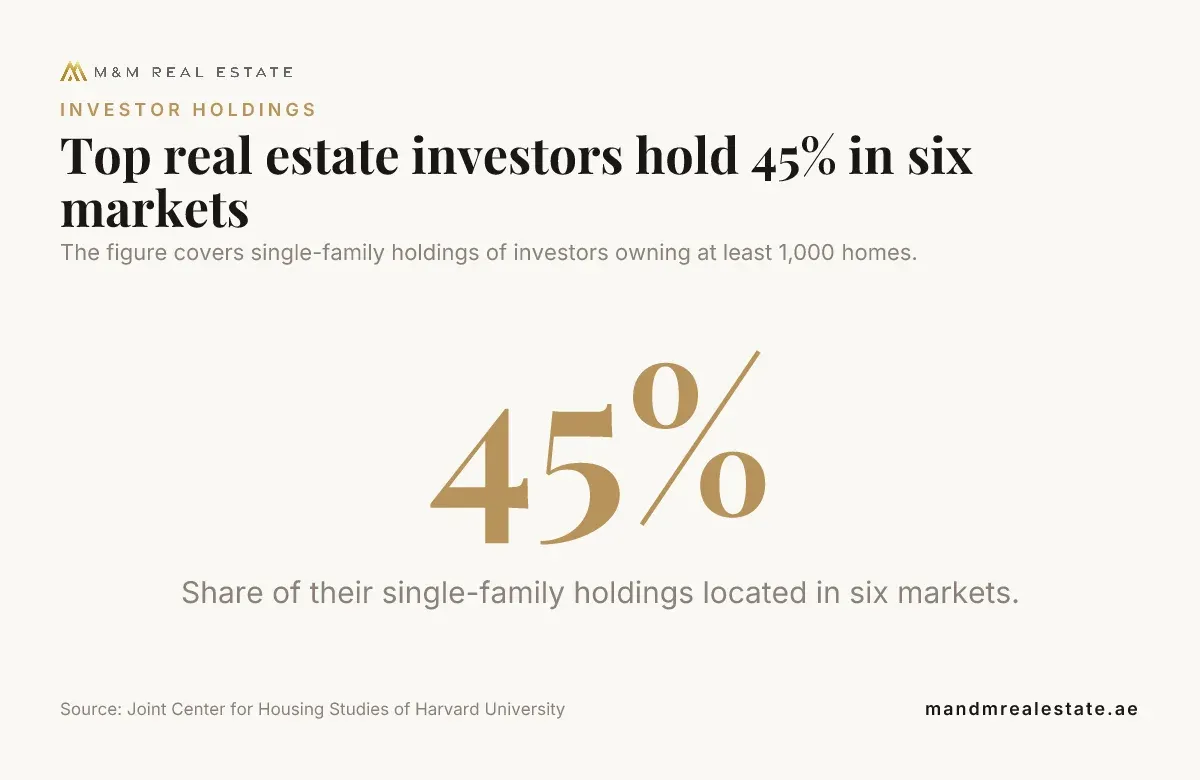
The chart concerns single-family holdings by investors who own at least 1,000 homes, as described in the Joint Center for Housing Studies of Harvard University article, accessed 6 October 2026.
See also: Locations.
The leading real estate investors cannot be compared fairly until you know whether a list measures assets under management, property owned or capital raised. Start with the firm’s actual role, then assess its strategy, sectors, regions, fees, leverage and exit terms.
For Dubai property investment, local knowledge matters as much as firm scale. We focus on clear analysis, real investor needs and honest discussion of risk, so you can decide whether direct ownership, a fund, a REIT or another route fits your objectives.

Can an overseas investor use a Dubai property adviser?
Yes, an adviser can help an overseas buyer understand available routes, compare projects and coordinate the purchase process. The investor should also consider home-country tax rules, currency exposure and the legal requirements that apply to their own circumstances.
Should the same firm advise on an investment and manage the property?
It can, but the roles and fees should remain clear. Ask how the firm handles conflicts of interest and whether you can appoint a separate property manager.
How should I assess leverage in a property fund?
Review the amount and terms of borrowing, when debt must be repaid and whether the fund can meet payments if income falls. Higher leverage can increase the effect of changes in property values and financing costs.
Does fractional ownership give me control over the property?
Control varies with the legal vehicle, voting rights and management agreement; read how decisions about leasing, maintenance and sale are made.
Can rental yield alone show whether a property is a sound investment?
No. Yield does not capture every cost, vacancy period, financing obligation or change in the property’s value, so compare net income and the full investment plan.
What happens if a private fund needs more capital?
The fund documents should explain whether investors can face additional capital calls and what happens if they cannot meet them. Read those terms before committing, and keep your own liquidity needs in view.


