

Dubai’s population growth is easiest to understand when we separate resident numbers from daytime visitors, projections and changing urban boundaries. That distinction matters to anyone assessing the city’s housing needs, infrastructure and long-term property demand.
- Resident population and daytime presence are different measures. Workers, tourists and other temporary visitors can raise the number of people in Dubai during the day.
- Always compare like with like. Check the boundary, date and counting method behind each population estimate.
- Migration and natural change both affect growth. The headline total alone does not show how much each contributes.
- Population growth can influence housing demand, but it does not guarantee property price rises. Location, supply, affordability and transport access also matter.
- Planning depends on where residents live and work. Citywide totals cannot explain neighbourhood-level pressure on roads, public transport or services.
- We bring location and investment considerations together in our locations page and wider property resources.
What Dubai’s population estimate counts
Dubai’s resident population refers to people who live in the emirate, not everyone who happens to be there on a given day. Tourists, commuters, students and short-term visitors may add to daytime presence without becoming part of the resident total.
Digital Dubai reported that Dubai’s population grew nearly 380-fold over 144 years, surpassing 4.580 million residents by the end of 2025 Digital Dubai. The date matters: a year-end total should not be compared with a figure recorded partway through another year as though both describe the same moment.
A population clock gives a changing estimate, while a census is a count tied to a defined period and method. Before comparing figures, we look at whether they refer to residents or people present, the date they cover, and whether the boundary is the emirate, the city, an urban area or a metropolitan area.
Digital Dubai reports that the average number of people present in Dubai during peak daytime hours in 2025 was 6.392 million, including the resident population and more than 1.812 million people temporarily present Digital Dubai.
How Dubai’s population has changed over time
Dubai’s population has grown over a long period, but the pace has not stayed constant. A useful comparison sets each period beside its own population base rather than treating one recent growth rate as typical of the city’s entire history.
Digital Dubai records the 1980 census as the point when Dubai’s highest historical population growth rate was reached, at 8.2% Digital Dubai.
When we assess whether the emirate is growing or declining, we start with dated resident figures produced on a consistent basis. A population clock can show short-term movement, while an annual or census figure offers a point of comparison over a longer interval.
Dubai is not a single, uniform housing market. Residents may settle in established central districts, new communities or areas closer to work, so a citywide increase does not reveal where demand is building.
What attracts new residents to Dubai
People move for different reasons, including employment, business opportunities, family, education and residency options. These choices can overlap, and the population total alone cannot show which motive contributes most to net migration.
Population change has two broad components: net migration, meaning arrivals compared with departures, and natural population change, meaning births compared with deaths. Separating them helps explain the trend, but a headline total does not reveal their individual contributions.
Residency arrangements can form part of a household’s decision about where to live and invest. We explain the property-related criteria and process in our Dubai Golden Visa property guide.
Economic activity can also support population change. Digital Dubai’s update reports the population growth rate alongside real GDP growth for 2025 compared with 2024, as shown below.
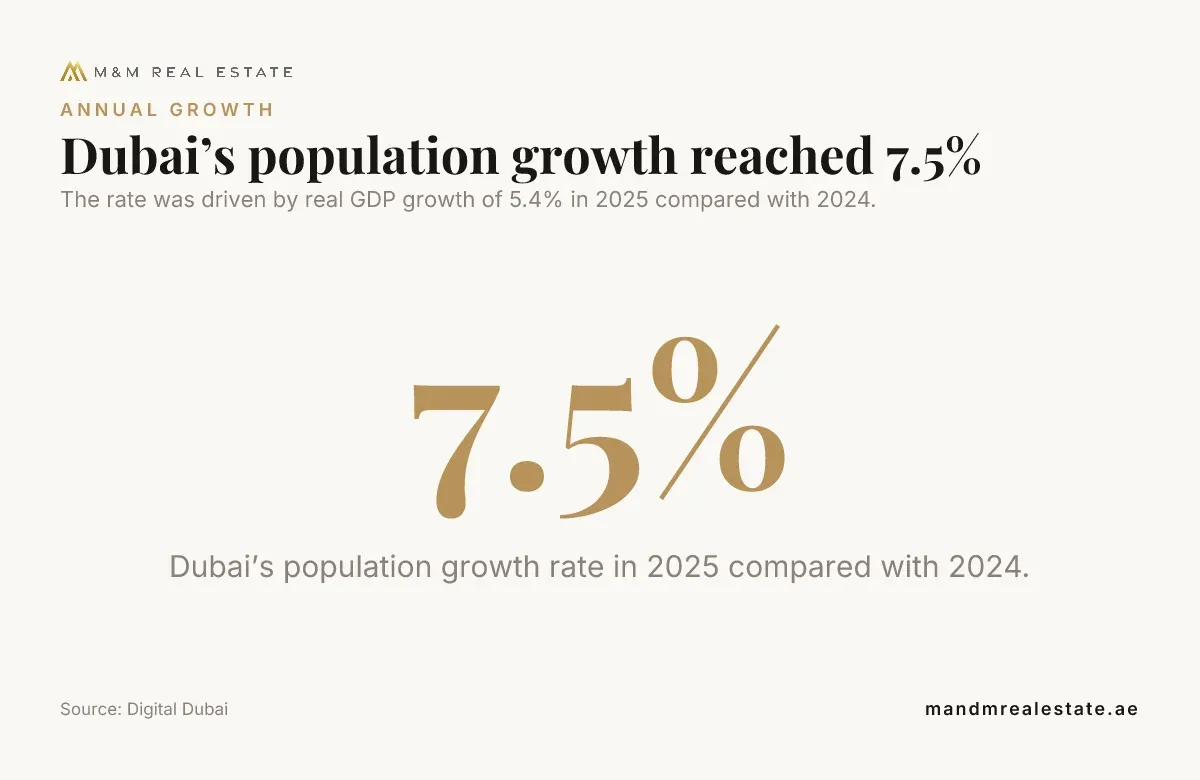
The rate was driven by real GDP growth of 5.4% in 2025 compared with 2024.
Source: Digital Dubai
Twelve chapters on what the regional war tested, the balance sheet and dollar peg behind the market, and how to pick the right side of this cycle.
Download free→Expatriate population, gender and nationality
Dubai has a substantial expatriate population, but a percentage should only be used when it refers to a dated, Dubai-specific count with a clear definition of who is included. Figures for the UAE as a whole and figures for Dubai do not describe the same population.
Nationality rankings also need a date and a defined population base. Without a current official breakdown, a list of the most represented nationalities can quickly become misleading; the same care applies to claims about gender composition.
For residents, the practical point is that Dubai serves households with different work patterns, family needs and plans for staying in the emirate. Those differences affect what people seek in a home, from smaller flats near employment centres to larger homes in family-oriented communities.
We focus on the real neighbourhood factors behind those decisions: access to work, everyday services, transport connections and the kind of housing available locally. Our guide to comparing Dubai areas looks at location as part of an investment decision, not as a substitute for assessing the asset itself.
Population growth, housing demand and property
A rising resident population can increase demand for homes, but it does not make every property a sound investment. Supply, affordability, location, transport access and the match between homes and household needs all shape how that demand reaches individual neighbourhoods.
For a useful housing assessment, we separate broad city growth from local evidence: who rents in the area, what types of homes are being delivered and how well the location connects residents to work and services. Our guide to Dubai rentals and yields covers rental strategy, while our property tax guide considers costs that can affect an investor’s net outcome.
New homes can add choice and capacity, but delivery timing and location matter. We explain how to assess construction stages and payment structures in our off-plan property guide, and readers can review current off-plan property opportunities in Dubai.
Developer selection is part of the same analysis. We compare a project’s location, delivery record and fit with an investor’s goals; population growth alone does not determine its performance; our Dubai developer directory introduces the names investors may encounter.
How infrastructure and neighbourhood planning respond
Population totals help planners set direction, but they do not show where pressure is greatest. Transport and neighbourhood decisions work best when they account for the routes people travel between home, work, schools, shops and public services.
For residents, infrastructure capacity is more than road access. It includes public transport, utilities, health and education provision, public space and the ability to reach daily services without adding unnecessary travel.
When we assess a community, we look beyond its buildings to how it connects with the rest of Dubai. A home can meet a household’s needs on paper, yet feel poorly placed if everyday destinations are difficult to reach.
New development can support a growing city when housing, services and transport are planned together. Our Dubai real estate investment guide sets out how we assess location and project fundamentals as part of a broader strategy.
What population projections can and cannot tell us
A population forecast is a scenario built from assumptions, not an observed count. Its result can change if migration, employment, household formation, housing supply or policy develops differently from the assumptions used.
We treat projections as planning tools, not promises. A useful forecast explains its time horizon and assumptions, while an observed resident count tells us what has already been recorded; mixing the two can create a false impression of certainty.
For property decisions, the relevant question is not simply how many people might live in Dubai in the future. We also ask where new residents may settle, what homes they can afford and whether transport and services can support that pattern.
Dubai’s continued growth is best understood through carefully dated resident counts, clear boundaries and a distinction between permanent residents and temporary daytime visitors. For residents and investors alike, the citywide total is only the starting point.
We look at the real factors behind neighbourhood demand: who lives there, what homes are being delivered and how well the area connects to work and services. That is a more useful basis for decisions than treating a population forecast as a guarantee.
Is Dubai mostly made up of expatriates?
Dubai has a substantial expatriate population, but the share should be tied to a dated, Dubai-specific resident count. A UAE-wide percentage cannot automatically be applied to the emirate.
Which nationalities are most represented among Dubai residents?
A reliable ranking needs a dated official breakdown that clearly defines the resident population. Treat nationality lists without that context as unverified rather than as a current ranking.
Does population growth automatically raise property prices?
No. Population growth can add housing demand, but prices also respond to supply, affordability, location and the type of homes available.
Can a population forecast tell me how many homes Dubai will need?
Not on its own. Housing needs also depend on household size, income, preferred home types, vacancy and where employment and services are located.
What should a renter compare when choosing a neighbourhood?
Compare the commute to work, public transport, nearby daily services and the kinds of homes available in the area. A neighbourhood’s fit with a renter’s routine matters as much as a citywide population trend.


