


The Dubai Rental Index can tell an investor how to compare rents and renewal decisions, but it is not a forecast of a property’s income. We use it as one part of an investment assessment, alongside unit details, rental demand and ownership costs.
Key Takeaways
| Investor question | Short answer |
|---|---|
| What does the index show? | A rental benchmark that can help you understand rent levels and permitted adjustments, subject to current official rules. |
| Does it predict achievable rent? | No. Market rent depends on the particular unit, its condition, lease terms and competing supply. |
| How should I compare properties? | Match location, building, property type, size, condition and lease details as closely as possible. |
| What does a good rental yield look like? | Assess net rental yield after vacancy and ownership costs, then compare it with the investment’s risks and alternatives. |
| Can the index tell me whether to sell? | It can inform a hold or sell review, but it cannot replace analysis of cash flow, resale prospects and your investment goals. |
| Where can I find related guidance? | Our Dubai property investment resources bring together further investor guidance. |
What the Dubai Rental Index is designed to show
The Dubai Rental Index is a benchmark for understanding rental values and, where applicable, permitted rent adjustments. Investors can start with the DLD’s residential rental performance information.
A benchmark is not the same as an asking rent, an agreed market rent or a property valuation. It cannot promise that a particular unit will achieve a certain rent, remain occupied or rise in value.
That distinction shapes how we use the DLD Rental Index. It can help test whether an assumption looks broadly consistent with a reference point, but an investment decision needs evidence about the actual property and its likely tenants.
How to check the index and compare properties
Start with the property’s location and building, then match the closest available property type and unit characteristics. For a renewal review, have the tenancy contract, Ejari details and relevant dates to hand, and use the current official guidance for that specific contract.
Comparisons become less useful when they mix different property types or treat an area benchmark as if it describes every unit in that area. Our Dubai area guide can help frame the location comparison, while the table below highlights the unit details to examine.
| Comparison point | Why an investor should consider it |
|---|---|
| Area and building | Neighbourhood averages can conceal differences between buildings, access and local demand. |
| Layout and floor | Usable space, room arrangement and floor position can influence a tenant’s preference. |
| View and condition | A well-maintained unit with a more appealing outlook may compete differently from a unit needing work. |
| Furnishing and lease terms | Furnishing, payment arrangements and contract terms affect how closely another rent is comparable. |
| Building classification and amenities | Facilities, maintenance standards and the building’s classification can shape a tenant’s experience and rental appeal. |
Area choice should reflect how a location fits an investor’s objectives.
Building classification deserves careful attention. If a building’s facilities, upkeep or recognised category differs from nearby stock, an area-level comparison may give an incomplete picture; we also assess the developer and the building’s operating context through our Dubai developer profiles.
How the index relates to rent increases and disputes
The index can inform a rent-renewal assessment, but it does not make every adjustment permissible. A permitted rent increase is a regulatory question, while market rent is the price a tenant may agree to pay for a property in current conditions.
Keep those questions separate. Use the current DLD or RERA method for the contract in front of you, and do not rely on an old example or a previous version of a digital tool when assessing a renewal.
For landlords and tenants, the contract, Ejari record and relevant official guidance are central to a renewal discussion. If the parties cannot resolve a rental disagreement, the Rental Dispute Settlement Centre is the formal channel for rental disputes.
For an investor, a permitted increase does not establish that the next tenant will accept a higher rent, or that the property will let quickly. It sets a regulatory reference for a particular situation, not a complete investment forecast.
Foreign capital is hesitating. The 3.9 million people inside the UAE have not. The asymmetry that defines 2026, and what it tells you to do about it.
Download free→Using rental trends to assess demand
Rental-index trends can help investors read the direction of registered rental activity, but they are a signal, not a promise of future performance. Check whether the pattern is supported by evidence of tenant demand in the specific area and building, and whether comparable units are being let on similar terms.
Separate renewal evidence from new-letting evidence wherever possible. Renewal figures can help explain existing tenancies, while new contracts may offer a different view of what tenants are agreeing to pay; neither alone establishes future rent, occupancy or resale value.
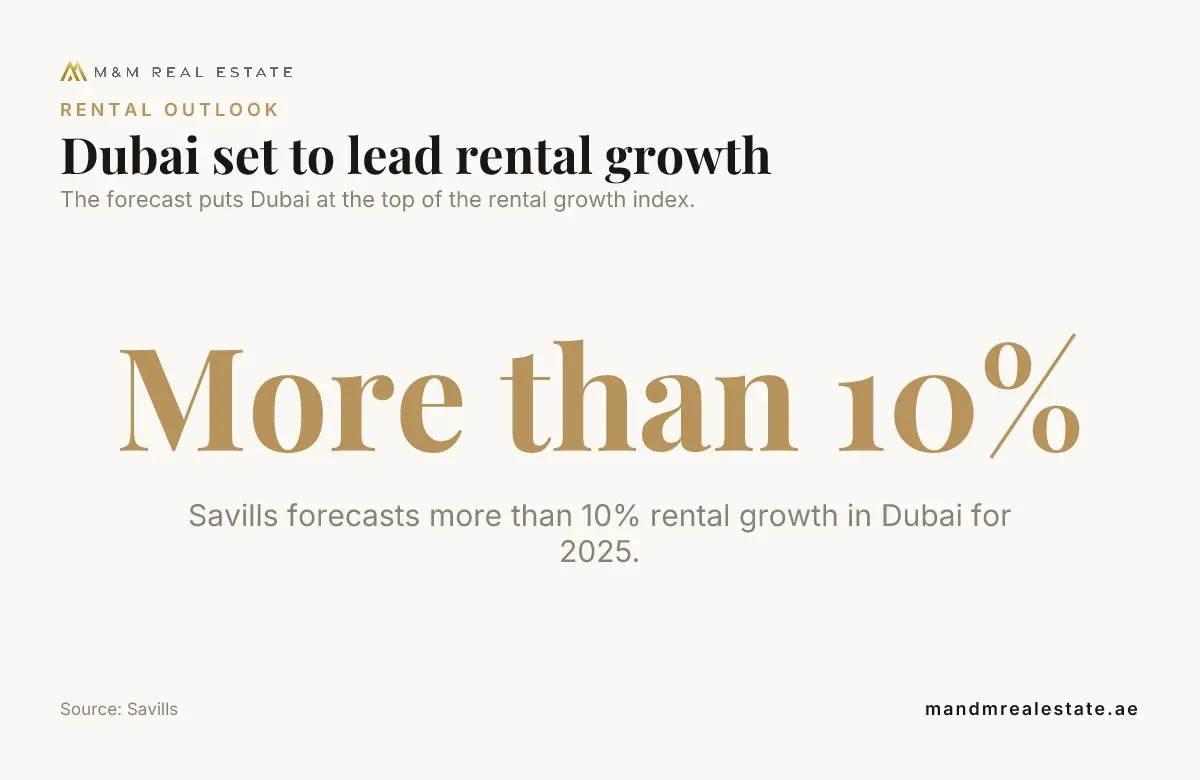
Savills forecast that Dubai would lead the index for rental growth in 2025, with a projected increase of more than 10%.
We look for alignment between the benchmark, the property’s letting prospects and its costs. A trend in one neighbourhood may not apply to another.
How to calculate net rental yield
Rental yield based on headline rent is a starting point. Net rental yield gives a more useful view of cash flow because it allows for vacancy, service charges, maintenance, management and other ownership costs.
Use this formula: net rental yield = annual rent after vacancy and operating costs ÷ property value × 100. Include costs that apply to your ownership and management arrangement, and keep financing costs separate if you want to compare the property before debt.
Worked example using your figures:
- Let annual rent be AED R and the vacancy allowance AED V: AED R - AED V = AED A (rent after vacancy).
- Let service charges be AED S, maintenance AED M and management costs AED G: AED S + AED M + AED G = AED C (total operating costs).
- Net rental income: AED A - AED C = AED N.
- At a property value of AED P: AED N ÷ AED P × 100 = net rental yield.
The example shows why a rental benchmark alone cannot tell you whether a property fits your return target. We also consider tax and ownership costs, which we explain in our guide to tax on Dubai property.
Rental yield and ownership costs both belong in a complete cash-flow assessment.
Using index evidence to review a property or portfolio
Portfolio benchmarking helps you compare each property against its own rental assumptions, costs and local conditions. If the benchmark moves while achieved rent, occupancy or expenses do not, investigate the difference before changing your investment plan.
When deciding whether to hold or sell, assess net cash flow, likely leasing conditions, maintenance needs and resale prospects together. The index can inform the rental side of that review, but it cannot establish a property’s sale value or forecast total return.
New-build and off-plan decisions need particular care because a rental benchmark for an established property cannot prove what an unfinished unit will earn after completion. We compare the purchase case, delivery stage and eventual letting assumptions in our off-plan property guide.
For completed rental stock, investors can also compare current Dubai property opportunities with the longer-term plan, while keeping future rent assumptions distinct from income already supported by a tenancy.
Residency eligibility is a separate consideration from rental yield. Our guide to the Dubai Golden Visa through property covers that investor question without treating it as evidence of rental performance.
We bring these checks together as an investment advisory, not as a single-index verdict. The rental benchmark is useful when it sharpens a real comparison; it is noise when it replaces property-level analysis.
The Dubai Rental Index can help investors assess rental benchmarks, renewal decisions and portfolio assumptions. It cannot forecast achievable rent, guarantee occupancy or replace a net-yield calculation.
We recommend a clear process: compare like with like, use current DLD and RERA guidance for contract questions, then test the property’s income after costs. Used this way, Dubai’s rental index is a practical part of an investment decision, not the decision itself.
Does the Dubai Rental Index show whether a tenant will pay on time?
No. A rental benchmark does not assess an individual tenant’s payment history or financial position. Investors need separate tenant screening and lease-management processes to assess that operational risk.
Can I use the Dubai Rental Index to price a short-term holiday let?
An annual tenancy benchmark is not a direct pricing tool for short stays. Short-term income depends on its own booking patterns, operating costs and applicable permissions, so assess it separately from long-lease comparisons.
Does a rental index include service charges?
No. The index is a rent benchmark, not a measure of net income; include service charges and other costs in your yield calculation.
Can I use the index as the rental figure for a refinancing application?
A lender may use its own valuation and underwriting criteria. Provide the property’s actual lease and financial position separately.
How often should an investor review rental-index information?
Review it when assessing an acquisition, preparing for a lease renewal or revisiting a portfolio assumption. A review is most useful when you compare the benchmark with current property-level evidence and your latest ownership costs.
What is a good rental yield in Dubai?
A good rental yield depends on the property’s costs, vacancy risk, location and your investment goals, so there is no single figure that suits every investor. Compare net yield after operating costs with the risks and returns of alternative investments.
Is rental property a good investment in Dubai?
Rental property can be a good investment in Dubai when tenant demand supports the expected rent and the income remains attractive after vacancy and ownership costs. Assess the specific property’s leasing prospects, cash flow, resale potential and risks rather than relying on the rental index alone.


