


Dubai property ROI is not a single figure that answers every investment question. The right measure depends on whether we are assessing rental income, cash flow or performance across the full holding period.
- Gross rental yield compares rent with the property price, while net yield and cap rate account for operating costs.
- Cash-on-cash return compares cash flow after debt service with the cash the investor contributed.
- IRR helps assess dated cash flows across a holding period, including the eventual sale.
- Consistent comparisons use the same cost denominator, return period and treatment of financing for each property.
- Rental assumptions should reflect comparable properties, vacancy, service charges and other operating costs, not asking rents alone.
- Our Dubai investment guides and resources help investors frame the questions behind a return estimate.
Choose the measure that fits your investment question
Start by asking what decision the calculation needs to support. A rental-income assessment, a mortgage cash-flow review and a comparison of multi-year investment performance each call for a different measure.
Gross rental yield compares rent with the property price before operating costs. It is a quick way to compare headline rent against purchase price, but it does not show how much income remains after service charges, management, maintenance or vacancy.
Net yield subtracts recurring operating expenses from rental income before comparing the remaining income with the property price. The term cap rate is commonly used for net operating income divided by a property’s value, before financing costs; it helps compare property performance without mortgage payments distorting the result.
Neither gross nor net yield captures every acquisition cost or the eventual resale outcome. They focus on income from the property, not the full result of buying, holding and selling it.
Cash-on-cash return answers a different question: how much annual cash flow remains after operating costs and debt service compared with the cash the investor contributed? Return on equity looks at performance against current equity, so the calculation should state how that equity is defined, including how the mortgage balance is treated.
Internal rate of return (IRR) is useful when the timing of cash flows matters. It considers when the investor pays for the property, receives rent and sells, rather than reducing the whole holding period to a single rental-yield figure.
When we compare properties, we keep the denominator, return period and financing treatment consistent.
Move from headline rent to net operating income
Begin with rent supported by comparable properties in a similar location, of a similar type and condition, and let under a similar strategy. Asking rents are evidence to test, not proof of the rent a landlord will achieve.
Then allow for vacancy and possible rent changes. Subtract recurring costs such as service charges, property management, maintenance and insurance to estimate net operating income (NOI), the income available before financing and income tax considerations.
Keep acquisition costs separate from recurring expenses. Transfer, registration, agency and financing fees affect the total amount invested and the return on that investment; they do not form part of the same recurring operating-cost calculation as maintenance or management.
Our Dubai rental-return guidance explains net rental yield and recurring operating costs, making it a useful companion when moving from headline rent to an estimate of income after expenses.
For a worked illustration, How Dubai Property Crowdfunding Works: Shares, Returns and Risks includes a hypothetical net cash return example; its figures are illustrative, not a forecast for a specific property.
That calculation shows how costs change the income figure before any mortgage or resale is considered. For Dubai property, our rental-yield analysis also covers gross returns, costs and tax.
Test rent and costs against the property’s location and strategy
Compare like with like. A furnished apartment in good condition let on a long-term basis is not a direct rental comparable for an unfurnished home, a property needing work or a short-term rental, so adjust the assumptions to reflect those differences.
Location and property type should match the investment objective. A rent-led assessment may favour a different balance of entry cost, achievable rent and ongoing expenses than an appreciation-led assessment; neither objective can be read from a neighbourhood label alone.
Use a less favourable case as well as a central estimate. Reduce achievable rent or occupancy, then test higher service charges and maintenance costs to see which assumption has the greatest effect on net income.
Our area-selection guidance helps investors relate neighbourhood choice to their investment goal, alongside our off-plan guide for readers comparing rental strategies and purchase stages.
Investors can also use our Dubai location guidance to examine neighbourhood choices in context. Keep projected rent growth and capital appreciation as assumptions in a scenario, not as assured parts of a return calculation.
Market context can help frame a question, but it cannot predict the rent or future value of an individual property. Use market figures as context, not as a substitute for checking comparable properties and costs.
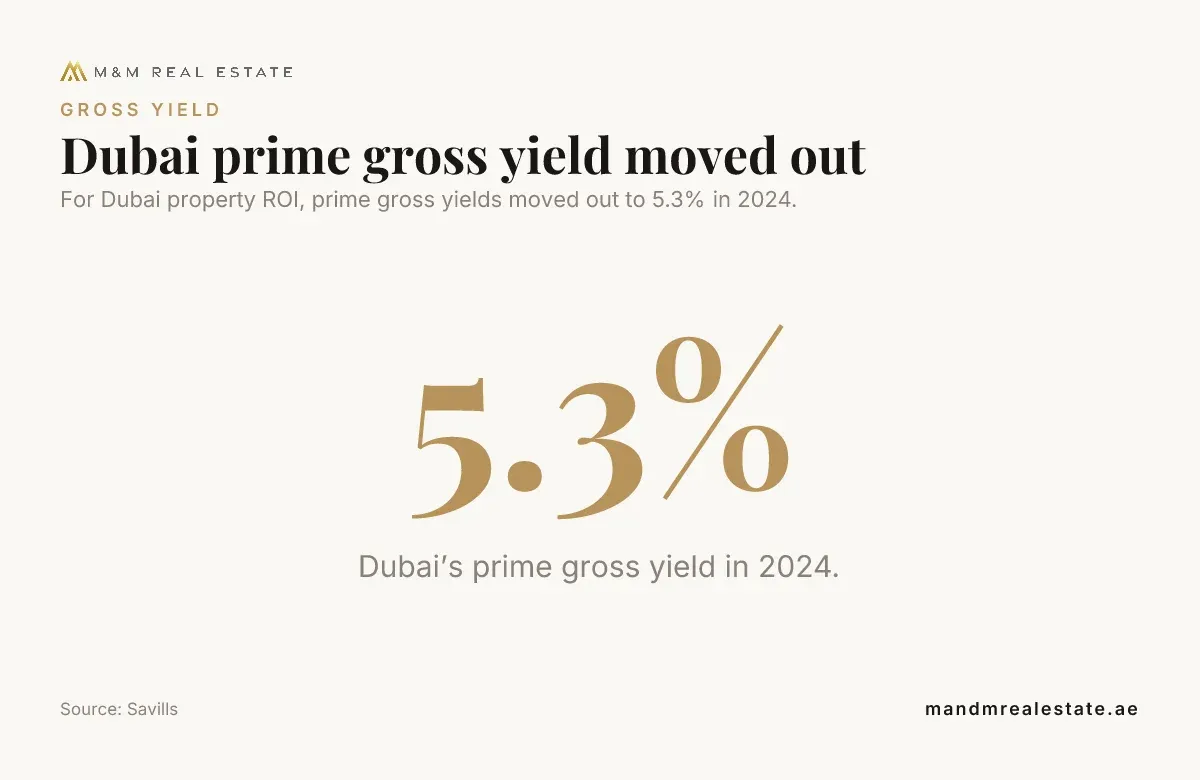
Source: Savills research covering 2024, Savills.
Area-level context should sharpen the questions you ask, not replace property-level analysis. Check that the rent evidence, property condition, rental strategy and cost assumptions all describe the same type of investment.
Foreign capital is hesitating. The 3.9 million people inside the UAE have not. The asymmetry that defines 2026, and what it tells you to do about it.
Download free→Separate mortgage cash flow from return on equity
For cash-on-cash return, compare cash left after operating expenses and debt service with the investor’s cash contribution over the same period. State which costs form part of the cash invested so the denominator is clear.
Separate mortgage interest from principal. Interest is a financing cost; principal repayment reduces cash flow but increases the owner’s equity by reducing the outstanding debt.
Return on equity answers a current-equity question, not the same question as yield on the original purchase price. Define equity in the calculation, for example by stating whether it means current property value less the remaining mortgage balance, and use that definition consistently.
Compare leveraged and unleveraged cases separately. Borrowing can amplify gains and losses, so a higher cash-on-cash figure does not by itself mean a stronger or safer investment.
Our property-based residency guidance covers a separate consideration for some investors. Keep residency eligibility outside the property return calculation unless you are explicitly assessing it as an additional objective.
Our wider investment guidance sits alongside the Bay Estate property investment case for readers considering an asset and its equity position.
Include appreciation, resale costs and the full holding period
Annual rent is only part of the result when the investment includes a future sale. A holding-period estimate combines rental cash flows with expected resale proceeds, then deducts selling costs and any mortgage balance still outstanding at sale.
Use IRR when timing matters. It treats the initial payment, rent receipts and sale proceeds as cash flows at different points in time, which makes it more informative than a single annual yield for a multi-year investment assessment.
Keep capital appreciation visible as a scenario assumption. Show the rent, operating costs, resale price, selling expenses and any remaining debt separately so the reader can see which assumptions drive the projected result.
Compare off-plan and completed properties over the same holding period. Include the timing of instalments, handover, rental income and sale rather than comparing an advertised yield for a completed home with a projected price gain for a property still under construction.
Our crowdfunding guidance separates rental income from capital appreciation and cautions against relying on headline advertised yield. For a closer look at the stages involved, see our Dubai off-plan property information and consider how the intended resale point affects the whole calculation.
Developer and delivery considerations also shape the timing assumptions in an off-plan scenario. Our developer information is useful background when assessing a project’s expected delivery and its place in a wider investment plan.
Compare estimates with a consistent stress test
Run each property through the same assumptions for rent evidence, vacancy, operating expenses, financing and resale. Before comparing results, decide which measure answers the decision: net yield for unleveraged income, cash-on-cash return for leveraged cash flow or IRR for cash flows across a holding period.
Test a less favourable case by reducing achievable rent or occupancy and increasing relevant expenses. Note which change has the greatest effect on net operating income or cash available after debt service, then judge whether that sensitivity fits your investment plan.
Do not compare gross yield for one property with net yield or cash-on-cash return for another. State whether acquisition costs and debt service are included, and keep the calculation period consistent so the comparison remains useful.
A stress test is a decision aid, not a promise. A property’s likely return depends on its specific income, expenses, financing and eventual holding-period outcome.
See also: What Investors Need to Know About Tax on Dubai Property.
Dubai property ROI becomes useful when the measure matches the question. Use gross yield for a headline rent comparison, net yield or cap rate for income after operating costs, cash-on-cash return for leveraged cash flow and IRR for dated cash flows across a holding period.
We keep the assumptions visible, separate operating costs from acquisition costs, and test rent, vacancy, financing and resale on a consistent basis. That is how an investor can compare properties with less noise and make a decision grounded in the return they actually want to assess.

What counts as a good property ROI in Dubai?
There is no single return threshold that suits every investor or property. Set a required return against your own investment objectives, time horizon and alternatives, then judge whether the assumptions behind the estimate support that requirement.
How often should I update a Dubai property return estimate?
Refresh the estimate when a material input changes, such as a lease renewal, revised service-charge budget, financing adjustment or significant repair. Keep the previous assumptions beside the new ones so you can see which changes altered the result.
How can exchange-rate movements affect ROI for an overseas investor?
Exchange-rate changes can alter the value of rental income and resale proceeds when converted into the investor’s home currency, even if the property performs as expected in AED. Compare the return in both AED and your reporting currency, and include conversion costs that apply to your own transfers.
Is IRR useful if I do not yet know when I will sell the property?
Yes, as a scenario tool: calculate IRR using different possible exit timings and sale assumptions. Without an assumed sale date and proceeds, IRR can describe the cash flows modelled so far, but it cannot represent a complete realised holding-period result.
How should I account for replacing furniture in a rental property?
Separate furniture replacement from routine repairs and include it as a planned capital expense in the cash-flow model. This helps distinguish the property’s operating performance from the additional cash needed to maintain its rental standard.
Can a projected property IRR be negative?
Yes. A model can show a negative IRR when its assumed cash outflows and sale proceeds produce an overall loss across the period being assessed.
Which property in Dubai offers the best return on investment (ROI)?
There is no single property type or neighbourhood that guarantees the best ROI. The strongest option depends on achievable rent, purchase price, operating costs, financing, resale prospects and your investment objective, so compare like-for-like properties using the same return measure and assumptions.


