


When we analyse Dubai property transactions, we separate sales volume from total sales value before drawing conclusions about market activity. The two measures answer different questions, and neither tells the full story alone.
- Sales volume counts registered sales; sales value adds up the recorded value of those sales.
- Compare like-for-like periods using the same sales categories, property types and reporting dates.
- Keep sales separate from mortgages, gifts, leases and other registered procedures.
- Break out off-plan, ready and secondary-market sales rather than combining them without explanation.
- Use median transaction value and price per square foot alongside the average to understand a typical sale.
- Use our Dubai investment resources to put transaction activity alongside other evidence about an investment.
Define volume and value before comparing periods
Sales volume is the number of sales recorded in a defined dataset and period. Sales value is the combined value of those sales. A transaction count describes how many registered sales occurred; a total value describes the monetary scale of that activity.
Those figures can move in different directions. A higher count can coincide with lower total value if the sales mix shifts towards lower-priced homes, while a smaller number of high-value transactions can lift total value without a rise in the number of deals.
Before making a comparison, we define what each figure includes. A report labelled “transactions” may include registrations other than sales, so its total can include more than sales volume or sales value.
A useful starting point is the Dubai Land Department’s 2024 year-end report, which recorded 226,000 real estate transactions with a combined value of AED 761 billion. Those figures cover the reported real estate transaction total, so they should not be presented as a sales-only count unless the selected records are restricted to sales.
Match time periods and compare the same dataset
Compare a month with the same month in another year, or a quarter with its equivalent in another year. Keep the start and end dates, transaction categories and reporting basis consistent; otherwise, a change in coverage can look like a change in the market.
Use the same source and filters for both periods. If one total includes sales across all property types and another covers residential sales only, the difference reflects both sales activity and the change in coverage.
For one worked example, the Dubai Land Department’s report for 2024 gives 226,000 real estate transactions and AED 761 billion in combined value. This calculation illustrates the average across that broad reported total, not a sales-only average.
- Step one: The Dubai Land Department’s 2024 report gives a combined value of AED 761 billion, or AED 761,000,000,000. Source: Dubai Land Department.
- Step two: The same DLD report for 2024 records 226,000 real estate transactions. Source: Dubai Land Department.
- Step three: Using those DLD figures for 2024, AED 761,000,000,000 ÷ 226,000 = AED 3,367,256.64 per transaction, rounded to two decimal places. Source: Dubai Land Department.
This average is useful only with its scope attached. The average can differ from a typical sale when the count includes different kinds of registered events or a small number of high-value records heavily influences the result.
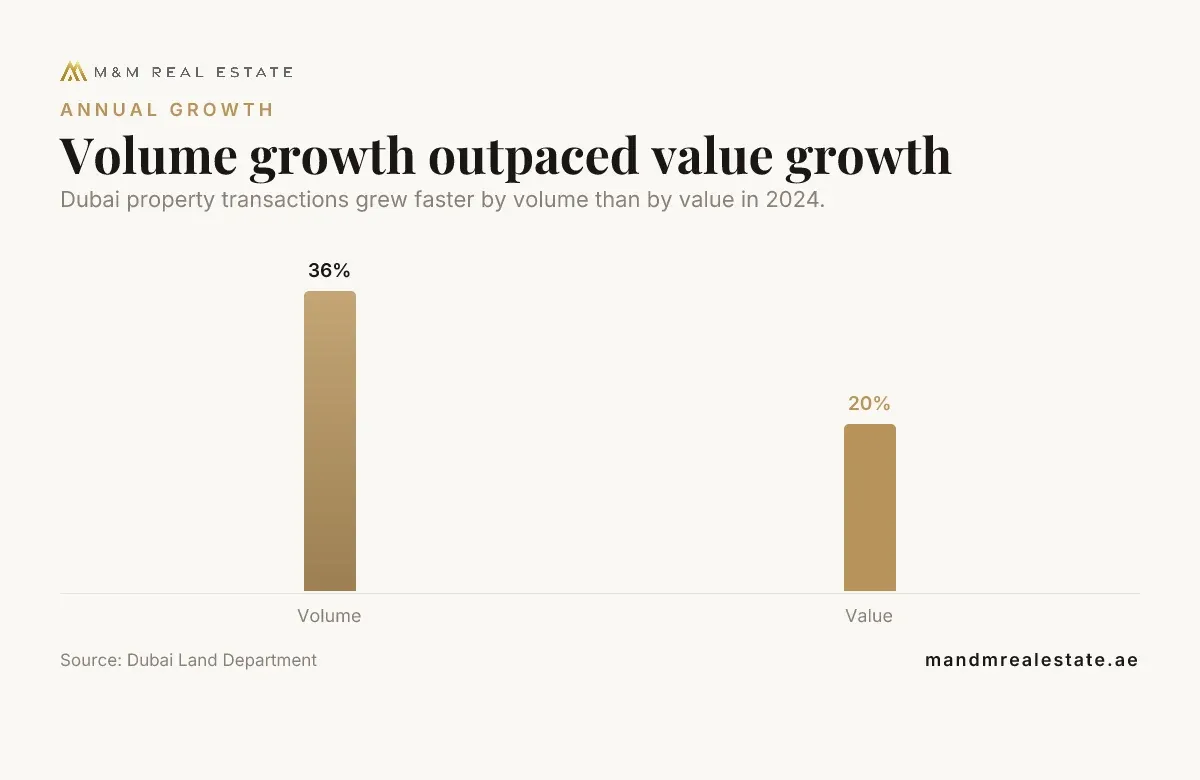
Source: Dubai Land Department data for 2024.
Keep sales separate from mortgages, gifts and leases
DLD transaction data can cover different registered procedures. A sale transfers ownership for consideration, a mortgage registration records a loan secured against property, a gift transfer records an ownership transfer without a conventional sale, and a lease records a rental arrangement.
These records should not be added together when the question is how many properties sold or how much those sales were worth. Select the sale category, then apply consistent filters for property type, area and registration period.
Also check what a record represents. A row in an export may represent a registered event or an individual unit rather than one distinct commercial deal. A portfolio or bulk registration may cover several properties, so inspect the record structure before interpreting a row count as a count of buyers or negotiations.
The registration date can differ from the date a buyer and seller agreed the sale. DLD transaction reporting captures the formal registration event, so the date shown reflects registration rather than necessarily the date of the original agreement.
Compare off-plan, ready and secondary-market sales separately
Off-plan property is sold before completion, while ready property is complete. A secondary-market sale is a resale between owners; it is not simply another name for a ready-property sale, because completed homes can also be sold by a developer.
Separate these categories before comparing total value or transaction count. Differences in completion status and sales channel can change the mix of recorded deals, even when like-for-like prices have not moved.
For a closer look at the buying process and market stages, read our off-plan guide. When assessing a particular project, compare its transaction category with the segment you are using as a benchmark, and consider the developer’s profile through our Dubai developer directory.
A rising off-plan share can lift the number of sales without producing the same change in total value as a ready-property segment, or the reverse. We keep each segment visible rather than hiding a change in composition inside one headline total.
Twelve chapters on what the regional war tested, the balance sheet and dollar peg behind the market, and how to pick the right side of this cycle.
Download free→Use median value and price per square foot to assess typical sales
Average transaction value is the total sales value divided by the number of sales. It is easy to calculate, but high-value outliers and shifts in property mix can pull it away from what most buyers paid.
The median transaction value is the middle sale when transactions are ordered from lowest to highest. It is often more useful when a small number of unusually expensive properties would distort the average, although it still needs a defined area, property type and reporting period.
Price per square foot offers another comparison, but it does not remove every difference between properties. Match the property type, area boundary, floor-area basis and sale stage; compare completed sales with completed sales rather than blending registered sale prices with asking prices or developer launch prices.
Asking prices show what sellers request, not what buyers paid in completed transactions. Use them to understand current competition, not as a substitute for registered sale prices when calculating transaction value or a sold-price benchmark.
Read area and property-type mix before drawing conclusions
Dubai-wide totals can shift because more deals take place in one area, property type or price band than before. That can raise total value and average transaction value even if like-for-like prices in each segment have not changed.
Break the figures down by area and property type, then compare equivalent groups across matching periods. If the focus is a shortlist of neighbourhoods, our Dubai area guides and area comparison guide provide context for deciding which local measures to examine.
For a simple decomposition, write total value as transaction count multiplied by average transaction value. First measure how much the count changed while holding the earlier average constant; then measure the change in average value using the later count. This separates the count effect from the combined effect of deal size and mix, without claiming that average value alone proves prices rose or fell.
For a fair comparison, keep a clear note of the area boundary used. A district name, community label and broader administrative area may not describe the same set of properties.
Use a source and coverage checklist
Before comparing DLD figures with a report from another source, match the definitions and coverage. Start with the measure itself, not the headline.
- Measure: Does the figure count sales, all registrations, or monetary value?
- Category: Are mortgages, gifts, leases and other procedures excluded from sales totals?
- Period: Do both figures cover the same dates, and do they use the same registration-date basis?
- Segment: Are off-plan, ready and secondary-market transactions separated in the same way?
- Property and area: Do the records cover matching property types and geographic boundaries?
- Record unit: Does a row represent a sale, a property or a broader transfer?
If a report does not make these points clear, do not compare its headline total directly with a differently defined figure. Keep the two measures separate until their scope matches.
Put transaction activity alongside the wider investment case
Sales activity can inform a Dubai property investment decision, but it does not measure rental income, ownership costs or residency eligibility.
For rental performance, consider the distinction between a sale price and rental income in our guide to Dubai rental yields. For ownership costs, see our guide to tax on Dubai property.
For questions beyond market activity, our Dubai Golden Visa property guide covers the residency topic separately. Keep those considerations distinct from what transaction records say about completed sales.
See also: Off Plan Properties in Dubai.
To interpret Dubai property transactions clearly, separate the number of registered sales from their combined value, then check the period, categories, property mix and registration basis. A count tells you how many sales were recorded; total value tells you their aggregate monetary scale.
Our advice is simple: compare like with like, use median and price-per-square-foot measures to test the typical sale, and treat every headline as one part of the evidence.
Are Dubai property prices coming down?
Transaction volume and total sales value alone cannot establish whether prices are falling. To assess price direction, compare completed sales within the same property type and area, and use a consistent price measure rather than relying on an aggregate transaction total.
Does sales volume count unique properties or registered sale events?
For an asset count, group records by property rather than counting each sale event.
Do off-plan bookings count as registered sales?
Count a reservation or booking as a registered sale only when it is recorded under the relevant sales category; keep expressions of interest and bookings distinct from registered transactions.
Can I compare apartment and villa price per square foot directly?
Use care: the property types can differ in layout, land component and measurement basis. A more meaningful comparison matches the property type and floor-area convention, then reports each segment separately.
Why might two reports show different DLD transaction totals for the same period?
Different filters, category definitions, area boundaries or registration-date cut-offs can produce different totals from the same underlying records. Compare those settings first, then decide whether the figures cover equivalent activity.


