


In Dubai’s hot climate, much of daily life happens indoors, so air is the health feature buyers should examine first in an apartment. When assessing indoor air quality in Dubai apartments, check the filtration grade, fresh-air rates, indoor monitoring and materials before you commit.
- Ask for the air specifications. Check for MERV 13+ filtration, documented fresh-air rates and indoor air monitoring. Explore the M&M wellness real estate hub for the wider buyer lens.
- Look beyond amenities. A spa, gym or yoga deck can support wellbeing, while air, water, daylight, acoustics and materials are design features to verify.
- Separate design from proof. Ask which certificate a project holds and whether it is achieved, pre-certified or registered.
- Check how the building operates. Ask about ventilation, filters, shared HVAC maintenance and who responds to recurring odours or moisture.
- Use sensors as one part of an assessment. Readings need context, including occupancy, ventilation, outdoor conditions, location and sampling time.
- Keep project claims in perspective. Eywa and Maravelle offer market examples of published design features. Confirm prices, availability and handover dates with the developer.
Why indoor air belongs at the top of a wellness checklist
Air is a daily health feature because residents spend so much time inside their homes. In an apartment, indoor air quality depends on the way fresh air enters, how air moves through the HVAC system, what the filters capture and what materials release into the rooms.
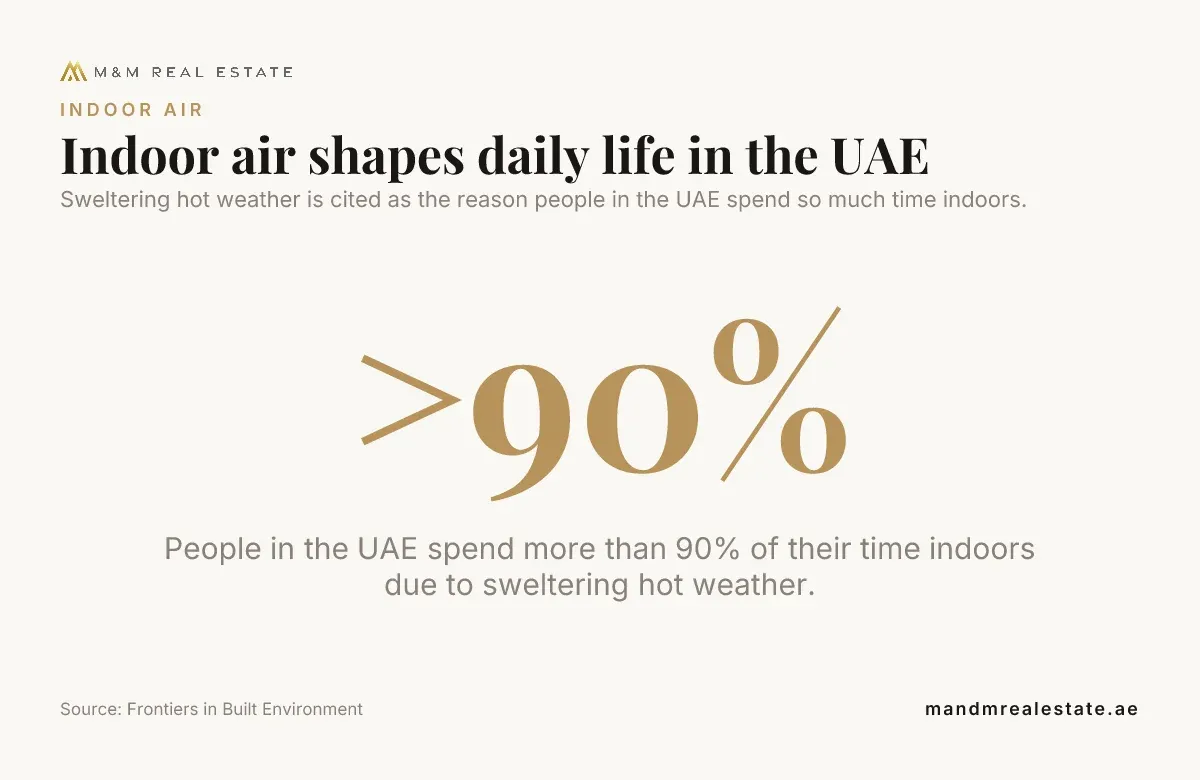
Sweltering hot weather is cited as the reason people in the UAE spend so much time indoors.
Source: Frontiers in Built Environment, 2021
Our buyer-first view separates health design from an amenity list. Filtration and air monitoring, water purification, daylight and circadian lighting, acoustics, low-VOC materials, active design, green space and health services all belong in the conversation.
Amenities can add value to daily life, but they do not explain how a home is designed to support health. Ask for the specification behind each claim, and the certificate or project documentation that verifies it.
What to check in an apartment’s air design
Ask the developer for clear answers on four points: filtration, fresh air, monitoring and materials. Use MERV 13+ as a filtration benchmark, and request fresh-air rates and indoor air monitoring details.
- Air filtration: Ask which filter grade the system uses, where filters sit and how maintenance is managed. A published MERV grade makes the specification easier to assess.
- Fresh-air rates: Request the design rate and ask how fresh air reaches the apartment. A filter specification alone does not explain how ventilation works.
- Indoor air monitoring: Ask whether the building or apartment monitors indoor conditions, which measurements it tracks and how residents can access the results.
- Materials: Request information on low-VOC and non-toxic finishes, especially where new furnishings or renovation work may affect the indoor environment.
These checks help distinguish a written design commitment from a general wellness promise. Ask for the relevant specification, and keep the answer with your purchase documents.
Pollutants, ventilation and shared HVAC systems
For an apartment, the indoor pollutants buyers commonly ask about include dust, fine particulate matter, volatile organic compounds (VOCs), formaldehyde and biological contaminants such as mold spores. The source can be inside the home, in building materials or furnishings, or associated with a shared system or moisture concern.
Ventilation and air filtration do different jobs. Fresh-air provision supports air exchange, while filtration captures particles as air passes through a filter; neither measure removes every potential source of indoor pollutants.
New construction, furnishing and renovation can introduce new materials and finishes. Ask what low-emission materials the project specifies, how the building manages ventilation and what steps follow after installation or maintenance work.
If you notice a recurring odour or moisture concern, record where and when it happens, whether the HVAC system is running and whether other residents report a similar issue. These observations help target an assessment, while the observation alone does not identify a specific pollutant.
When a possible source involves shared HVAC equipment, contact property management with a concise record of dates, locations and conditions. Ask about filter maintenance, ventilation settings and any recent work on shared equipment, then request a follow-up after the inspection or maintenance is complete.
What foreign buyers get wrong in Dubai off-plan, what each mistake costs, and exactly what to do instead.
Download free→How to test indoor air quality and interpret readings
Yes, there are ways to check indoor air quality. A buyer can review the building’s design specifications, ask about monitoring and arrange an indoor air quality assessment when the home or building needs closer investigation.
Air quality sensors can help residents track selected conditions, but a single reading does not describe the whole apartment. Choose a sensor by the measurements it reports, such as particulate matter, carbon dioxide, TVOC or humidity, then keep a record of the room, time and conditions alongside each reading.
Interpret readings in context. Occupancy, ventilation, outdoor conditions, the sensor’s location and the time of sampling can all affect what a measurement tells you about the home.
A professional assessment should begin with the concern and the spaces involved. Ask the assessor to explain the sampling plan, the pollutants or conditions being measured, the ventilation and HVAC conditions during sampling, and how the results will be interpreted.
After a suspected source has been removed or maintenance work has finished, retest under comparable conditions. Keeping the location, time, occupancy and ventilation conditions similar makes it easier to compare results.
Recurring odours, visible moisture or occupant concerns can help direct an assessment, but symptoms alone do not prove the presence of a particular pollutant. Share a clear log with the assessor or property manager so they can investigate the likely source rather than mask the smell.
Certificates and market examples of health design
Several standards can help buyers assess health-focused design. The WELL Building Standard and WELL Community Standard, Fitwel and LEED are standards buyers may encounter.
Dubai’s Al Sa’fat is another rating buyers may encounter. Ask which standard a project uses and what stage it has reached.
Ask whether a project’s certification is achieved, pre-certified or only registered, and request the relevant certificate.
Eywa is an example to ask about for its MERV 14+ air filtration.
Maravelle is another example to ask about for its ventilation. Treat these as design details to discuss with the developer, and confirm prices, availability and handover dates directly with the developer.
Use published project features to shape specific questions about the design and supporting documentation. For a wider view of health-led communities and buyer checks, see the free wellness real estate guide.
An 11-question checklist for buyers
Use these questions to assess health design alongside the rest of your purchase:
- Which certificate does the project hold? Ask whether WELL, Fitwel, LEED or Al Sa’fat is achieved, pre-certified or registered.
- What is the air specification? Request filtration grade, fresh-air rates and indoor air monitoring details.
- How is water filtered? Ask whether filtration operates at building or apartment level.
- How do light and sound perform? Ask about daylight, circadian lighting and acoustic ratings.
- Which materials are specified? Request details on low-VOC and non-toxic finishes.
- How much green space is planned? Ask about the share of the masterplan, trees and distance to the nearest park.
- Does the design support movement? Ask about trails.
- Who provides health services? Ask whether clinics or longevity programmes are planned and who will operate them.
- What does the service charge cover? Review the service-charge budget and ask what the wellness programme adds.
- How does the developer approach delivery? Review track record, escrow arrangements and the expected handover date.
- Does residency planning affect your choice? A completed home worth AED 1 million or more, paid in full and held with its title deed, can meet the property conditions for a renewable 5-year retirement visa for people aged 55 or over, subject to GDRFA conditions. Property worth AED 2 million or more can qualify for a renewable 10-year Golden Visa; off-plan property at that value can qualify subject to ICP’s current conditions. Read M&M’s property Golden Visa guide.
Indoor air is one part of a considered purchase. For broader due diligence, M&M readers can use the off-plan buying guide, the Dubai off-plan property overview, the developer directory and the Dubai and Abu Dhabi locations guide.
Investors weighing wider ownership questions can also read the Dubai real estate investment guide, the area comparison for Dubai, M&M’s rental and yield explainer and its property tax guide. The M&M resources library gathers further buyer material.
Indoor air quality in Dubai apartments deserves a place near the top of a buyer’s health-design checklist. Ask for filtration grade, fresh-air rates, indoor monitoring and low-emission material details, then review the certificate and its exact stage.
For clear next steps, start with the free wellness real estate guide. For a conversation with a real person about your wider purchase questions, contact an M&M advisor.
Where should I place an air quality sensor in my apartment?
Place it in a room where you spend time and keep it away from direct airflow, open windows and local sources such as cooking. Use the same position when comparing readings so that the location itself does not change the result.
Should I test every room in my apartment?
Choose rooms according to the concern, how each space is used and any differences in ventilation or materials. A professional assessor can help plan sampling across the areas most relevant to your observations.
Should the HVAC system run during an air quality assessment?
Tell the assessor how the system normally operates and follow the sampling plan they set. Record whether the HVAC was running, since that context helps explain the readings.
Can an outdoor air reading tell me what the air is like inside?
No single outdoor reading gives a complete picture of indoor air quality in a Dubai apartment. Indoor sources, ventilation, occupancy and the location of the sample also shape the result.
What should I send property management when I report an air concern?
Share the room, time, duration, odour or moisture observation, HVAC conditions and any recent maintenance or furnishing work. A concise record gives the building team a practical starting point for investigation.
How do I know if my indoor air quality is bad?
Warning signs can include recurring unpleasant odours, visible moisture or mold, or concerns that persist in a particular room. These observations do not identify a specific pollutant, so use them to guide an assessment and interpret sensor readings alongside ventilation, occupancy, location and sampling conditions.


