


When we assess Dubai townhouses, we judge how community facilities affect fit by testing them against the household’s real routines, access needs and preferred way of living. A long amenity list is no substitute for a playground, shop or fitness centre that people can reach and use comfortably.
- Start with routine. Give priority to facilities household members expect to use regularly, not features that sound appealing only occasionally.
- Test the route. Check shade, crossings, distance and whether a car is needed to reach parks, shops, schools and healthcare.
- Separate open from planned. Find out which facilities operate now, who can use them and what access or booking rules apply.
- Judge the home as well as the community. Shared facilities add options, but they do not replace suitable indoor space or a useful private garden or balcony.
- Compare consistently. Use the same categories for each community, including recreation, daily services, education, healthcare and transport.
- Keep price and facility fit distinct. Compare listing prices separately from the question of whether a community suits the household.
Start with the facilities your household will use
Begin with the household’s ordinary week. For children, consider their ages and the times they are likely to play outdoors; a shaded path and nearby play area can be more practical than a larger park that takes an awkward route or a drive to reach.
Compare pools, gyms and sports courts with the activities people actually enjoy and the hours they are free. A community pool or fitness centre is useful when residents can fit it into a regular routine, not only when they have time for an occasional visit.
A clubhouse or family lounge earns its place when it supports a real habit, such as meeting neighbours, gathering with relatives or spending time together outside the home. Private space counts too: a garden or balcony can make everyday outdoor use easy, while shared facilities add room for recreation and socialising.
Water-based recreation and outdoor activity feature prominently in DAMAC Islands, which makes it a useful example to assess against a household’s routine rather than an amenity count. The development offers 4-, 5-, 6- and 7-bedroom homes from 2207 sq.ft., with a listed price of AED 2,250,000.
The development’s described facilities include an aqua park, a waterfall lagoon, a fitness park and floating yoga decks, alongside features such as jungle swings and LED-lit gondola rides. Ask which of these activities match the household’s regular interests, and how much value residents would place on them alongside private outdoor space.
Trace the routes to parks, recreation and daily services
Map the walk from the front door to parks, playgrounds and recreation spaces. Note where shade falls, where roads must be crossed and whether paths connect directly, because a short distance on a map can still mean an inconvenient walk or a drive between parts of a master-planned community.
Separate facilities inside the community from nearby shops, supermarkets, cafés, pharmacies and healthcare. For each one, consider the actual route and likely mode of travel; a nearby service is not the same as one residents can reach easily on foot.
The route to schools and nurseries matters as much as the destination. Consider the household’s regular drop-offs, work journeys and public transport connectivity, including whether those routines depend on a car.
For anyone with mobility needs, walk or roll the route from accessible parking or drop-off areas to the facility entrance. Gradients, kerbs and crossing points can affect whether a space is genuinely usable, even when the entrance itself is accessible.
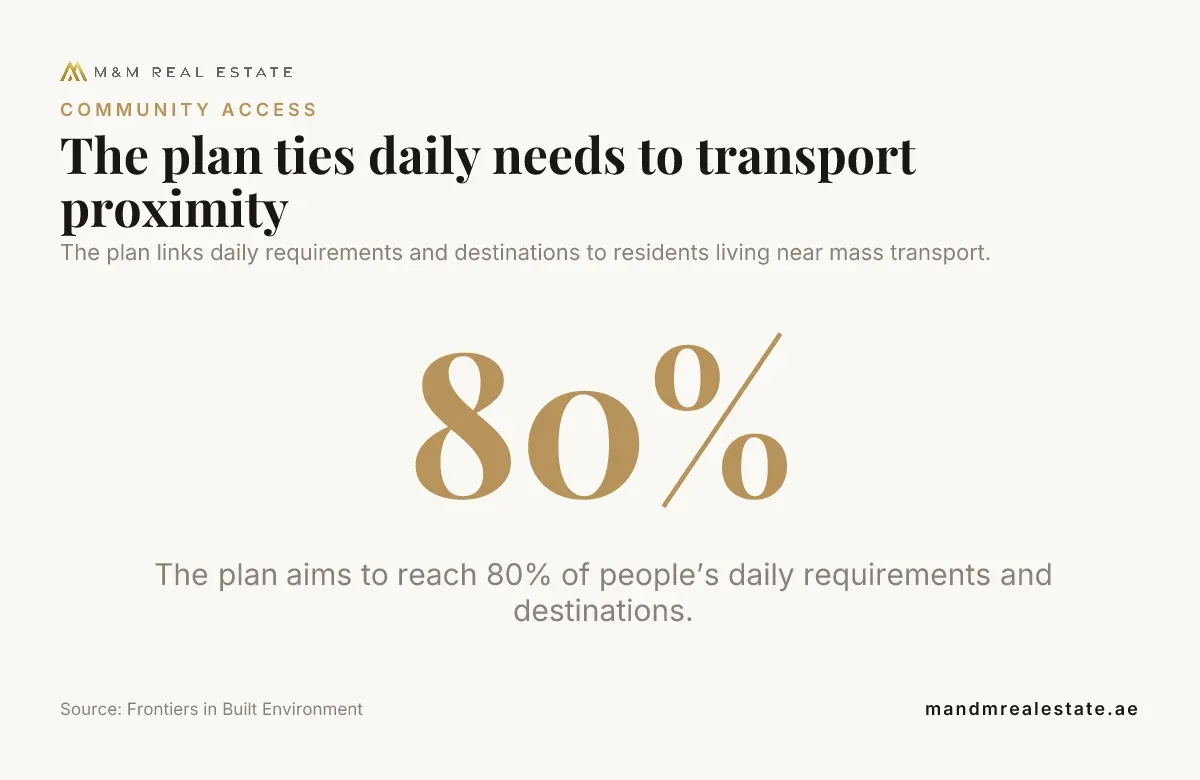
The graphic summarises a transport-planning relationship between daily needs and station access described in a 2026 Frontiers in Built Environment article.
Source: Frontiers in Built Environment
When comparing districts, use the same questions at each address rather than relying on a broad description of the area. M&M’s Dubai locations guide can help frame that comparison, but the household’s route from a specific home to a specific service is what determines day-to-day convenience.
Check what is open, maintained and accessible
Separate facilities that are completed and operating from those planned for a later development phase. If a household’s routine relies on a pool, play area or shop that is still planned, that gap changes the practical fit until the facility opens.
For an off-plan purchase, use our off-plan buying guide and browse off-plan properties in Dubai as starting points for phase and handover questions. Ask which facilities residents can use, whether access requires registration or a booking, and whether a membership or usage charge applies.
Check opening arrangements and maintenance in person where possible, or through reliable community information. A facility needs to be available at the hours the household can use it, and its condition should support the activity it is meant to serve.
Capacity matters as well as presence. A pool, gym or play area can be less useful at the times a household needs it if crowding makes it difficult to swim, exercise or play comfortably.
Jouri Hills is relevant when assessing how access and operation affect townhouse fit. Its described facilities include family lounges, a gymnasium, sauna, swimming pool, parks and gardens.
For a specific development, identify the named developer and assess the actual arrangements for residents rather than relying on a general description. M&M’s Dubai developer directory and its page for Dubai Properties can help with that initial identification.
Twelve chapters on what the regional war tested, the balance sheet and dollar peg behind the market, and how to pick the right side of this cycle.
Download free→Compare townhouse living with the household’s alternatives
Is it better to buy a townhouse or an apartment in Dubai? Neither property type wins for every household: compare the townhouse’s private space and layout with an apartment building’s shared facilities and access arrangements, then decide which matches daily needs.
A standalone villa usually gives the household more autonomy over its private outdoor space, while townhouse community living can add shared recreation and social spaces. The right balance depends on how much private garden space and control the household wants, and how often it would use communal facilities.
Bedrooms and living areas must suit the people who will use them and the way they work. A household that needs a dedicated workspace or separate areas for different routines should not expect a gym, lounge or pool to compensate for an unsuitable indoor layout.
Do not treat a broad amenity offer as proof of suitability or future property performance. Keep household fit separate from financial analysis: our guides to Dubai rental yields, Dubai property tax and Dubai property investment address separate ownership questions.
Use a household checklist to make the decision
List facilities by how often each household member expects to use them. Give frequent needs such as children’s play, exercise and daily shopping more weight than occasional extras that may add little to the weekly routine.
Then test the list against the household’s circumstances: children’s ages, mobility needs, work hours and reliance on a car. A facility is a stronger fit when its route, access arrangements and opening hours work with those constraints.
Compare each community using the same headings: private outdoor space, recreation, daily services, schools and nurseries, healthcare access and public transport. For each, note whether it is inside the community, nearby or reachable only by driving.
Keep facility fit separate from price comparisons; a price difference alone does not establish which community offers better facilities or value for a particular household.
That arithmetic compares two listed prices only; it does not establish that either community offers better facilities or better value for a particular household. For a wider location comparison, see our guide to Dubai areas by investment goal, and consider property and Golden Visa planning separately if residency is part of the household’s decision.
For a considered decision, keep the completed checklist, route notes and access questions together with the property details. Our Dubai property guides and resources offer further reading for the wider decision.
Community facilities affect a townhouse’s fit when they support the household’s everyday routines and remain practical to reach, access and use. Weigh shared recreation against the home’s own layout and outdoor space, then compare each community using the same household checklist.
Real fit comes from the route, the operating arrangements and the way residents will use the space. Judge those details alongside the property, not by the length of an amenity list.
Can guests use shared facilities in a Dubai townhouse community?
Guest access can involve visitor registration, resident accompaniment or separate parking arrangements. Ask whether visitors need advance approval and whether access is limited to particular facilities or times.
Do community rules affect whether residents can bring pets to shared outdoor areas?
Yes, community rules can set conditions for pets, including leash requirements, waste disposal and areas where animals are not permitted. Check the written rules for each shared space, as policies can differ across the community.
Can facilities in one phase be used by residents of another phase?
Access may depend on the community’s operating arrangements, not simply on how close a facility is to a home. Ask management to confirm which phases and resident groups can use each shared space.
How can a household reassess facility access when a community is still being built?
Keep a dated record of which facilities are planned, open or temporarily unavailable, and update it when the community issues formal operating notices. Revisit the assessment when the household’s move-in timing or routine changes.
Are shared facilities included in a townhouse community’s service charges?
Maintenance and resident access are not always the same cost: some activities, bookings or memberships may carry separate charges. Ask management to distinguish recurring community costs from optional, pay-per-use fees.
Can residents reserve a shared facility for a private gathering?
Some facilities may have separate rules for private events, including booking windows, guest limits or cleaning requirements. Ask for the event policy as well as the everyday access rules.
Which is the best townhouse community in Dubai?
There is no single best townhouse community for every household. The right choice depends on which facilities suit your routine, how easily you can reach them, and whether the home’s layout and private outdoor space meet your needs.
What are the key differences between a villa and a townhouse?
A villa is generally a standalone home, offering more separation and autonomy over its private outdoor space. A townhouse is typically attached to neighbouring homes and may be part of a community with shared facilities, so the balance of privacy, space and communal amenities differs.


