


Longevity real estate means homes that pair health-supporting design with health services. The UAE does not regulate the label, so buyers should judge a residence by its services, operator and any certificate.
- Look beyond the label. Check the home’s design features, health services, operator and any certificate.
- Separate design from amenities. A gym, spa or yoga deck can support a routine; indoor air, water, light, acoustics and accessible routes shape everyday living.
- Ask who provides care. For diagnostics or health monitoring, clarify clinical oversight, qualifications and how urgent concerns are handled.
- Check the evidence. Ask how a health benefit is measured and whether an independent body validates the relevant claims.
- Assess the full experience. Service charges, maintenance, accessibility and continuity of care all affect how well a home works over time.
- Use a practical test. Compare homes against your routines, mobility needs and plans for ageing in place, as well as their headline amenities.
What longevity real estate means
Longevity concerns both lifespan and healthspan, the years lived in good health. In housing, longevity-focused design aims to support comfort, healthy routines and independence across life stages.
Khaleej Times reports that longevity real estate is not a regulated label in the UAE. That leaves buyers with a clear test: examine what the home provides, who operates its services and what evidence or certificate supports its health claims.
A spa, gym or yoga deck offers amenities. A residence makes a broader health case when its physical design supports daily wellbeing and its services provide meaningful, well-managed support.
Healthy ageing matters to families, working residents and older adults alike. We assess longevity homes through everyday usability, not through the strength of a marketing phrase.
Design features that support everyday health
Residents experience indoor conditions day after day. Air filtration and air-quality monitoring, purified water, daylight, circadian lighting, acoustic comfort and non-toxic materials are practical features to examine closely.
In Dubai, indoor air quality and water use deserve particular attention alongside heat and the design of outdoor space. Sustainability and climate resilience support a home’s long-term health performance when residents can use its spaces comfortably through daily routines.
Age-friendly design also depends on the route through a home and community. Look for accessible layouts, adaptable spaces and step-free routes that can keep working as mobility, household needs or daily routines change.
Outside the home, walkability, trails and a high share of green space can make movement and time in nature part of ordinary life. Biophilic design and active design add value when residents can use them conveniently, rather than only on special occasions.
- Air: Ask about filtration grade, fresh-air rates and indoor air monitoring.
- Water: Find out whether filtration operates at building or unit level.
- Light and sound: Ask how the design provides daylight, circadian lighting and acoustic comfort.
- Materials: Look for low-VOC and non-toxic finishes.
- Movement and nature: Check green-space provision, trails, cycling links and the practical walk to a park.
How services and care fit into a residence
Recovery and fitness amenities can support regular routines. Contrast therapy, exercise spaces or a pool describe facilities; ongoing preventive care depends on the people and systems responsible for residents’ health needs.
For diagnostics, personalised care or health monitoring, ask who provides the service and what qualifications they hold. Find out who oversees clinical decisions, how urgent concerns are escalated and how residents can access external clinicians when appropriate.
Continuity matters as needs change. Ask how a service coordinates with other providers, what happens when a resident needs a different level of support, and who remains accountable for the resident experience.
Approach claimed health benefits as evidence questions. Ask what outcomes an intervention supports, how the provider measures them and whether an independent body has validated the relevant evidence.
Dubai examples: design, amenities and health services
Dubai’s examples show several ways longevity and wellness can enter residential life. The M&M wellness real estate hub includes a project map for readers comparing the local market.
Press reports dated 10 September 2025 describe Emerge Residences in Meydan launching with a longevity clubhouse offering contrast therapy, red light, cryotherapy and hyperbaric oxygen. It illustrates a recovery-focused amenity offer; buyers should assess health claims separately from the presence of facilities.
Press reports describe Eywa on the Dubai Water Canal as featuring MERV 14+ air filtration, low-EMF bedrooms, non-toxic materials and a health and longevity concierge. These features give buyers specific design and service points to examine.
Compare each example through its stated design measures, services and responsible operator. These are market examples, not a single standard;
Green space is the first thing Dubai’s wealthiest buyers look for. In 20 pages: what makes a home a wellness home, the WELL, Fitwel and LEED ratings that prove it, Dubai’s rated and longevity-led communities with starting prices, health design for a hot climate, the 55+ retirement visa and the 10-year Golden Visa, and the 11 questions to ask before you buy. Checked October 2026.
Download free→Technology, privacy and independent validation
Biometric monitoring and diagnostics can inform care when qualified people interpret the information appropriately. Technology or AI by itself does not establish improved health outcomes.
Before accepting data collection, ask what information the residence gathers, who owns it and who can access it. Clarify how residents give or withdraw consent and what privacy and cybersecurity protections apply.
Check who is responsible for health services and what evidence supports advertised interventions. For a certificate, ask which standard applies, whether it is achieved, pre-certified or registered, and how its scope relates to the features residents will use.
Certification can contribute evidence about defined criteria. Day-to-day usability, service quality and operator accountability remain essential parts of the assessment.
Dubai’s longevity framework and the evolving market
Dubai has created a Longevity Authority to license what comes next.
Buyers can assess each property’s own services, usability and ongoing costs.
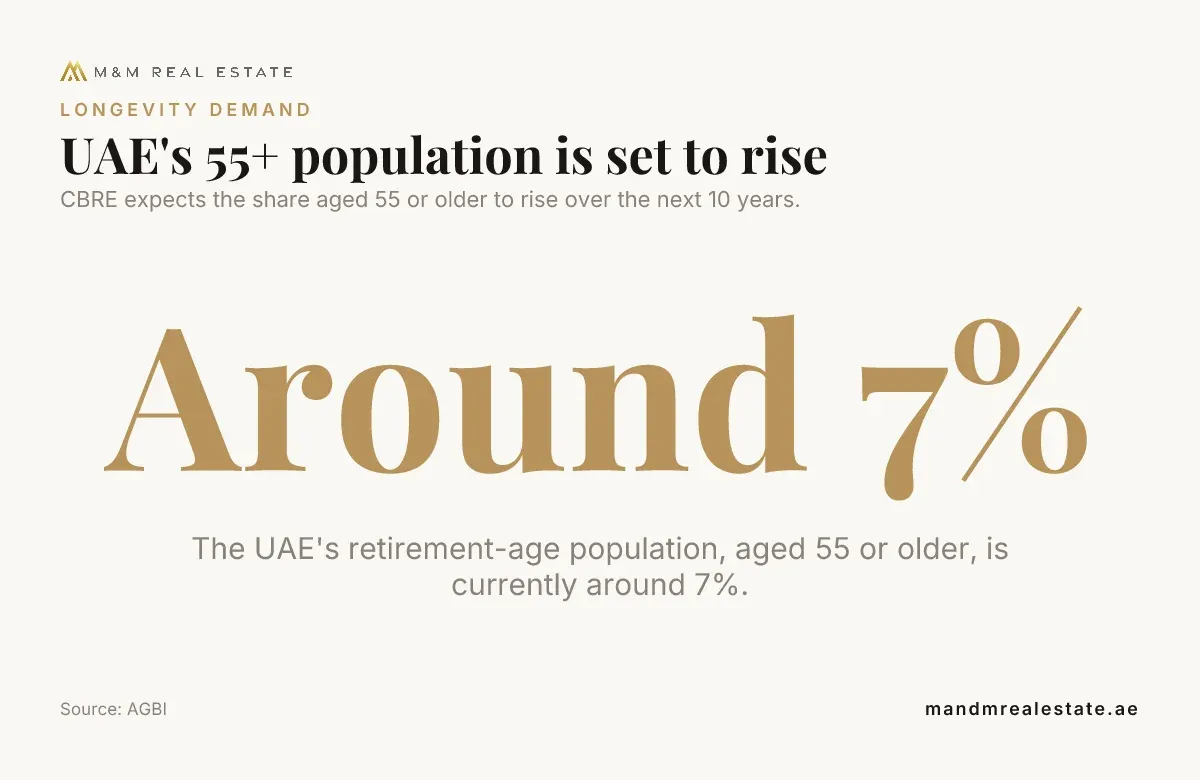
CBRE expects the UAE’s retirement-age population of 55 or older, currently around 7 percent, to rise over the next 10 years, according to AGBI’s December 2024 analysis.
Source: AGBI
The free Wellness Real Estate in Dubai report from M&M is a 22-page PDF on Dubai wellness real estate.
A developing longevity economy can shape residential services and investment models. For broader investment analysis, we also offer a Dubai real estate investment guide, a comparison of areas to consider in Dubai, and guides to rental strategy and yields and property tax considerations. Our property resources bring together further buyer information.
A practical buyer assessment
Use this 11-question checklist to compare the practical offer, the operator and the ongoing commitment.
- Which certificate applies? Ask whether the certificate is achieved, pre-certified or registered, and which standard it follows: WELL, Fitwel or LEED.
- How does the air system work? Ask about filtration grade, fresh-air rates and indoor air monitoring.
- Where is water filtered? Check whether purification operates at building level, within the unit or at both levels.
- How are light and sound addressed? Ask about daylight, circadian lighting and acoustic ratings.
- Which materials are specified? Ask for details on low-VOC and non-toxic finishes.
- How much green space is planned? Check the share of the masterplan, tree provision and distance to the nearest park. Compare neighbourhood access across the area.
- How easy is it to move around? Look for trails and cycling links, then consider access to everyday destinations.
- Who provides health services? Ask about clinics, longevity programmes, provider qualifications and the operator responsible for each service.
- What does the service charge fund? Review the RERA-approved budget and ask what the wellness programme adds, including maintenance and equipment costs.
- How will delivery be managed? Review the developer’s track record, escrow arrangements and handover date. Developer track records and purchase steps are covered in developer reviews, the off-plan buying guide and off-plan property information.
- Which residency route fits? Property-linked visa details are in M&M’s Dubai Golden Visa guide.
For the guide’s broader coverage of wellness ratings, communities, health design, visa pathways and questions to ask before buying, use the free Wellness Real Estate Guide. It gives buyers a structured starting point for comparing longevity living in Dubai.
See also: Locations.
Longevity real estate in Dubai is best assessed through the details residents experience: indoor conditions, accessible design, green space, qualified services and accountable operators. The city’s examples and policy framework create room for new approaches, while careful due diligence helps buyers separate practical support from broad claims.
Start with the free guide above. Then contact an M&M advisor for a conversation about your priorities. No noise, just a real person and a clear assessment.
What are the four pillars of longevity?
There is no single four-pillar formula for longevity homes. For a property decision, group the assessment into the indoor environment, movement and access to nature, health services, and adaptable design for independent living.
Can a longevity-focused home support health without collecting biometric data?
Yes. Building design, accessible routes, green space and well-managed services can support residents without biometric monitoring; data collection is a separate choice that requires clear consent and safeguards.
How often do home air-filtration and water-purification systems need maintenance?
Follow the equipment manufacturer’s service schedule and keep records of filter changes, inspections and system checks. The appropriate interval depends on the installed equipment and its operating conditions.
How can two residents with different mobility needs assess whether the same home will work for both?
Have both residents test the same routes, entrances, bathrooms, storage and shared facilities, including the path from the home to outdoor areas. Record each person’s current needs and likely adaptations so the comparison reflects both residents’ daily routines.
Can buyers assess a longevity home before its services begin?
Yes. Review the service scope, operator responsibilities, building specifications, maintenance commitments and service-charge budget before the home is occupied. After handover, compare the installed systems and delivered services with those documents.
What should residents ask if a health-service operator changes?
Ask how residents will receive notice, how continuity of care will be maintained and who will hold responsibility during the transition. Residents should also understand how any health records or personal data will be handled under the new arrangement.


