


Yes. GCC nationals may generally buy freehold property throughout Dubai; they are not limited to the designated areas for non-GCC foreign buyers. The property’s registered title still determines the interest and any restrictions attached to the specific unit.
- GCC nationals may generally buy freehold property across Dubai, not only in designated areas.
- Rules for non-GCC foreign buyers differ. Dubai Regulation No. 3 of 2006 identifies plots where they can acquire freehold ownership.
- Freehold, leasehold, usufruct and musataha describe different property interests. The sales description alone does not establish which one a buyer receives.
- A company wholly owned by GCC nationals may qualify under the ownership rules. A company with mixed ownership needs a separate eligibility check with the DLD.
- For an off-plan purchase, the buyer can follow the registration and payment steps in our Dubai off-plan property guide.
- Before choosing a property, match the buyer’s legal status to the title registered for the exact plot or unit.
GCC nationals and non-GCC buyers have different eligibility rules
Dubai’s ownership rules distinguish UAE nationals, GCC nationals and buyers from outside the GCC. The registered title and applicable eligibility rules determine what a buyer may own. A company’s ownership structure is relevant when assessing those rules.
Dubai’s Real Property Registration Law contains the ownership provision: GCC nationals may generally acquire freehold property across Dubai, while Dubai Regulation No. 3 of 2006 identifies designated plots where non-GCC foreign buyers may acquire freehold ownership and other property interests. This separates GCC eligibility from designated-area limits; it does not make every offered interest freehold, so verify the registered title for the exact property.
For a company, the ownership structure matters. A company wholly owned by GCC nationals may qualify under the GCC rule. When shareholders have mixed nationalities, the company should ask the DLD to confirm how it classifies the entity and which ownership interests it can register.
Dubai-wide eligibility answers who may own property. The title record answers what interest the buyer will hold. At M&M Real Estate, we help clients separate those questions when they compare Dubai real estate options.
Freehold areas and property titles answer different questions
Dubai classifies plots for property ownership, including designated freehold areas for non-GCC foreign buyers. A district name or area guide can help narrow a search, but it does not establish the title for each plot, building or unit within that district.
The distinction matters when an older area list, a sales description and a current title record use different terms. Use the property’s registered details to resolve the difference, then ask the DLD to confirm the classification and permitted interest for that specific unit.
Palm Jumeirah is one clearly described example: M&M’s Palm Jumeirah property information states that its units are freehold for buyers of any nationality. That area-specific example does not turn every district label into proof of a unit’s title. Treat the listing information as a guide, not proof for a specific unit; confirm the DLD title record.
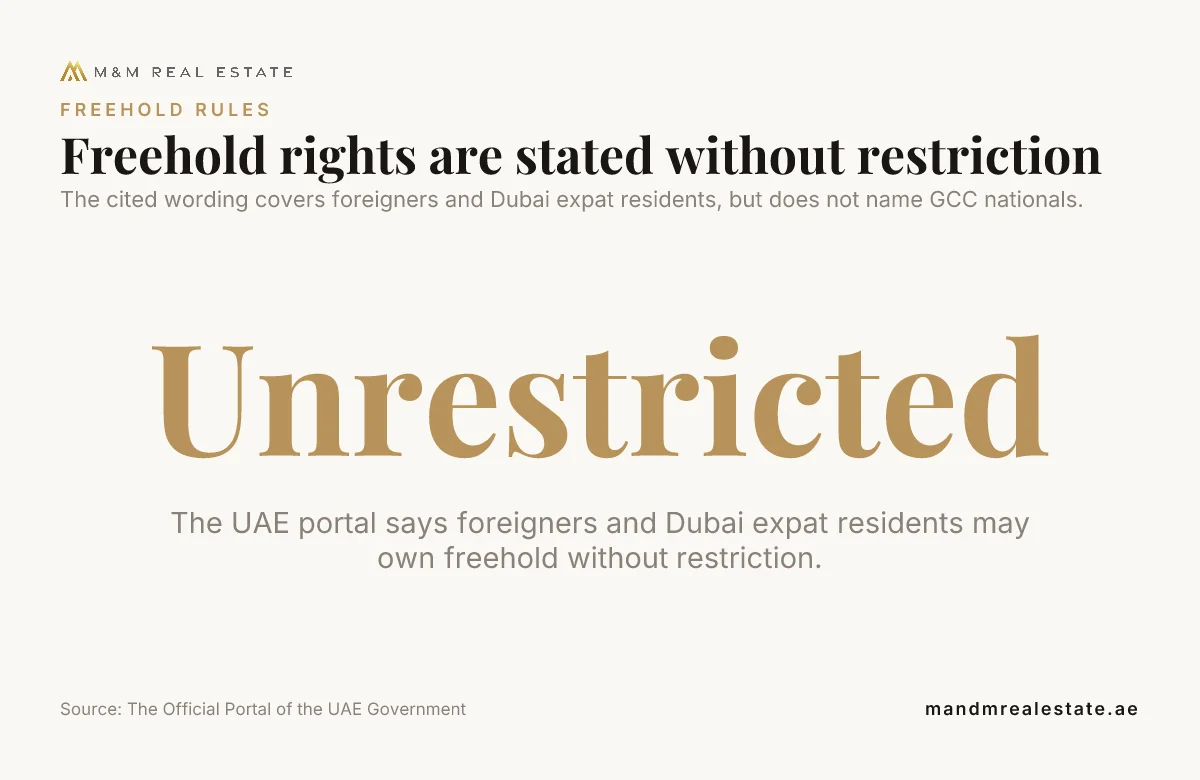
Source: The Official Portal of the UAE Government
The Government portal describes property interests available to foreign and expatriate residents. Dubai’s ownership rules also set eligibility by buyer status and plot, so read the property’s registered title alongside the area classification.
Freehold, leasehold, usufruct and musataha carry different rights
Freehold gives the registered owner a property title. The owner may sell, lease or transfer that interest, subject to the law and any rules applying to the property; changes to a building or unit may also need relevant approvals.
Leasehold gives the holder the right to use a property for a defined term under the registered lease. The Official Portal of the UAE Government states that foreigners and expatriate residents may acquire leasehold rights for up to 99 years in Dubai.
| Property interest | What it generally gives the holder | What to examine in the registered record |
|---|---|---|
| Freehold | Ownership of the property interest recorded in the title. | Owner’s name, plot or unit details, and any registered restrictions. |
| Leasehold | The right to use or occupy a property for the term in the lease. | Term, permitted use, transfer terms and any renewal provisions. |
| Usufruct | The right to use and benefit from property owned by another party. | Scope of use, term, permitted transfers and obligations. |
| Musataha | A registered right to build on or use land under agreed terms. | Development rights, term, maintenance duties and what happens when the term ends. |
These terms are not interchangeable. A leaseholder’s right to rent, transfer or alter a property depends on the registered agreement and applicable rules; the same applies to usufruct and musataha interests.
Twelve chapters on what the regional war tested, the balance sheet and dollar peg behind the market, and how to pick the right side of this cycle.
Download free→Ownership eligibility does not decide every right attached to a title
A GCC buyer can have broad eligibility to own property and still need to check the interest offered for a specific home. Freehold, leasehold, usufruct and musataha carry different rights over use, income, transfer and the property at the end of a term.
At the end of a fixed leasehold term, the leaseholder’s registered right ends. Renewal or other rights depend on the registered agreement, so read its expiry and renewal terms before committing.
For off-plan property, match the sale agreement to the registered project and unit. Oqood, the DLD’s off-plan registration, records the purchase before the final title deed is issued. For a mortgaged or off-plan property considered for a Golden Visa, confirm with the DLD.
This is general information, not tax or legal advice.
Check the registered title before signing
Use this process to verify eligibility and the rights attached to the property:
- Identify the buyer. Confirm whether the purchaser is an individual GCC citizen, a UAE national or a company. For a company, prepare its ownership and shareholder documents.
- Identify the exact property. Match the plot, building and unit details on the sale documents to the DLD record. A district-level label does not settle a unit’s classification.
- Read the registered interest. Check whether the record says freehold, leasehold, usufruct or musataha. Review the term and any conditions on use, transfer or alteration.
- Compare the documents. Check that the title deed or off-plan registration, sale agreement and developer’s description refer to the same property and interest.
- Resolve differences with the registry. If an area list or marketing description differs from the registered record, ask the DLD to confirm the current classification and the buyer’s eligibility in writing.
For Jumeirah Village Circle and Dubai Hills Estate, the area guides can help with location research. Use the DLD record for the separate question of ownership classification.
Assess the investment after confirming the title
Legal eligibility answers whether the buyer can own the property. It does not establish whether the price, rent, costs or payment schedule fit an investment plan. We advise clients to review the title and the numbers as separate parts of the decision.
For area comparisons, use our guides to Dubai neighbourhoods and areas matched to investment goals. Our Dubai rental yield guide explains how rent figures relate to costs, while our population growth analysis gives further context on demand.
For project-level checks, compare developer records and project information. The Bay Estate Investment Case and The Yards Plaza Investment Case show how an Investment Case examines a named project. Our separate Yards Plaza project case also gives an example of project-specific analysis.
Buyers considering construction-stage purchases can use the payment-plan analysis alongside our Dubai real estate investment guide. For wider reading, see our property investment resources and guide to property crowdfunding.
Ownership and investment returns are separate questions from tax and residence eligibility. Read our guides to tax on Dubai property and the Golden Visa through property as separate matters.
See also: Off Plan Properties in Dubai, Emaar and DAMAC: How to Compare Two Projects on the Public Record.
What to do next
Before paying a reservation amount, identify the buyer’s legal status, obtain the exact property details and review the registered title. Ask the developer or seller to provide documents that match the DLD record, and get written confirmation from the DLD if the area description, title and buyer structure do not align.
An M&M advisor will go through your budget, timeline and shortlist with you. contact M&M.
Figures are past data from the sources named; this article is general information and not tax, legal or financial advice, and returns are not guaranteed.


Is DAMAC Hills 2 freehold property?
The area name alone does not establish the registered title for a specific property in DAMAC Hills 2. Ask the DLD to confirm the plot or unit classification and the interest recorded for that property.
Can an overseas GCC national buy property in Dubai?
GCC nationality and UAE residence are separate questions. A GCC buyer can assess property ownership under the GCC eligibility rules, while any residence permit follows its own requirements.
Can a company with GCC and non-GCC shareholders buy freehold property across Dubai?
The DLD must confirm whether a mixed-ownership company qualifies under the GCC rule. Give the DLD the company’s ownership documents and ask it to confirm the entity’s eligibility before the purchase proceeds.
What happens when a Dubai leasehold term ends?
The registered agreement sets out any renewal option and the parties’ obligations at expiry.
Can a GCC buyer choose leasehold when a property is offered with that title?
Yes, if the registered property interest and sale terms permit that purchase. GCC eligibility to buy freehold does not change the rights, term or conditions attached to a leasehold agreement.


