


In Dubai investment analysis, separating evidence from projection gives us a clear way to test whether a property claim can support a decision. We distinguish what has been recorded from what someone expects, then examine whether that expectation fits a real investor’s goals, costs and holding period.
- Start with what happened. Completed sales and registered leases are observations; asking prices, advertised rents and forecasts describe offers or expectations.
- Check the scope of each figure. Record its source, date, geography, property type, transaction type and calculation method before making a comparison.
- Compare like with like. Align neighbourhood, building, unit type, size, condition and measurement period.
- Calculate beyond gross yield. Include vacancy, service charges, maintenance, transaction costs and financing where relevant.
- Test the assumptions. Change rents, occupancy, costs and timing to see whether the investment case still holds.
- Assess the individual unit and its exit. A market trend does not prove that a particular property is fairly priced or easy to resell.
What Counts as Evidence, and What Remains a Projection
Completed transaction records and realised rental evidence tell us what took place. An asking price is an offer, an advertised rent is a landlord’s expectation, and a forecast is an estimate of what may happen next.
Before comparing figures, write down their source, reporting date, geography, property type, transaction type and measure. A neighbourhood average for one period cannot be compared cleanly with an asking-price sample from another area or date.
| Information | What it tells us | How to use it |
|---|---|---|
| Completed sale records | Prices recorded for transactions that took place | Use them to examine realised transaction data and comparable sales. |
| Registered or completed rental evidence | Lease activity recorded for rental properties | Compare achieved rents for similar properties and locations. |
| Asking prices and advertised rents | Terms sellers or landlords are seeking | Use them to understand current competition, not as proof of completed deals. |
| Forecasts and estimates | An expected future outcome based on assumptions | Keep them separate from recorded history and test the assumptions behind them. |
Use Dubai Land Department records to investigate completed sales, then distinguish registered or completed rental evidence from advertised rents. Keep projections in a separate part of the analysis, with the assumptions connecting past indicators to expected rents, prices, costs and timing made explicit.
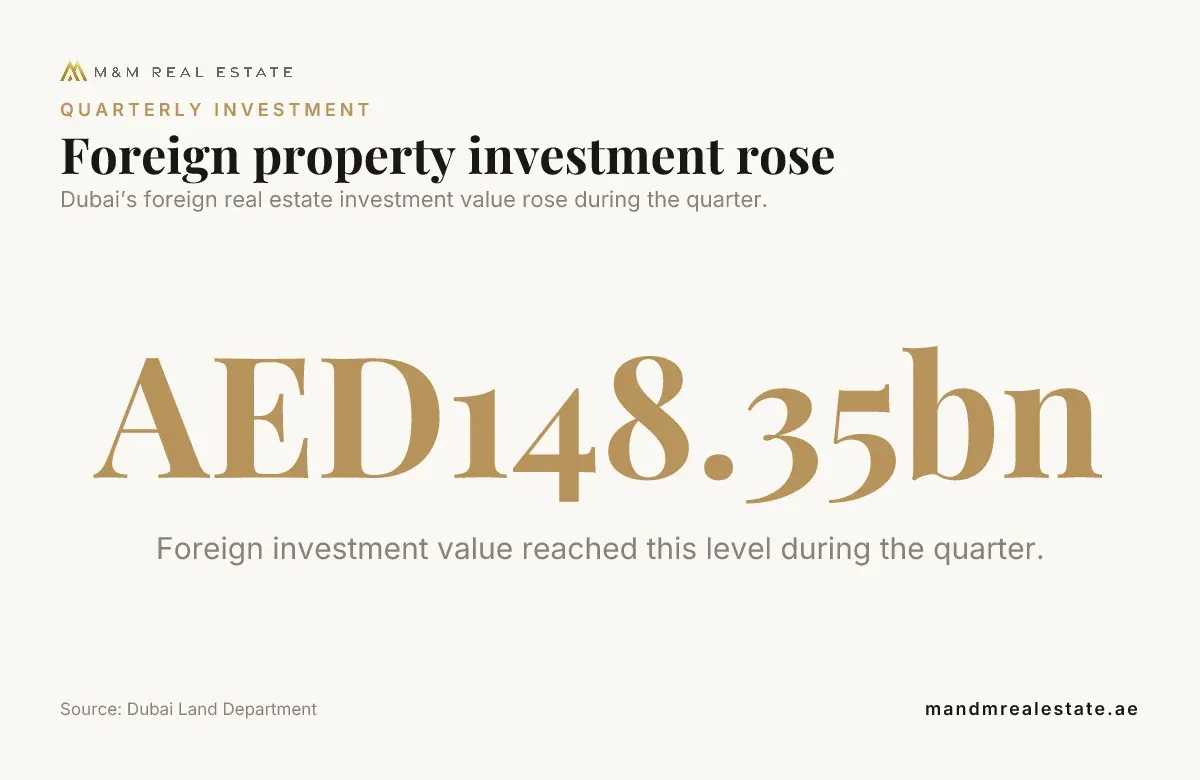
Dubai Land Department data for Q1 2026 shows foreign real estate investment value rose during the quarter.
Source: Dubai Land Department
The Dubai property market-data analysis gives investors a practical method for checking data scope, comparing price measures and separating transaction volume from value. It also reinforces the discipline this section sets out: keep forecasts distinct from recorded history.
Make Market Indicators Genuinely Comparable
Compare properties that match in neighbourhood, building, type, size, condition and measurement period. Each difference can alter the price or rent, so a comparison that ignores them can make a fair unit look expensive or an overpriced unit look like a bargain.
Check whether a price figure is a median, an average or a price per square foot. These measures answer different questions, and transaction volume describes the number of deals rather than their total value.
When we shortlist areas, we hold the investor’s objective and property type constant before drawing conclusions. The images below link to area-focused guidance that supports a more careful comparison rather than a decision based on reputation alone.
Build a consistent set of comparable properties, then note differences in coverage or methodology. That record helps prevent a change in the dataset from being mistaken for a change in the market.
Area guides can help organise a shortlist, but the unit still needs its own comparison set. We use Dubai property locations as a starting point for identifying areas to assess, not as a substitute for matching individual properties.
Test Rental Evidence and Calculate the Return That Matters
Give more weight to comparable completed or registered leases than to advertised rents. Check whether the evidence reflects the rent a similar property achieved and whether its occupancy pattern makes sense for that location and property type.
The Rental evidence comparison method connects achieved rents with likely tenant demand between areas. It suits this part of the analysis because a strong advertised rent alone cannot establish that a property will find tenants at that level.
Gross rental yield is annual rent divided by purchase price. Net rental yield is more useful for decision-making because it accounts for the costs that reduce income, including vacancy, service charges, maintenance, transaction costs and financing where relevant.
One worked example: The following are illustrative assumptions, not market facts. They show how to move from a gross figure to an estimate after costs.
- Assume a purchase price of AED 1,000,000 and annual rent of AED 80,000.
- Gross rental yield: AED 80,000 ÷ AED 1,000,000 = 0.08; 0.08 × 100 = 8%.
- Assume vacancy of AED 4,000, service charges of AED 10,000, maintenance of AED 3,000, annualised transaction costs of AED 5,000 and financing costs of AED 12,000.
- Net annual income: AED 80,000 - AED 4,000 - AED 10,000 - AED 3,000 - AED 5,000 - AED 12,000 = AED 46,000.
- Net rental yield: AED 46,000 ÷ AED 1,000,000 = 0.046; 0.046 × 100 = 4.6%.
This calculation is a starting point, not a full return model. Add the investor’s financing terms and the timing of purchase and sale to assess total ownership cost and the net result over the intended holding period.
The linked images below cover rental returns and property-related costs, both of which belong in a realistic assessment of income rather than a gross-yield headline.
Compare rental evidence and likely tenant demand between areas; an area-wide yield does not apply to every unit. Tenant demand depends on the fit between a property’s price, type, condition and the needs of people looking in that micro-market.
Twelve chapters on what the regional war tested, the balance sheet and dollar peg behind the market, and how to pick the right side of this cycle.
Download free→Assess the Area, Building and Individual Unit
Shortlist areas against the intended strategy: income, appreciation or personal use. Then assess local rental conditions, comparable properties, building details and future supply, because a broad area trend cannot tell us how a particular unit will perform.
Local property area analysis provides a framework for weighing relevant local evidence, property comparability, rental conditions, building details and future supply. It fits the property-level assessment because each of those factors can change the decision about a specific unit.
Population, tourism and infrastructure activity can inform a demand thesis, but they do not prove that a property will achieve a particular rent or appreciate. Treat them as indicators to investigate, then test them against the unit’s real rental comparables and building context.
Assess condition, layout and building quality alongside nearby alternatives. Also consider competing supply: tenants and future buyers choose between available properties, so new homes in the same micro-market can affect both rental interest and resale demand.
Some investors also assign value to personal use or residency planning. Keep those goals distinct from rental returns; the linked resources below address property investment and the residency route separately.
Stress-Test Forecasts, Off-Plan Claims and Future Supply
Write down each market forecast’s assumptions about rents, prices, occupancy, costs and timing. Then change the inputs one by one through sensitivity analysis so you can see which assumptions drive the result and where the investment case becomes vulnerable.
Build alternative scenarios, not just a single expected outcome. Include delayed infrastructure, delayed project handovers, additional competing supply and weaker rental demand, because each can shift income, costs or the time before a property contributes to the investment plan.
The Property-market forecast context helps keep expectations in their proper category: projections, not recorded results. Compare a market forecast with past performance, but do not treat a previous trend as proof that the forecast will happen.
For an off-plan property, examine the developer, delivery evidence, payment schedule and competing projects as separate parts of the case. A payment plan and a projected completion date do not establish investment value on their own.
We treat a project’s delivery evidence and competing pipeline as distinct questions, then test how a change in either would affect the investment thesis.
For a structured review of off-plan property in Dubai, separate the project’s advertised terms from evidence about delivery and demand. Our Dubai property developer resources can support the developer part of that assessment.
Match the Decision to Costs, Holding Period and Exit Options
Match the location and expected income pattern to the intended holding period. A short timeframe leaves less room to absorb entry and exit costs or a weak resale market, so the plan should account for how the property will be held and sold.
Assess exit liquidity at unit level. Consider the likely buyer pool, competing properties and the features that distinguish the unit, rather than relying on projected appreciation or area-wide transaction activity.
Financing terms and currency exposure belong in the investor’s own return assessment. Borrowing costs can change the net outcome, while exchange-rate movements can affect the amount an investor ultimately measures in their home currency.
Set out the investment thesis and the evidence that would lead you to revise it, such as weaker leasing, rising ownership costs or a changed supply outlook. A clear revision rule helps keep a decision tied to evidence rather than attachment to an original forecast.
Location and time horizon should be assessed together, not as separate choices. Use this guide to matching a Dubai property area to the holding period, alongside this analysis of how location changes the investment case.
For a broader set of investor materials, explore our Dubai property investment resources.
See also: What Investors Need to Know About Tax on Dubai Property.
A sound Dubai property investment analysis separates completed sales and achieved rents from asking prices, advertised rents and forecasts. It compares like with like, calculates net returns after ownership costs, and tests whether the property-specific case survives changes in demand, supply, timing and exit conditions.
That is how we separate evidence from projection and turn market claims into a decision an investor can explain, review and revise.
How often should I update a Dubai property investment analysis?
Review it at decision points and whenever new lease evidence, revised financing or a change to the property plan alters the assumptions. Keep dated versions so you can distinguish a changed conclusion from a change in the inputs.
Does buying a property with cash remove the main investment risks?
No. Cash removes lender repayment obligations, but it can concentrate more of an investor’s capital in one asset and create an opportunity cost if that capital could serve another purpose. It does not remove the need to assess the property’s operating performance and resale prospects.
How should I assess a property intended for both personal use and rental income?
Assign separate value to the periods reserved for personal use and the periods available to tenants. Include furnishing, changeover and management needs in the rental plan, and avoid counting the same period as both personal use and rental income.
What should I do if actual rent or occupancy falls below my forecast?
Identify whether the shortfall comes from pricing, the time taken to find a tenant, unit condition or lease terms, then revise the operating plan accordingly. Recalculate the investment case using the actual pattern and decide whether holding, selling or changing strategy best fits your objectives.
Should I use an independent valuation before buying a Dubai property?
An independent valuation can provide a separate view of the property’s value and explain the comparable evidence behind that view. It is most useful when you understand its valuation date, scope and assumptions, then compare those with your own investment case.
How do I compare a ready property with an off-plan property?
Compare when each option requires capital, when rental income could begin and how much of the outcome depends on future delivery. A ready property can be assessed against existing lease evidence, while an off-plan case depends more heavily on timing and project assumptions.


