


Choosing between villa communities in Dubai starts with the routes your household repeats, not a community’s reputation or a pin on a map. We recommend testing real trips from a specific villa at the times you will make them, on foot as well as by car.
- Rank regular trips by frequency and time sensitivity, so everyday needs carry more weight than occasional outings.
- Start each route at the villa or cluster entrance, not the community boundary.
- Test drives during normal, peak-hour and school-run traffic, then check weekend access separately.
- Walk the full route to nearby amenities and inspect shade, crossings, lighting and path continuity.
- Compare the same destinations, travel modes and times across every community on your shortlist.
- Choose for your household’s actual routine. No single location suits every work pattern, family or set of priorities.
Start with the journeys your household makes most
Write down the trips your household makes regularly: work, school, groceries, healthcare and recreation. Rank them by how often they happen and how time-sensitive they are, because a repeated school run can have a greater effect on daily life than an occasional trip to a leisure destination.
Trace every route from the specific villa or villa cluster entrance. A community gate may be close to a main road while a home deeper inside the development adds internal driving or walking time.
Compare the route itself, not just the distance between two map points. Walls, gated boundaries, road layouts and entrance locations can make a nearby destination awkward to reach.
The Al Furjan community guide includes an aerial view of homes and internal roads, a useful reminder to look beyond the outline of a development and identify the actual starting point for your trips.
La Mer Villas illustrates why a development name alone is not a useful route origin.
For route planning, start from the particular home or cluster you are considering, then trace its drive or walk to the places your household uses. That gives you a real comparison rather than an assumption based on the project label.
Test road connections at the times you will travel
A quiet viewing can make road access look easier than it feels during an ordinary commute. Drive the main route on a weekday and again during peak traffic, paying attention to queues at community exits, junctions and merge points.
Check school-run periods separately. Drop-off traffic can slow local roads and junctions even when the wider commute appears manageable.
Repeat relevant routes at weekends if your plans often involve central districts, shopping or leisure destinations. Traffic conditions and convenient approaches can change with the time and purpose of a trip.
Before settling on a route, identify an alternative and note where you could turn around or park if you miss a turn or encounter a disruption. A practical backup makes a routine trip more resilient.
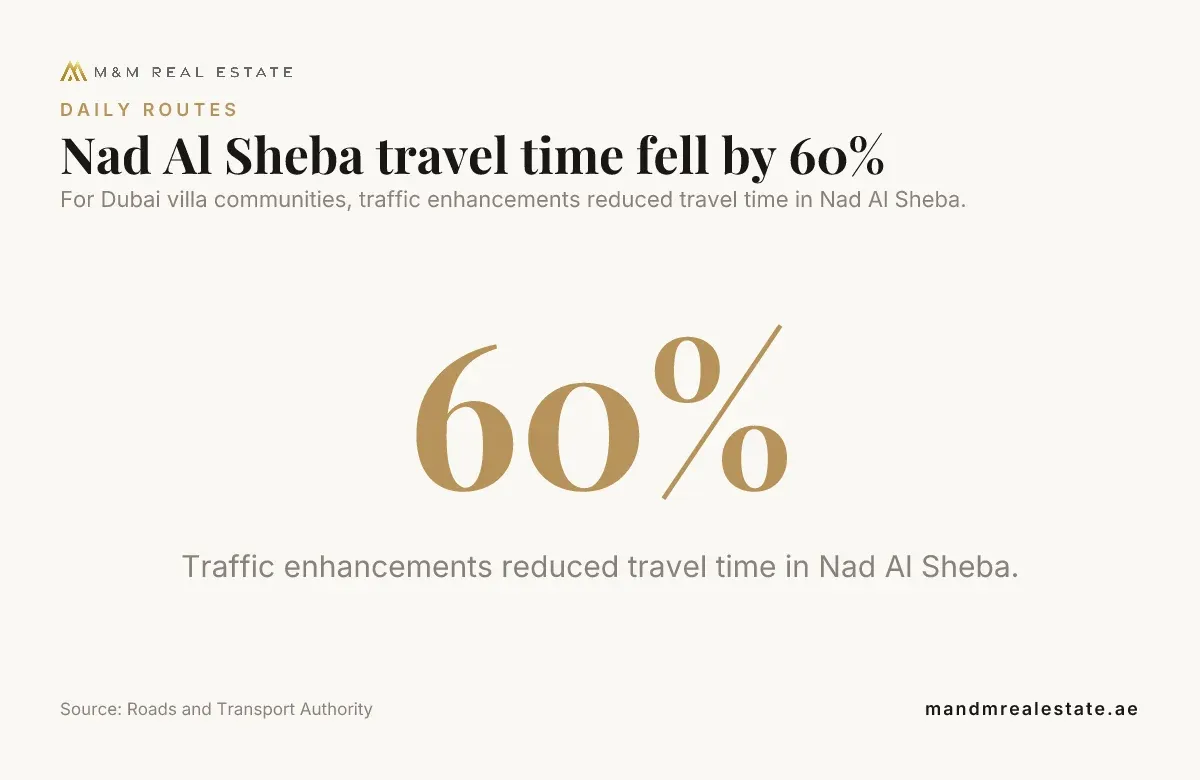
The RTA’s account of traffic enhancements implemented in 2024 says these enhancements reduced travel time by 60% in Nad Al Sheba.
Source: Roads and Transport Authority
Road access can change as infrastructure changes, so separate what you can test now from what depends on future works. For your own comparison, record the conditions you actually observe.
Check whether walking and cycling routes really connect
Walk from the villa cluster to a park, shop or other regular destination, and follow the path all the way to its entrance. A pavement that stops at a road or gated boundary may look close on a map but fail as a practical everyday route.
Assess the whole pedestrian pathway for shade, lighting, surface condition, road crossings and barriers. These details affect comfort and safety for children, pushchairs and people with limited mobility.
For cycling, check whether routes connect to useful destinations and whether crossings feel manageable. An internal recreational loop can be pleasant for exercise without offering a practical way to reach shops or schools.
When a household needs to travel without a car, make the test on foot rather than relying on a map. Check for a direct entrance to the destination and note where parking areas or road crossings interrupt the walk.
The street view in the Tilal Al Ghaf guide and the waterside walkway in The Oasis guide offer examples of residential settings to compare against the paths you inspect in person. Treat attractive internal amenities as one part of the assessment, not proof that the full route to an everyday destination works.
Twelve chapters on what the regional war tested, the balance sheet and dollar peg behind the market, and how to pick the right side of this cycle.
Download free→Put schools, shops and healthcare on the same route map
For each school or nursery, trace the drive-in route and the walking approach. Note where drop-off queues form and where children or adults need to cross a road.
Map a grocery shop, pharmacy and clinic that suit ordinary errands. A service may appear close yet require a long detour or a car for every visit, making it less convenient than the distance suggests.
Consider who will make each trip and how they will travel. A route that works for an adult driver may be difficult for a child walking, a pushchair or someone with limited mobility.
Look for useful connections between essential trips. If the school route also passes a suitable grocery shop or clinic, you may be able to combine errands with a school run or commute.
For each destination, write down the entrance you would use, the mode of travel and any point where the route becomes difficult. This makes it easier to distinguish nearby amenities from services your household can reach comfortably and reliably.
Balance community layout with connections beyond the gates
In a gated community, follow the route from the villa cluster to the gate, then continue to an outside destination. Visitor access, security points and internal road layouts can all affect the time and ease of an everyday trip.
Compare paths between homes, parks and community amenities with road connections to outside destinations. Strong access within a master-planned community does not automatically mean convenient access to workplaces, central districts or services beyond it.
Palm Jebel Ali Villas is a development name, not a route origin; assess the specific home and its connections.
Weigh suburban space and internal amenities against the routes your household needs. For children and less mobile residents, prioritise continuous paths, clear crossings and direct connections between homes and shared amenities.
Make a like-for-like comparison during your visit
Use the same destinations for every community on your shortlist. For each trip, record the route from the specific villa, the travel mode, the time of day and any queue, awkward crossing or access restriction.
Visit at more than one relevant time, including a school-run period and a weekend, and walk at least one route to an everyday amenity. A drive-through alone will not show whether pedestrian paths connect or where a barrier changes the route.
| Record | What to note |
|---|---|
| Destination | Work, school, groceries, healthcare or recreation |
| Starting point | The villa or cluster entrance |
| Mode and timing | Car, walking or cycling, and the time you tested it |
| Route friction | Queues, crossings, barriers, detours or access restrictions |
| Household fit | Who makes the trip and whether the route works for them |
Give greater weight to trips your household repeats often. A shorter school run may count more in your decision than a longer, occasional leisure trip.
Community guides can give useful background, but your own route checks should decide the fit. We provide community context in the Tilal Al Ghaf guide and The Oasis guide; use those alongside the access points and routes you have tested for your routine.
That is practical Market Intelligence: compare the same trips, record what you observe, then decide which trade-offs you can live with.
See also: Buy Off-Plan Property in Dubai: 2026 Guide, Dubai Golden Visa through Property: 2026 Guide, Which Dubai Property Area Fits Your Investment Goal in 2026?, Dubai Property Developer Reviews, Dubai Rental Yields in 2026: Gross Returns, Costs and Tax, What Investors Need to Know About Tax on Dubai Property, Dubai Property Investment in 2026, Off Plan Properties in Dubai, Best Areas to Invest in Dubai and Abu Dhabi, Dubai Investment Guides & Resources.
The daily routes that matter most are the ones your household repeats, especially trips tied to work, school, groceries and healthcare. Compare them from the villa itself, at the right times and on foot as well as by car.
When comparing Dubai villa communities, we look past reputation and map distance to the routes people actually use. A consistent route audit gives you a clearer basis for choosing a community that fits real life.


Which is the best villa community in Dubai?
Start with the destinations your household visits most often, then compare how practical each shortlisted community is for reaching them.
Where is the best area to buy a villa in Dubai?
Use your household’s most frequent destinations to shortlist areas, then compare routes from individual homes in each one.
How should I compare communities if my workplace may change?
Separate fixed commitments, such as children’s schools or regular healthcare, from work trips that may shift. Compare access to more than one plausible work destination, and avoid letting one uncertain commute decide the whole choice.
How does Dubai’s summer heat affect walking routes and daily errands?
Heat can make an exposed walk less comfortable, especially for children and people with limited mobility. Check whether shade is continuous, whether errands can be timed for cooler parts of the day and whether a practical alternative is available when walking does not suit the conditions.
Can a metro connection make villa community living workable without a car?
That depends on the full trip, including the route from home to the station and from the station to your destination. Check how you would handle the last mile and whether the same option works for the trips your household makes outside commuting hours.


