A Dubai mortgage for European residents is available through some UAE lenders, but European citizenship alone does not set eligibility. Lenders set their own criteria and terms for non-resident offers.
- A lender assesses nationality, country of residence, income and property separately.
- UAE-resident mortgage terms do not set a non-resident buyer’s budget.
- Compare the lender’s loan-to-value limit with the purchase price, then allow for fees and currency transfers.
- Prepare identity, income, tax, credit and source-of-funds documents in the format the lender requests.
- Seek pre-approval early, then submit the specific property for valuation and final approval.
- Keep property ownership, mortgage approval and residence visa eligibility as separate checks.
How lenders assess European applicants living abroad
A UAE-resident expatriate and a European buyer living abroad can face different mortgage criteria. Resident mortgage examples therefore cannot set a non-resident budget.
Lenders may assess nationality, country of residence, where income is earned and the currency in which it is paid as separate factors. A bank’s willingness to assess one European nationality does not establish that it accepts every country of residence or income source.
Employment type also shapes the assessment. A salaried applicant may provide employment and salary records, while a self-employed applicant may need business accounts and tax documents that show how income is earned.
Lenders consider a borrower’s existing loans and regular commitments when assessing the income available for a mortgage payment.
There is no single minimum salary that sets borrowing capacity for every European applicant. Each lender assesses verified income, existing commitments, deposit, loan term and its own criteria.
Work out the deposit and borrowing capacity
Start with the lender’s non-resident loan-to-value (LTV) limit. The down payment covers the part of the purchase price the loan does not fund, and the buyer also needs cash for purchase and mortgage costs.
The CBUAE rules set expatriate LTV ceilings of 80% for a first home priced up to AED 5 million, 70% above that price, 60% for an investment or second home, and 50% for off-plan property. The rules do not set a separate non-resident LTV, so a bank may apply a lower limit or other conditions.
Estimate affordability from verified income, existing debt and the lender’s debt-to-income assessment. Then test the monthly payment against a weaker euro, exchange-rate changes and international transfer charges, since the loan is repaid in AED.
Cash buyers avoid borrowing costs and loan conditions, while mortgage buyers keep more capital available for other uses. Compare that flexibility with rate changes, currency exposure and the cash required for fees.
To compare location and investment choices, read M&M’s Dubai area analysis alongside its population analysis. Buyers weighing direct ownership against pooled exposure can also read the overview of real estate crowdfunding in Dubai.
A property purchase can also be part of a separate residence decision. For residency planning, M&M’s Dubai Golden Visa through property guide explains the DLD route for qualifying purchases worth AED 2 million or more in the applicant’s own name, with a 10-year renewable permit.
Compare lenders, rates and repayment terms
Before comparing headline terms, ask whether the lender accepts your nationality, country of residence, income type and income currency. Then compare LTV, maximum loan, term, documents, fees and repayment conditions together.
A fixed-rate mortgage keeps the rate unchanged for the agreed fixed period. A variable-rate mortgage can move over time, so read what happens when any fixed period ends.
For a variable loan linked to EIBOR, the reference rate and lender’s margin both affect repayments. Ask the lender for a payment schedule at the offered rate and test affordability if the rate rises.
Compare written offers from lenders that accept the applicant’s circumstances.
Check the property and ownership rules separately
Check that the specific property is open to foreign ownership and that the lender will finance its type and status. Ownership eligibility and mortgage approval are separate decisions.
Off-plan finance needs its own enquiry because lender availability and the timing of funds can differ from a completed property. ADCB’s non-resident page, for example, limits its programme to completed property.
Before paying a reservation deposit, obtain the lender’s view on the property and understand the reservation terms. A pre-approval is an initial borrower assessment, while final approval depends on full underwriting and the property valuation.
For off-plan due diligence, review the off-plan properties available in Dubai and the payment-plan analysis. The Dubai investment guide compares ready and off-plan decisions.
For area research, shortlist options through M&M’s locations, then compare specific guidance for Al Jaddaf Waterfront. Developer and project checks can include the developer profiles, the Emaar and DAMAC comparison, and M&M Investment Cases for Bay Estate by Nakheel, The Yards Plaza offices and The Yards Plaza.
Buying with a mortgage does not itself grant UAE residence. The Dubai Land Department issues a 10-year property-based Golden Visa for qualifying purchases of AED 2 million or more at purchase price in the applicant’s own name; for mortgaged or off-plan property, confirm with the DLD.
Prepare overseas income, identity and funds documents
Prepare a clear file with identity and residence evidence, such as a valid passport and proof of address. Each lender sets the accepted document format.
Include existing loans and regular commitments in the affordability file, and keep a traceable record of the deposit. Account history and source documents help the lender follow where the purchase funds came from.
Budget for the full purchase, not just the down payment
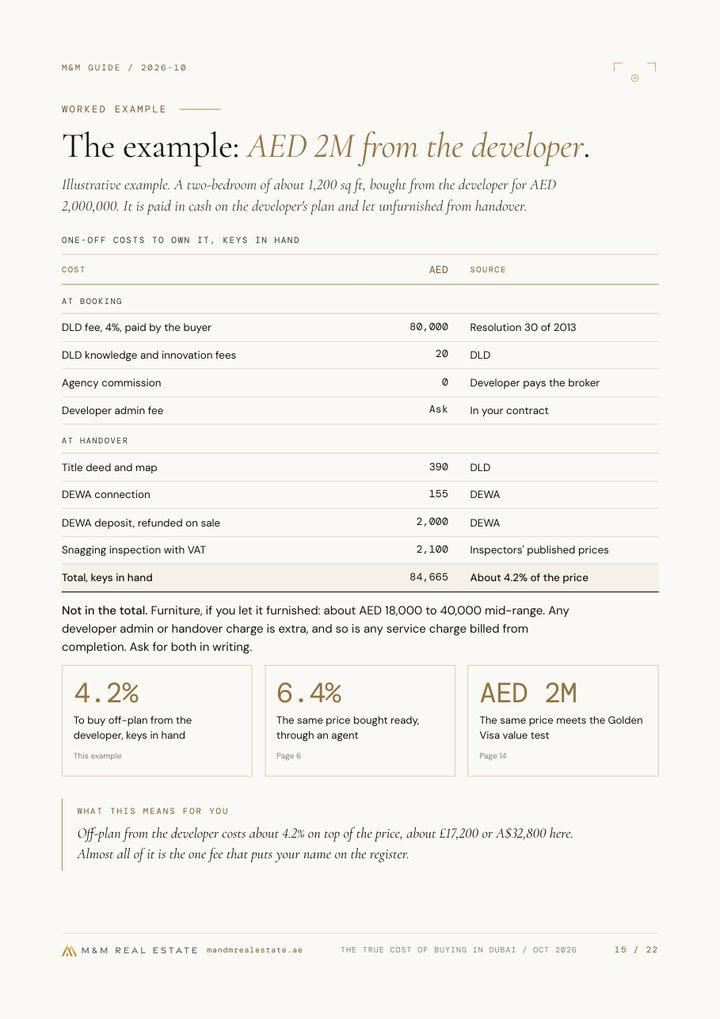
Separate the down payment from transfer charges, registration costs, valuation, lender fees and any agency fee. Add ongoing insurance, account or loan charges, and the cost of converting and transferring money from Europe.
The Dubai Land Department (DLD) lists a purchase transfer fee of 4% of the sale price, split 2% and 2%, plus title deed, map and trustee charges. Its property sale registration service lists the other charges; its mortgage registration service lists a fee of 0.25% of the loan, plus AED 270 and trustee charges.
The DLD amounts above come from its registration services accessed 9 Nov 2026, and the valuation fee comes from HSBC’s non-resident page accessed the same date. DIB’s schedule of charges lists a non-resident Ijarah documentation fee of 1.3125% of finance, so a AED 1,000,000 finance amount would add AED 13,125 if that product applies.
Keep a contingency for a valuation below the agreed price, since the lender may calculate its loan from its valuation. Consider the intended holding period and your home-country tax position alongside the initial cash budget.
Spanish, Italian and Dutch tax treatment of Dubai rent, assets and loan interest follows each buyer’s circumstances and tax residence. Read M&M’s tax overview and rental analysis alongside the relevant property strategy.
This is general information, not tax or legal advice. For Spanish, Italian or Dutch tax treatment, confirm with a tax adviser in your country.
Arrange pre-approval and complete the purchase from abroad
Seek mortgage pre-approval before choosing or reserving a property. It gives the lender an initial view of the borrower, while final approval follows full underwriting and the valuation of the selected property.
After selecting a property, send its details to the lender and allow time for valuation, final approval and the payment deadlines in the purchase contract. M&M’s property for sale page gives international buyers a starting point for a shortlist.
Plan how to sign documents, transfer funds and complete identity checks from abroad. A power of attorney may support remote steps when it is properly arranged and accepted for the transaction.
Before finalising the loan, agree the repayment route from your home country, including transfer timing and currency conversion. ADCB requires a savings account with the bank for repayments, while other lenders set their own payment arrangements.
For further reading, M&M’s property resources can support the wider investment review. An M&M advisor will go through your budget, timeline and shortlist with you.
What to do before you apply
Ask each lender to assess your nationality, residence, income currency and employment type. Request written terms for LTV, loan amount, term, fees and repayment conditions, then build a cash budget that includes the DLD charges and currency transfers.
After pre-approval, submit the specific property for valuation and final review before committing to its payment dates. Speak with an M&M advisor through the contact page to go through your budget, timeline and shortlist.
Figures are past data from the sources named; this article is general information and not tax, legal or financial advice, and returns are not guaranteed.


What happens if the lender’s valuation is lower than the agreed purchase price?
The lender may base its loan on the lower valuation, leaving the buyer to fund a larger part of the agreed price. The reservation terms and sale contract set out whether the parties can change the price or end the transaction.
Can two buyers apply jointly if only one has European citizenship?
A lender assesses each applicant under its own rules for identity, residence, income and liabilities. Ask the bank to assess both buyers on the same application and state how it will count each person’s income.
Can I rent out a Dubai property while it has a mortgage?
Yes, where the finance agreement and property rules allow the planned tenancy. For a long-term rental, register the tenancy through Ejari, Dubai’s tenancy registration system.
Can mortgage interest on a Dubai property be deducted from tax in my European country?
Tax treatment depends on the buyer’s country and circumstances, so there is no single answer for European residents. Keep annual loan statements, rental records and ownership documents for your tax adviser.
The true cost of buying in Dubai
Every fee from reservation to resale, with a worked example on an AED 2 million home. 22 pages. Free by email.