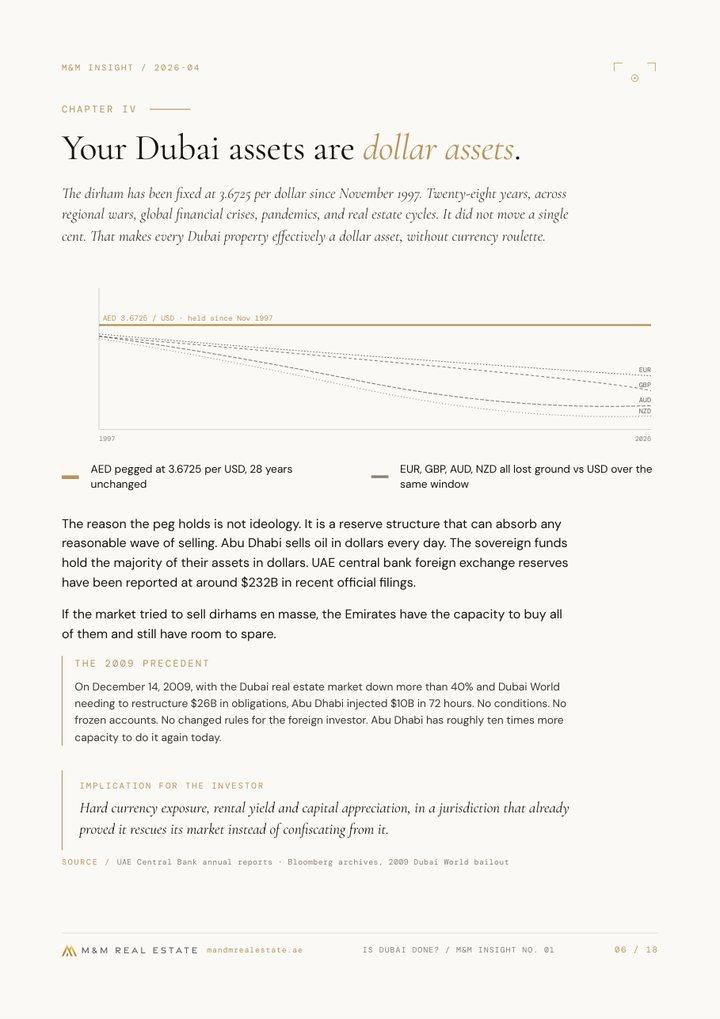
For property investors, the AED-USD peg links the dirham to the US dollar. It links Dubai property to the US dollar, while buyers whose home currency is sterling or euros still face exchange-rate exposure.
How the dirham’s peg to the US dollar works
Yes, the AED remains pegged to the USD.
The peg keeps the AED closely aligned with the USD. It does not set the dirham’s value against sterling, euros, Canadian dollars or other currencies, so an investor’s home-currency value can change as the dollar moves against that currency.
Exchange-rate stability and investment performance are separate questions. The peg does not set a property’s price, rent, resale time or return, so assess the asset and its costs on their own terms. Our Dubai property investment guide covers the wider investment decision.
Where currency exposure remains for investors
A USD-based investor has less routine exchange-rate movement between the AED and their home currency because of the peg. Property prices, rent, selling time, transaction costs and the possibility of a policy change remain separate investment considerations.
For investors paid in GBP or EUR, AED exposure follows the dollar against their home currency. A stronger USD raises the home-currency amount needed to buy a fixed AED value; a weaker USD lowers it. That is the central currency risk in Dubai property for a non-USD investor.
Map the currency of your purchase funds, mortgage payments, rental income and future spending. A property and its rent can both be denominated in AED while the investor’s salary, loan or planned withdrawals are in another currency.
US investors can consult the free investor guide. British buyers can also consult the free investor guide.
The peg offers dollar-linked stability as one part of diversifying beyond GBP or EUR. It leaves the value of that exposure in the investor’s home currency open to change.
Calculate the full cost of buying in AED
An AED purchase price is only one part of the home-currency cost. For each payment, use the exchange rate on the day you convert funds, then add the bank’s exchange-rate spread and any transfer or intermediary charges. Those charges reduce the AED received for each unit of home currency.
Include sale-registration and related transaction costs in your budget; the DLD’s property sale registration service sets out the process.
The bank’s exchange rate will differ from a reference rate, so compare the all-in quote for each transfer.
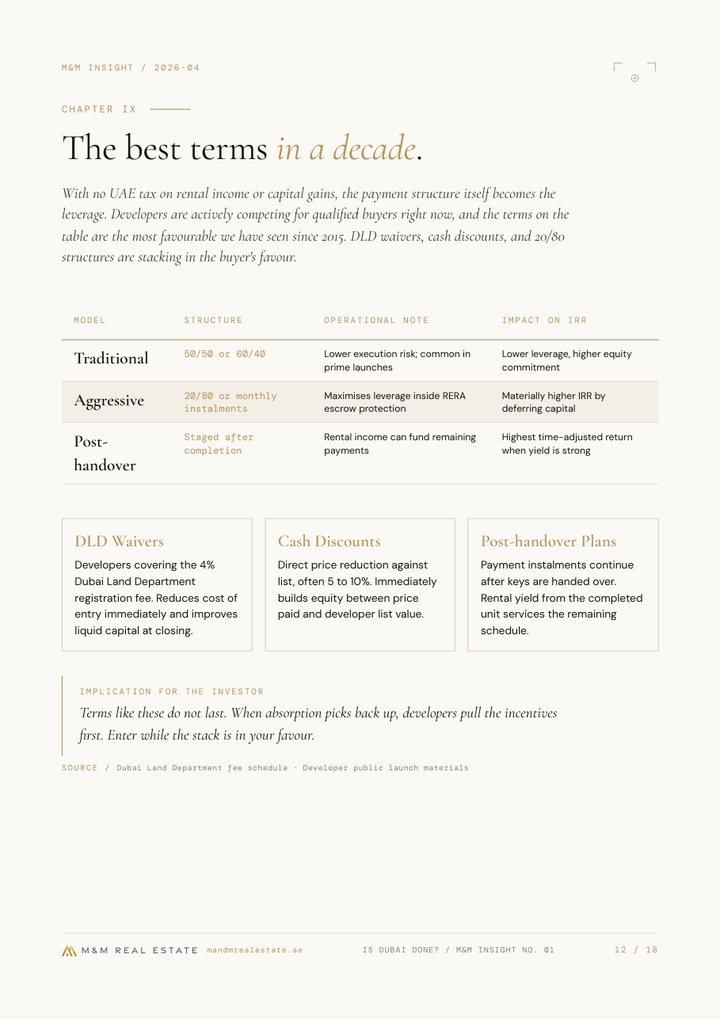
For off-plan purchases, assess every instalment at its expected payment date. The off-plan buying guide explains payment plans and escrow, the project account that holds buyer payments. Pay instalments in AED into the project escrow account, and keep a record of the home-currency amount and conversion date for each payment.
A multi-currency account can hold funds until conversion; a forward contract can set an exchange rate for a specified future amount and date. Compare the cost and timing of each option against your instalment schedule. For a stress test, rerun your budget with your home currency weaker and stronger against AED; these are planning scenarios, not forecasts.
Track rent and sale proceeds in the currency you will use
If you receive rent in AED and later convert it, its home-currency value depends on the exchange rate and conversion costs on the date of each transfer. Service charges, the recurring building costs billed to owners, and other AED expenses can be paid from AED income when the timing and balance allow.
Set the purpose for rental income before deciding when to convert it. Rent intended for spending in Dubai, reinvestment in AED or repatriation to another country can follow different conversion schedules.
Apply the same method to a sale. Record the AED proceeds, then calculate the amount left in your home currency after conversion and transaction costs; the AED-USD peg alone cannot show the final value for a GBP or EUR investor.
Our Dubai rental income and costs guide looks at rental performance alongside the costs that reduce the cash available to an owner.
Separate property performance from currency effects
Keep the property ledger in AED first. Record the AED price movement and rental cash flows, then translate each payment and receipt into your home currency using the rate on its transaction date.
Show the result in separate parts: property-price movement, net rental cash flow, currency movement and acquisition, operating, disposal and conversion costs. This lets you see whether the result came from the property, the currency or the costs.
Compare the same holding period and include all costs. Gross rent or an increase in the AED price alone does not show the investor’s net return. A favourable currency movement can soften a property loss in home-currency terms, while leaving the property’s own performance unchanged.
Home-country tax on rent and gains is calculated in the home currency, so foreign-exchange movements can change the taxable amount. Confirm with a tax adviser in your country. This is general information, not tax or legal advice.
Currency analysis sits alongside the property decision. For market and location context, compare our Dubai area investment analysis, Dubai location directory, Dubai population analysis and developer profiles. The off-plan property selection is another part of assessing the asset behind the currency figures.
For examples of project and payment-plan analysis, read the Bay Estate by Nakheel Investment Case, the The Yards Plaza by BEYOND Investment Case, the Emaar and DAMAC comparison and Beyond’s 30/70 payment-plan analysis.
Area-level research includes the Al Jaddaf Waterfront guide, the JVC guide and the Dubai Hills Estate guide. For alternative investment structures and ownership goals, see the Dubai property crowdfunding guide, the The Yards Plaza Investment Case and our Dubai Golden Visa guide. For tax questions alongside a cash-flow plan, see our Dubai property tax guide.
How US interest rates can affect UAE borrowing
The dollar peg links UAE monetary conditions to the US rate cycle, while local lending terms and each borrower’s pricing can differ. For an AED mortgage with a variable rate, track the benchmark and the bank’s margin separately.
Track your benchmark and the bank’s margin separately. Stress-test your budget against higher repayments instead of relying only on the current instalment.
Higher borrowing costs can put pressure on a buyer’s budget and affect wider demand for property. Lower rates can ease borrowing pressure; neither change establishes how property values will move.
Match the mortgage currency to the income used to repay it where practical. If income arrives in GBP or EUR and repayments fall due in AED, an adverse exchange-rate move can increase the home-currency repayment burden.
Manage currency exposure without assuming the peg is permanent
Treat the peg as a monetary arrangement, not a contractual promise of every future exchange rate. For a long holding period, include the possibility of a policy change in your risk assessment without treating it as an expected event.
Follow CBUAE communications, foreign-exchange reserve conditions and changes in the external economic environment. Each is a monitoring point, not a prediction on its own.
For staged payments or future rental income repatriation, compare converting funds as needed with tools such as forward contracts or currency options. Hedges have costs and can reduce flexibility, so consider their dates and terms against the expected payment or receipt.
Set a currency plan around payment dates, rental use and sale proceeds. Review it when the financing, timeline or intended spending changes; M&M’s Dubai investment guides and resources cover related investor decisions.
Plan the next conversion
Before moving funds, set out the AED amount due and its payment date. Compare your bank’s all-in quote with the CBUAE reference rate for that day, record the home-currency cost, and include the related fees in your investment calculations.
An M&M advisor will go through your budget, timeline and shortlist with you. contact M&M about the currency plan alongside the property decision.
This article is general information, not tax, legal or financial advice.


Can I use rental income kept in AED to pay Dubai property expenses?
Yes, AED rent can meet AED invoices such as maintenance and building costs when the payment dates and balance line up. Keep enough available for expenses that fall due before the next rent receipt.
Can an investor pay a Dubai property instalment in USD instead of AED?
The sale agreement and the developer’s payment instructions determine whether a USD transfer is accepted and how it is converted. Get the AED amount that will be credited and the conversion terms in writing before sending the funds.
Is a forward contract still suitable if a property completion date changes?
A forward contract has an agreed amount and settlement date, so a changed completion date can leave it out of step with the payment. Ask the bank whether it can amend or extend the contract and what costs or collateral may apply.
How often should I review my currency plan for a Dubai property investment?
Review it at least quarterly during construction and before each large conversion. Add a review when your income currency, financing or planned use of rent changes.
Is Dubai done?
The risks investors ask about most, checked against the data. 18 pages. Free by email.