


For a Spanish tax resident buying one Dubai property, personal ownership is usually simpler to administer; company ownership can suit co-investors or several assets when its governance and costs fit the plan. Is buying a Dubai property through a company preferable to owning it personally as a Spanish investor? The answer turns on tax residence, property eligibility, finance, personal use and the intended exit.
- Personal ownership puts the investor directly on the title and gives them direct control over letting and sale decisions.
- Company ownership places the property, its income and its decisions within a separate legal entity, which brings accounting and governance work.
- Spanish tax residence is central to the cross-border tax review. Spanish nationality alone does not determine the investor’s tax position.
- Property eligibility depends on the specific company and location, so the buyer checks the relevant Dubai Land Department registration requirements before paying a deposit.
- Total cost includes company setup and upkeep, purchase and property costs, finance, and eventual transfer or sale.
- Succession and exit need separate planning. Company shares and changes in ultimate beneficial ownership can still have registration and tax consequences.
How personal and company ownership differ
With personal ownership, the investor’s name appears on the property title. They make decisions about renting or selling directly, without company accounts, shareholder resolutions or governance steps.
With company ownership, the company holds the property and receives its income. Decisions must follow the company’s authority and records, so the structure adds administration even when it gives co-investors a shared framework.
| Question | Personal ownership | Company ownership |
|---|---|---|
| Who holds title? | The investor. | The company. |
| Who makes decisions? | The investor, subject to the property documents and applicable rules. | The company’s authorised decision-makers, under its governance documents. |
| What ongoing administration applies? | Property records and the investor’s own tax and reporting obligations. | Property records, company accounts, compliance and governance. |
| What can the structure organise? | A direct holding by one investor. | Shared investment, multiple assets and agreed decision rights. |
Before choosing, compare the holding period, number of investors and likely exit. A company can organise shared ownership or a portfolio, while its setup and upkeep add costs and do not settle the tax outcome by themselves.
Nationality and tax residence answer different questions. Spanish tax residence is central to the investor’s cross-border obligations, so an investor with Spanish nationality who lives elsewhere needs a different analysis from a Spanish tax resident.
M&M Real Estate’s Advisory Session and Investment Structuring services map an investor’s fiscal position, objectives, residence, assets and risk tolerance before a property is selected. That first review helps establish whether direct title or a company fits the investment plan.
What personal ownership means for a Spanish investor
Direct title gives the investor control over rental and sale decisions, and keeps the property’s ownership separate from company governance. For a single personally held investment, that can make day-to-day administration more direct.
A Spanish tax resident should assess Spanish tax and reporting obligations for foreign rental income, sale gains and property or other wealth. Dubai’s tax treatment does not settle those Spanish obligations, so the investor reviews the full position with a Spanish tax adviser.
A Spanish tax resident may still have home-country tax obligations. Compare personal ownership and company ownership against the investor’s full portfolio and succession plans, not only the purchase process.
Tax, capital transfers, ownership structures, residence and investment risks are covered by M&M’s free investor guide and Advisory in Spanish. The Spanish-language guide gives investors a practical way to prepare questions before choosing a route.
For property context, compare area and rental considerations separately from the ownership structure. Rental figures and costs are set out in M&M’s Dubai rental yield analysis, while the linked area images show examples of Dubai locations an investor may assess.
This is general information, not tax or legal advice.
When a company can hold Dubai property
A UAE mainland company, a free-zone company or an existing foreign company may be considered for ownership. A Dubai freehold area is a designated area where eligible buyers can hold property rights; eligibility depends on the company type and the property’s location, so confirm the registration requirements for that combination with the Dubai Land Department (DLD).
Before paying a deposit, map who owns the proposed company and who can authorise a purchase. Prepare the company’s constitutional documents, signing authority, beneficial-ownership disclosures and source-of-funds evidence for the transaction.
A special purpose vehicle (SPV) is a company set up for a defined purpose, such as holding an investment. A cross-border adviser can assess whether a Spanish-controlled company raises controlled foreign company or other anti-deferral questions, or questions about where its place of effective management sits. Treaty treatment needs a case-specific review.
Before purchase, M&M’s Investment Structuring service, linked above, addresses entity, banking, tax-residence, payment-plan and exit arrangements. The developer profiles can support a separate review of the property and its developer.
For an area-specific example, M&M’s guide to Al Jaddaf Waterfront places the proposed property in a location context. The company’s eligibility still needs to be assessed against the exact title and registration requirements.
This is general information, not tax or legal advice.
Your own name, a company or a foundation: what each one gives you in Dubai, in 20 pages. Who DLD lets on the title deed, the 4% on every route, Corporate Tax and the free zone myth, why the Golden Visa, a permit DLD issues for 10 years, needs your own name, wills and foundations, and a worked example on one AED 2.5 million flat. Checked October 2026.
Download free→How Spanish tax residence changes the calculation
Model the Spanish position under both routes. Direct ownership can require the investor to report property income and disposal gains, while company ownership adds questions about company profits, shares and distributions.
For a Spanish-controlled entity, a cross-border adviser should assess controlled foreign company rules, anti-deferral provisions and place-of-effective-management principles against the facts. The incorporation location alone does not settle how Spain treats the company.
Review any relevant tax treaty for the investor, the company and the income in question. Treaty relief depends on how the treaty applies to those facts, so the investor asks a tax adviser to make that assessment.
An investor’s tax position, legal and corporate structure, goals and timeline are reviewed by M&M’s investment advisory before a property is recommended. That review helps coordinate the Dubai purchase with advice in the investor’s country of residence.
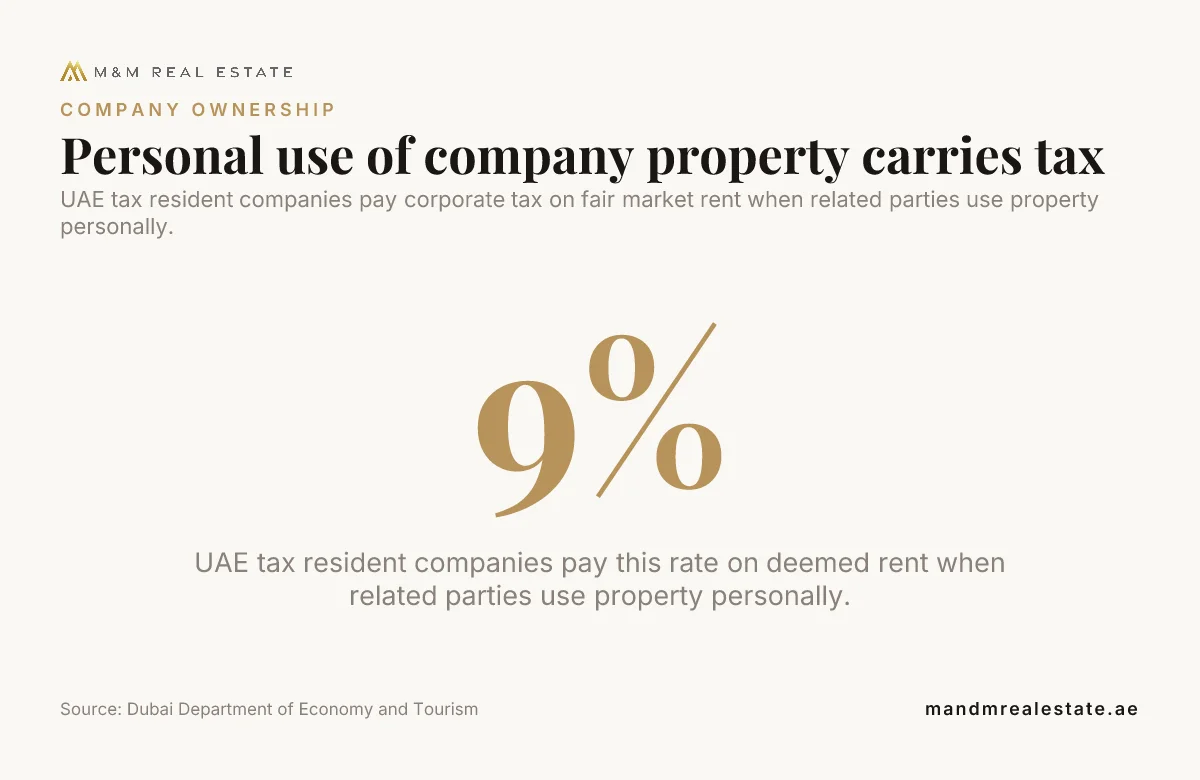
UAE tax resident companies pay corporate tax on fair market rent when related parties use property personally.
Source: Dubai Department of Economy and Tourism
This is general information, not tax or legal advice.
Compare full costs, financing and visa implications
Build a like-for-like cost schedule for each route. Include company formation and renewals, accounting and compliance, banking, purchase and registration, borrowing, property expenses, and the eventual sale or transfer.
| Cost area | Personal ownership | Company ownership |
|---|---|---|
| Setup and administration | Personal purchase records and the investor’s own tax reporting. | Formation, renewals, company accounts, compliance and banking. |
| Finance | Personal lender eligibility, income evidence and security. | Company eligibility, company records and any lender requirements for shareholder guarantees. |
| Property holding | Service charges, maintenance, vacancy and letting costs. | The same property costs, recorded and paid through the company. |
| Exit | Sale and any related tax or transfer costs for the investor. | Asset sale or share transfer, plus company and ownership-change requirements. |
Lenders assess the named borrower and title holder, so a company’s mortgage eligibility can involve different documents, conditions or guarantees from an individual mortgage. Get the lender’s requirements for the intended owner before relying on personal-owner terms in a company budget.
The property route for a Golden Visa can affect the intended title holder. Read M&M’s Dubai Golden Visa guide before setting the intended title holder.
A 30-minute portfolio review considers a buyer’s goals, budget and timeline, then recommends opportunities that fit. It can help organise the cost and finance comparison before the buyer selects a structure.
Once the ownership route is clear, assess the property separately. Area and income context comes from M&M’s Dubai area guides, population analysis and rental yield coverage; compare Emaar and DAMAC and review the payment-plan analysis for project-specific due diligence.
M&M’s Investment Cases include Bay Estate by Nakheel, The Yards Plaza offices and The Yards Plaza. For shared-investment context, read the Dubai property crowdfunding guide and browse the wider Dubai investment resources.
Plan succession, co-investors and an eventual exit
With direct ownership, plan how the property will be dealt with on death under the relevant succession rules. With company ownership, plan the inheritance or transfer of shares and check that the company’s governance documents support the intended outcome.
A separate legal entity can separate the property title and company accounts from an investor’s personal affairs. Personal guarantees, conduct and the circumstances of a claim can affect that separation, so a lawyer reviews the finance and company documents as part of the structure.
A share sale still needs a review of property registration and beneficial-ownership requirements. The Dubai Department of Economy and Tourism states that when Dubai real estate is transferred, a change in Ultimate Beneficial Owner (UBO) incurs a real estate transfer fee of up to 4% of the property’s fair market value, as charged by the DLD.
For co-investors or a property portfolio, record who can make decisions, how each investor funds the purchase and what happens at exit. Then test those terms against tax, lender conditions and registration requirements before the company signs a purchase agreement.
This is general information, not tax or legal advice.
Conclusion: what to do now
Before paying a deposit, ask the DLD whether the proposed company can register the specific property, ask the lender for conditions for that title holder, and have a cross-border adviser model Spanish tax treatment for both routes. Add formation, compliance, holding and exit costs to the same schedule, then decide whether company ownership earns its administration for this investment.
For a Spanish investor, is buying a Dubai property through a company preferable to owning it personally? Choose personal ownership when direct control and simpler administration fit the plan; choose company ownership when its governance and portfolio role justify the added work and the tax review supports it.
An M&M advisor will go through your budget, timeline and shortlist with you. Contact M&M.
Figures are past data from the sources named; this article is general information and not tax, legal or financial advice, and returns are not guaranteed.


Is a Dubai property SPV the same as a holding company?
An SPV is formed for a defined purpose, such as holding a specific investment. A holding company can own shares in other companies or assets as part of a wider group structure, so the company’s legal documents and intended use distinguish the two.
Can one Dubai company own more than one property?
A company may hold multiple properties when its licence, constitutional documents and registration arrangements support that activity. Keeping several assets in one entity also means they share its records and governance, which the investor can compare with separate vehicles for distinct investments.
Can a Spanish resident be a director of a UAE property-holding company?
A Spanish resident can be appointed as a director when the company’s rules and appointment process allow it. The director’s residence can also be relevant to assessing where the company is effectively managed, so the adviser reviews how decisions are made and recorded.
What documents are commonly requested for source-of-funds checks when buying through a company?
A buyer commonly prepares company registration and constitutional documents, a shareholder and UBO chart, identity documents for relevant people, and a board resolution authorising the purchase. Banks or transaction parties may also ask for company bank statements, accounts, contracts or other records showing how the purchase funds were earned and moved.


