


Is Dubai property a better investment than an apartment in Sydney or Melbourne? The decision turns on net income, tax, financing, currency and resale prospects for comparable apartments.
Key takeaways: compare net cash flow, tax and currency
| Question | What to compare |
|---|---|
| Which market has stronger rental income? | Compare gross rent with service charges, owners corporation or strata fees, management, repairs and vacancy. |
| What does an apartment cost to buy? | Include the purchase price, transfer or stamp duty, financing costs and any currency transfer charges. |
| How does tax affect the result? | Dubai’s local tax treatment and an Australian tax resident’s obligations are separate questions. |
| What can change the return? | Model lower rent, vacancy, higher building costs, a slower sale and an unfavourable AED to AUD exchange rate. |
| Where can I compare Dubai opportunities? | Start with M&M’s Dubai real estate investment guide and Dubai area guides. |
Gross rental yield gives a starting point, not net income
Gross rental yield divides a property’s annual rent by its purchase price. It leaves out running costs, vacancy, finance and tax, so use net rental yield and cash flow to compare apartments after expenses.
Asking-based figures do not establish the rent or net return for a particular apartment.
For each shortlisted unit, estimate achievable annual rent, then subtract service charges, property management fees, maintenance, insurance, financing costs and expected vacancy. Use comparable apartments with similar size, condition, tenant profile and access to transport or employment areas.
Dubai’s prime rental market also has its own cycle. Savills reported that prime rental values increased by 23.5% over 2024, surpassing the 2016 market peak. Treat that as past market information, then build your own rental estimate from the location and unit you are assessing.
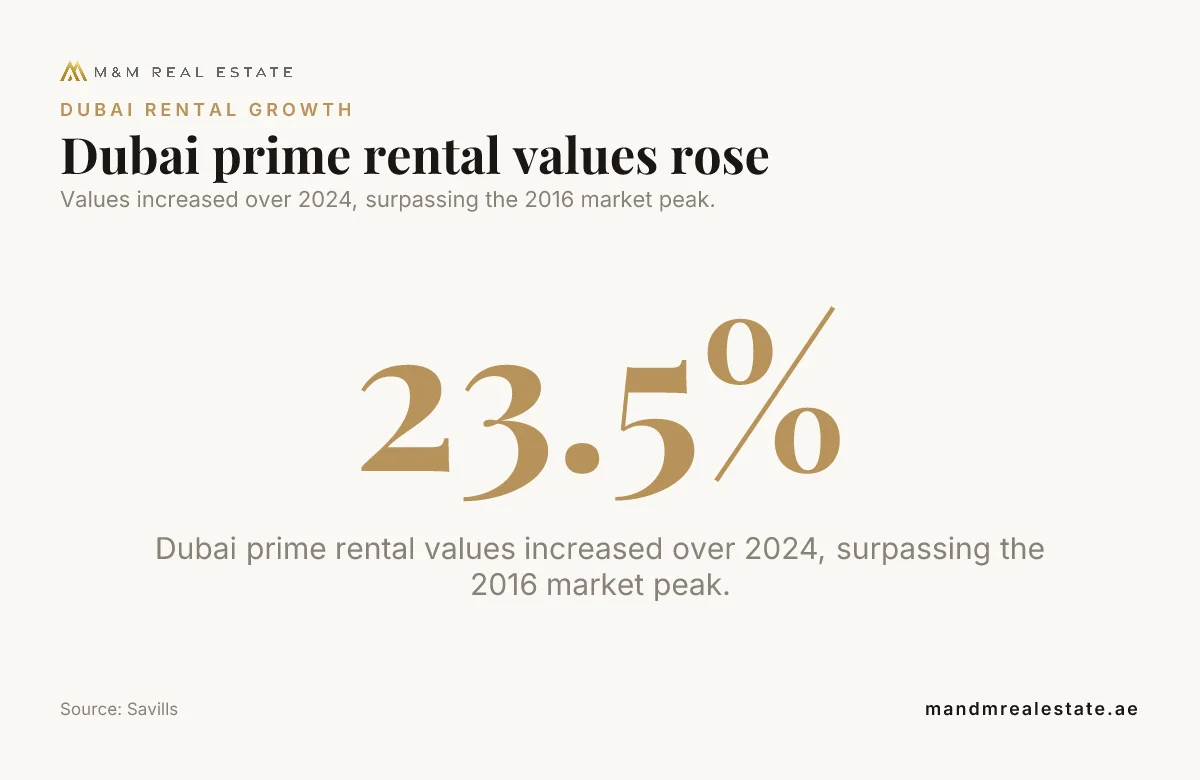
Values increased over 2024, surpassing the 2016 market peak.
Source: Savills
A like-for-like comparison starts with the same apartment brief
A Dubai apartment and a Sydney or Melbourne apartment are comparable when the unit size, building condition, location, tenant profile and total purchase cost are close. A city-wide average beside an individual listing can hide differences in service charges, rental demand and resale appeal.
| Factor | Dubai | Sydney or Melbourne |
|---|---|---|
| Unit and location | Match the bedroom count, usable area, building quality, access and tenant profile. | Use the same criteria, including neighbourhood, building condition and likely tenant. |
| Purchase costs | Include the DLD transfer fee, registration and any financing costs. | Include state stamp duty, conveyancing and financing costs. |
| Ongoing costs | Allow for service charges, management, maintenance and vacancy. | Allow for owners corporation or strata fees, management, maintenance and vacancy. |
| Rent and sale currency | Model rent and resale proceeds in AED, then convert them to AUD. | Model rent, costs and resale proceeds in AUD. |
| Tax and ownership | Assess UAE rules alongside the investor’s home-country tax position and the title arrangements. | Assess Australian tax and state-based ownership costs for the specific property. |
Keep the property type consistent too. M&M’s Bay Estate Investment Case covers townhouses and villas, while The Yards Plaza case covers commercial offices. Each needs its own rent, cost and resale assumptions alongside an apartment comparison.
Property crowdfunding offers a separate form of exposure, covered by M&M’s guide to property crowdfunding in Dubai. Consider it separately from direct ownership of an apartment because the investor’s control and exit route differ.
Local property tax and Australian tax residency are separate questions
The investor’s home country may still tax rental income or a future gain, so an Australian tax resident should assess Australian reporting and tax obligations before buying.
Ask an Australian tax adviser to review residency, ownership structure, deductible costs and the tax treatment of a future sale. The answer depends on the investor’s circumstances and Australian rules, not only on the Dubai property’s local tax treatment.
This is general information, not tax or legal advice.
Purchase and running costs change the net return
Include the DLD transfer fee in the purchase-cost calculation.
Budget the transfer fee alongside the deposit. Add registration and mortgage costs, conveyancing or legal fees, currency transfer charges and any costs set by the developer or lender.
In Sydney and Melbourne, stamp duty varies by state and buyer circumstances. Recurring owners corporation or strata fees, land tax where applicable, insurance, repairs and management also belong in the model. Compare each market using total acquisition cost and annual net income, not the purchase price alone.
A building’s service charge affects the amount left after rent arrives. Ask for the applicable charge for the shortlisted unit, then include a reserve for maintenance, vacancy and management before estimating cash flow.
Foreign capital is hesitating. The 3.9 million people inside the UAE have not. The asymmetry that defines 2026, and what it tells you to do about it.
Download free→Currency risk can change an Australian investor’s return
A Dubai apartment earns rent and sells in AED, while an Australian investor may measure wealth and meet expenses in AUD. The AUD value of rent, loan payments and eventual sale proceeds can change with the exchange rate and with the fees charged to move money.
Build the comparison in AUD as well as AED. Record the exchange rate and transfer cost for each payment, estimate rent after local costs and tax, then convert the expected sale proceeds using a less favourable exchange-rate scenario.
Model weaker rent, a vacant period, higher maintenance costs and a slower resale at the same time. This shows whether the investment can meet its cash needs without relying on a favourable currency move or a quick sale.
Australian and UAE lenders assess different properties under their own terms. For Dubai off-plan property, compare the bank’s lending terms with the buyer’s cash contribution and the developer’s payment schedule.
Location, supply and resale demand matter alongside rent
Rental demand depends on the unit’s location, layout, building management and the needs of tenants in that area. Resale demand also depends on competing supply, the building’s condition and the range of future buyers for that apartment type.
Compare specific neighbourhoods rather than using a Dubai-wide label. For a shortlist by investment goal, use M&M’s guide to areas that fit different investment goals; assess Al Jaddaf Waterfront alongside the unit’s access, nearby housing and competing rentals.
Dubai’s sales market also moves through cycles. Model a lower resale price and a longer selling period so the purchase works under a slower exit scenario.
Population planning is another consideration: M&M’s analysis of Dubai population growth provides context for how the city plans for residents. Population trends can inform a location review, while the rent and resale case still needs evidence from the specific building and apartment.
Off-plan due diligence starts with the developer and payment schedule
Off-plan property means buying before the developer completes construction. Review the sale contract, project registration, escrow arrangements, construction milestones, handover terms and payment schedule before comparing its expected rent with a ready apartment.
Escrow is a project account that holds buyer payments for the development under Dubai rules. Oqood is the DLD’s off-plan registration. Check the project status with the DLD, read the contract clauses on delays and cancellation, and ask how service charges and building management will work after handover.
Review the developer’s delivered projects, construction record and current obligations; M&M’s Dubai property developer profiles and its comparison of Emaar and DAMAC can support that review.
A payment plan changes when cash is due, not the apartment’s total cost. Read the schedule against your expected income and financing; M&M’s analysis of a 30/70 payment plan explains how the handover portion affects the funding plan.
For a buyer who needs a mortgage, the off-plan lending limit means planning the cash contribution before signing. Compare the full payment schedule with the bank’s lending terms and the buyer’s ability to meet each instalment.
This is general information, not tax or legal advice.
Dubai may suit an income-focused investor, while Sydney or Melbourne may suit a local plan
Dubai may fit an investor seeking rental income in AED and willing to manage a property from overseas. The investor needs a local management plan, cash reserves for vacancy and repairs, a tax review, and a clear approach to converting income and sale proceeds into AUD.
An apartment in Sydney or Melbourne may fit an investor who values local oversight, Australian-dollar income or a direct connection to the city. Compare the specific property’s costs and rental prospects with the Dubai shortlist, then judge both against the investor’s cash needs and holding period.
A Golden Visa is a separate residency consideration. M&M’s Dubai property Golden Visa guide explains the route.
See also: The Yards Plaza by BEYOND, City of Arabia Offices, M&M.
What to do before choosing a city
Shortlist comparable apartments, request rent and service charge details, calculate the full acquisition cost, and model vacancy, repairs, tax, financing and currency movements. For off-plan property, review the developer, escrow, title registration, contract and payment schedule before committing.
M&M Real Estate’s investor resources provide further Dubai buying guidance. Is Dubai property a better investment than an apartment in Sydney or Melbourne? The answer comes from the net cash flow, tax position, currency exposure and exit plan for the specific apartments; an M&M advisor can review your budget, timeline and shortlist with you at mandmrealestate.ae/contact.
Figures are past data from the sources named; this article is general information and not tax, legal or financial advice, and returns are not guaranteed.


What should an Australian citizen check before buying an apartment in Dubai?
Include the apartment’s location, title and ownership structure in a legal review before buying.
Does Dubai’s lack of personal income tax remove Australian tax obligations?
No. An Australian tax resident may still have Australian tax reporting and tax obligations on Dubai rental income or a sale gain, so an Australian tax adviser should review the investor’s circumstances.
How can an Australian investor model AED to AUD currency risk?
Convert each purchase payment, rental receipt and sale scenario into AUD using the exchange rate that applies when money moves. Include transfer fees and model a less favourable rate for future rent and resale proceeds.
Can buying a Dubai apartment qualify for a Golden Visa?
Treat residency eligibility as a separate question from rental returns, and assess whether it fits your own plans.


