


An Australian tax resident generally reports rent from a Dubai property as foreign income in Australia. That is how the ATO taxes rental income from a Dubai property owned by an Australian resident, even when the rent stays in a Dubai account or passes through a property manager.
- Australian tax residency determines whether you report worldwide income, including Dubai rent. M&M Real Estate’s overview of tax on Dubai property sets out the difference between the UAE position and an investor’s home-country obligations.
- Record gross rent and property expenses separately. A manager’s net payment alone does not show the full rental income and costs.
- Convert each rental receipt and expense into Australian dollars using a consistent, supportable method.
- Allocate rental income and eligible expenses according to legal ownership shares.
- Classify Dubai property charges by what they pay for. A service charge or municipal payment is not automatically an Australian tax payment or a rental deduction.
- Keep rental reporting separate from any Australian capital gains tax calculation when the property is sold.
Australian tax residency determines what income you report
An Australian tax resident generally reports worldwide income, including foreign rental income from Dubai. The rent’s location and payment route do not decide residency or remove the reporting obligation.
The ATO considers four residency tests: the resides test, the domicile test, the 183-day test and the Commonwealth superannuation test. Each looks at different facts, so no single day count automatically settles every case.
Moving to Dubai or spending substantial time there does not, by itself, end Australian tax residency. The relevant facts can include where the owner’s home and family are, where they work, and which ties to Australia continue.
Rent paid into a Dubai bank account, or held by a property manager, remains connected to the owner’s Australian tax position. An investor considering a move should establish their residency status and the date it changes with an Australian tax adviser.
A Dubai residence permit and Australian tax residency answer different questions. Read about the Dubai Golden Visa through property and the Dubai off-plan buying process.
Report gross rent, not just the amount transferred to you
Start with the gross rent received or credited for the property, then record the property-manager fees and other expenses separately. Reporting only the net transfer can hide both assessable rent and costs that may qualify as rental deductions.
Reconcile the manager’s rental statement with the rent ledger and bank receipts. Include rent the manager retained to pay fees or other bills, so the gross rent and each outgoing can be traced separately.
The Australian Taxation Office says bond money retained for a final month’s rent is included as income in the tax return for the year the property manager receives it, as in Stephanie and Patrick’s example.
Include rent in the Australian income year it is received, including when a property manager receives it on your behalf; the tenancy period it relates to does not by itself set the income year. Match each receipt date to the manager’s statement and record separately what was retained and what reached your bank account.
For rental and area context, read M&M’s Dubai rental yields and costs article and its Dubai area guide.
Convert rent and expenses into Australian dollars consistently
Convert gross rent and each expense separately. Converting only the manager’s net transfer can obscure the individual receipts and costs that make up the Australian rental result.
An ATO-accepted method can use transaction-date exchange rates or an appropriate period average. Apply the chosen method consistently to comparable receipts and expenses, and keep the original AED record beside the Australian-dollar calculation.
| Dubai record | What to record | Australian-dollar working |
|---|---|---|
| Gross rent | Receipt date, amount in AED and any rent retained by the manager | Rate used, rate source and converted amount |
| Each expense | Invoice date, service or work provided, and amount in AED | Rate used, rate source and converted amount |
| Rental result | Gross rent less expenses considered under Australian rules | Reconciled Australian-dollar amount for the reporting period |
Keep rental statements, bank records, invoices and the exchange-rate workings together. This gives the owner a clear trail from Dubai records to the Australian return.
For a simple AUD rental calculation, add the gross rent after converting each receipt, then subtract only expenses that qualify under Australian rules after converting them separately. The result is net rental income or a rental loss; allocate it according to legal ownership shares. Do not treat the manager’s net remittance as gross rent or subtract a cost just because it was paid.
In an individual return, look under the foreign income section; foreign rent is generally reported as “Other foreign income”. Any qualifying foreign income tax offset is reported separately in its dedicated section. Check the current return prompts, as labels can change.
The Australian investor guide is for Australians considering Dubai real estate. It covers ATO implications, capital transfer, ownership structures, the Golden Visa and investment risks, so it can sit alongside the rental records an investor prepares for an Australian tax adviser.
For broader property context, read M&M’s Dubai property investment guide and Dubai off-plan property page.
Foreign capital is hesitating. The 3.9 million people inside the UAE have not. The asymmetry that defines 2026, and what it tells you to do about it.
Download free→Separate deductible rental costs from capital and ownership costs
Assess property-management fees, insurance, loan interest and eligible property charges under Australian rules. The key question is whether a cost relates to earning rent and meets the requirements for a deduction.
A repair restores a worn or damaged part of the property to its former condition. An improvement adds value or changes the property, so it is generally treated under capital works or capital gains tax rules instead of as an immediate repair deduction.
Record Dubai municipal charges, service charges and transaction costs in separate categories. A property-related payment is not automatically an Australian income-tax payment or an immediately deductible rental expense.
Management and letting fees, landlord insurance and ordinary costs of maintaining the rental property may be deductible to the extent they relate to earning rent. For loan interest, check what the borrowed funds were used for and the period they were used to earn rental income; keep loan statements so the deductible amount can be identified.
For repairs, distinguish work that restores an existing item from an initial repair of a defect present when you acquired the property. Initial repairs are not generally an immediate rental deduction. Improvements or capital projects, including some special building levies, may instead be dealt with as capital costs. Ask for a breakdown of service charges or levies, and classify them by what they paid for rather than by their label.
Keep invoices and payment evidence that identify the work or service and its date. Use M&M’s JVC guide and Dubai Hills guide for building and location details that can help keep property records tied to the correct asset.
For further property context, M&M’s pages cover Dubai property developers, the Dubai location directory, Al Jaddaf Waterfront and Dubai population growth. Keep the actual invoice and service description as the basis for classifying a cost.
Allocate rent and expenses according to legal ownership
Use the legal ownership shares to allocate rental income and relevant expenses. The person who receives the rent or pays a bill does not, by that fact alone, change the ownership share used for reporting.
Compare the title or ownership documents with the manager’s rental statement and the amounts reported by each co-owner. The total income and expenses allocated between the owners should reconcile to the property records.
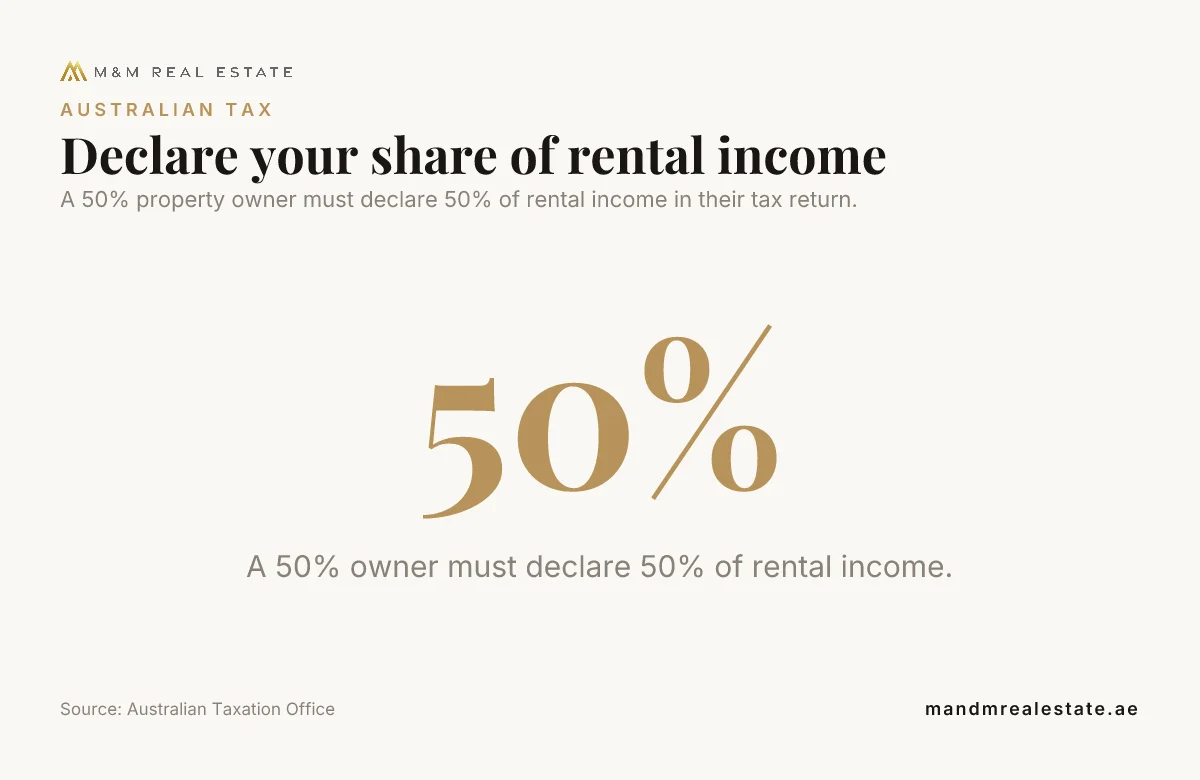
A 50% property owner must declare 50% of rental income in their tax return.
Source: Australian Taxation Office
Keep records of any change in ownership interests and the date it took effect. The ownership documents, rental statement and each owner’s return should tell the same story.
Wider investment structures are covered in M&M’s Dubai investment resources; M&M’s overview of property crowdfunding also covers them. Each owner should still report according to the legal interest shown in the relevant ownership records.
Treat UAE charges and foreign tax relief as separate questions
The UAE does not levy personal income tax on rent or property capital gains. An Australian tax resident still reports foreign rental income under Australian rules, so the UAE treatment and the ATO reporting question need separate answers.
Australia and the UAE have a double tax agreement. Its application depends on the relevant provision and effective date, but it does not by itself remove an Australian resident’s obligation to report Dubai rent in Australia.
A foreign income tax offset concerns qualifying foreign income tax paid and is subject to Australian rules and limits. Dubai municipal charges, building service charges and other property costs do not become foreign income tax simply because the owner paid them in relation to a rental property.
Record the nature of each Dubai payment and the authority or service provider that received it. This is general information, not tax or legal advice.
A sale can create a separate Australian capital gains tax issue
Selling the property raises a separate Australian capital gains tax question. The annual rental calculation does not determine the tax result on disposal, and sale proceeds belong in the sale calculation rather than the rental-income total.
Keep the purchase and sale documents, ownership details and records of eligible capital costs. Store improvement invoices separately from repair invoices because improvements may affect the cost base, while repairs are considered under rental deduction rules.
If the property is still under review, M&M’s investment cases include Bay Estate by Nakheel, The Yards Plaza office case and The Yards Plaza Investment Case. For payment-plan context, read M&M’s payment-plan analysis; its developer comparison covers developers.
What to prepare before lodging the return
- Confirm Australian tax residency and the relevant period with an Australian tax adviser.
- Reconcile gross rent, manager-held amounts, expenses and bank receipts.
- Keep the AED records beside the exchange-rate workings and Australian-dollar totals.
- Match income and expenses to legal ownership, and separate repairs from capital improvements.
An M&M advisor can go through your Dubai property plans, ownership records and operating costs with you. Contact M&M.
this article is general information and not tax, legal or financial advice, and returns are not guaranteed.


Can a rental loss from a Dubai property reduce salary income in Australia?
A rental loss may reduce other taxable income when the expenses qualify as deductions under Australian rules and exceed assessable rent. Private use, ownership and the owner’s tax status can affect the calculation, so an Australian tax adviser should review the loss before it is claimed.
Are mortgage principal repayments deductible on a Dubai rental property?
Mortgage principal repays borrowed capital and is not a rental expense deduction. Interest may qualify when the borrowing relates to earning rental income, with any private or other use considered separately.
How are periods when a Dubai property is vacant treated for Australian tax?
A vacant property can still have rental expenses during a period when it is genuinely available to tenants. Keep evidence of advertising, agent instructions and the dates the property was ready for rent, since personal use or a decision to hold it off the rental market changes the expense analysis.
What changes if an Australian resident uses the Dubai property privately for part of the year?
Private use can require the owner to apportion expenses between rental and personal use. Keep a calendar of occupancy and rental availability, together with the bills for the same period, so the calculation reflects how the property was used.
Is rent taxable income in Australia?
Yes. Include Dubai rent in the Australian return for the income year it relates to.
What is the most tax-efficient way to be a landlord?
There is no single approach that suits every landlord; ask an Australian tax adviser to review the arrangement before lodging if the property has mixed private and rental use.


