


How should I compare Dubai service charges with annual property holding costs in Spain? Build the same annual cost schedule for each property, with Dubai service charges, Spain’s IBI and community fees, and the other recurring bills shown separately. Dubai Land Department’s Service Charge Index lets buyers check the approved service charge for a specific Dubai property.
- Compare annual ownership costs, not purchase fees, sale costs or payment-plan instalments. M&M Real Estate’s guidance for investors considering Dubai from Spain covers the wider cross-border context.
- In Dubai, a service charge is one line in the annual budget. Utilities, insurance, repairs and property management may sit outside it.
- In Spain, list IBI and community fees separately, then add household and property costs that apply to the chosen use.
- Compare both the full annual total and the cost per square metre, using the same area basis and occupancy assumptions.
- Keep predictable bills separate from vacancy, repairs and major works. Model those variable costs as scenarios.
- For a rental comparison, deduct costs from rent before judging net rental yield. A gross rental yield does not show the income left after expenses.
Define the annual cost you are comparing
Keep one-time purchase and sale costs outside the annual holding-cost total. They affect the amount of capital needed to buy or sell, while recurring costs show what it takes to own and operate the property year by year.
Use the same cost categories for both homes. Separate recurring bills from costs that depend on use, an empty period or a repair.
| Annual cost line | What to record |
|---|---|
| Building and local charges | Dubai service charges, or Spain’s community fees and IBI, each listed separately. |
| Property and household costs | Utilities, insurance, routine maintenance and any property-management fee. |
| Variable costs | Vacancy, repairs and major works, shown as separate scenarios. |
| Purchase and sale costs | Record separately from the annual total. |
Set the occupancy assumption before comparing bills. An owner-occupied home and a rented property can have different utility use, management costs and responsibilities under the tenancy arrangement.
Do not read the absence of a particular recurring property tax as a zero-cost ownership case. The building still needs upkeep, and the owner may still pay for insurance, repairs, utilities or management.
For an off-plan purchase, keep construction-stage instalments separate from post-handover running costs. M&M’s article on the Beyond payment plan concerns how purchase payments are structured, which is a different question from the annual cost of holding a completed property.
Understand what Dubai service charges include
A Dubai service charge is a recurring building-level contribution towards shared areas and services. Depending on the building, that can include items such as common-area cleaning, security, lifts, landscaping and shared facilities.
Buildings do not all provide the same services or work to the same budget. Compare the approved charge for the specific property with the services included and the building’s maintenance record, rather than relying on a district average or another unit’s bill.
For the building’s approved information, consult the Dubai Land Department’s Service Charge Index and Mollak, the DLD system for service-charge oversight. Ask for the budget and the list of included services. Keep utilities, insurance, repairs inside the unit and property management in separate lines unless the building’s stated charge expressly covers a particular service.
Where a Dubai charge is quoted as an annual rate per square foot, estimate it by multiplying the rate by the unit’s chargeable area in square feet. Treat this as a cross-check, not a substitute for the approved bill: confirm whether balconies or other spaces are included, and use the rate and area attached to that property. A rate from another building or a sale listing may not match the approved assessment.
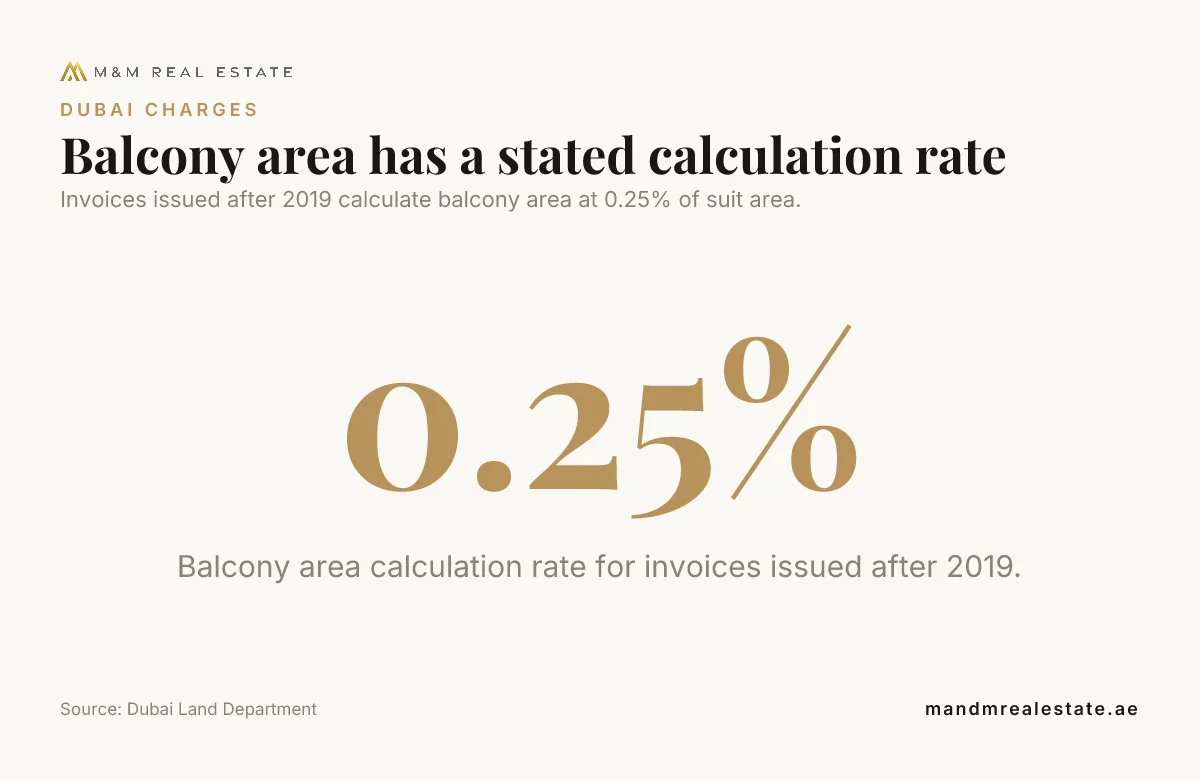
Invoices issued after 2019 calculate balcony area at 0.25% of suit area.
Source: Dubai Land Department
The stated balcony-area percentage is not explained well enough to use as a general rule and may materially understate chargeable area. Ask for the unit’s area schedule and approved charge calculation, and verify how any balcony area is treated before multiplying a rate by the area. This avoids letting an unexplained area convention distort the annual comparison.
Facilities and management affect what owners pay, so the lowest charge is not automatically the strongest value. Compare the service level and upkeep against the charge for the unit you are considering.
For a buyer assessing a particular district, M&M’s Downtown Dubai property advisory supports clients from defining their objectives and identifying opportunities through purchase and handover. M&M’s Dubai developer profiles and Emaar and DAMAC comparison provide further context when reviewing a project and its delivery background.
Build the Spanish annual-cost checklist
List IBI, the annual municipal property tax, separately from community fees. Community fees fund shared building or development costs through the owners’ association, while IBI is a local tax linked to the property.
Then add maintenance, insurance, utilities and any property-management fee. IBI and community fees are important lines, but they do not represent every cost of owning a Spanish property.
Local charges and responsibility for bills can vary with the property’s municipality and its use. Identify any municipal or occupancy-related charge that applies, then establish from the relevant bill and tenancy terms whether the owner, tenant or both pay it.
Community facilities and association budgets also differ between properties. A home with shared services may carry different costs from one with fewer shared facilities, so compare the budget and the services together.
For a hypothetical Spanish home, let I be the IBI on its bill and C its annual community fee. Its recurring-cost total is I + C + owner-paid insurance + utilities + maintenance + management. Keep a major-works contribution or repair allowance as a separate scenario, and check whether any cost is already bundled into another bill before adding it. This gives you a property-specific budget without treating the tax and association fee as interchangeable.
For the Dubai side of a shortlist, off-plan properties in Dubai covers project analysis, direct developer access and support through handover. That helps investors assess a specific project before comparing its eventual recurring costs with a Spanish property.
What foreign buyers get wrong in Dubai off-plan, what each mistake costs, and exactly what to do instead.
Download free→Normalise the comparison for size, amenities and use
Compare the full annual cost and the annual cost per square metre. Dubai charges may use a different area basis from a Spanish property record, so convert both properties to the same area measure before comparing them.
Match homes with similar shared facilities where possible. If one building has facilities that the other lacks, show their associated costs separately instead of treating the headline service charges as directly equivalent.
Use the same occupancy assumption on both sides. For a rental comparison, separate the owner’s costs from any costs passed to a tenant under the relevant tenancy terms.
Set one exchange rate and one comparison date for the currency conversion. Record the rate beside the calculation, so changes in the euro-to-dirham exchange rate do not hide differences in the underlying annual bills.
Facilities and management arrangements can reflect area choice. To assess a property, consult M&M’s Dubai area guides for a shortlist and the Investment Case for The Yards Plaza for a project-specific reference point.
Separate fixed bills from variable and occasional costs
Put predictable recurring bills in one part of the budget: service charges, IBI and community fees. Keep utilities, repairs and property management visible as separate lines, since their amounts may change with use and the service provided.
Model vacancy and major building works as separate scenarios. They are not guaranteed annual bills, but leaving them out can make a rental budget incomplete.
Check the building budget and the services it funds before judging a low charge as good value. A lower bill can come with a different level of maintenance or shared facilities, so compare the upkeep and inclusions as well as the amount.
Keep municipal charges, taxes, utilities and service charges distinct to prevent double counting. If a bill bundles several services, split out the parts that belong to different cost categories before adding the annual total.
Neighbourhoods offer useful context for a shortlist, not a substitute for a building’s approved charge. M&M’s guides to Jumeirah Village Circle and Dubai Hills Estate can help frame area choices; compare the actual buildings and facilities under consideration.
Translate annual costs into net rental income
Calculate net rental income by deducting applicable ownership costs, management, maintenance and vacancy from rent. Gross rental yield describes rent against purchase price before those deductions, so it does not show the income an owner retains.
Use the same expense categories and occupancy assumptions for both properties. Show Dubai service charges as a distinct deduction, so their effect on the rental result is clear.
Keep predictable bills apart from variable costs. Run a separate scenario for a repair or vacancy period to see how each would change the annual result, rather than folding either into a fixed bill.
Rental demand is another assumption to assess separately from ownership costs. M&M’s article on Dubai population growth provides wider context for considering a rental plan, while the property’s own costs still need to come from its building and operating budget.
For a matched rental comparison, let R be scheduled annual rent and V the rent expected to be lost to vacancy. For Dubai, estimate net rental income as R - V - service charges - owner-paid operating expenses. For Spain, use the same basis, deducting IBI and community fees as well as the other owner-paid expenses. Divide each result by the same purchase-price basis to compare net yield. Keep major works as a separate scenario, and show annual costs alongside yield so similar yields do not conceal different cash outlays.
Account for ownership structure and tax residency
Keep building and property expenses separate from tax consequences linked to the owner’s residence, ownership structure or cross-border position. A change in tax residency can alter the wider investment calculation even when the building costs stay the same.
For residence planning rather than the property’s annual operating-cost total, consult M&M’s Dubai property Golden Visa guide, which covers the route.
Ownership structure also affects the investor’s wider plan. M&M’s article on property crowdfunding in Dubai describes a different way to access property exposure, while its Dubai property tax guide addresses tax questions for property investors.
Ask a Spanish tax adviser to assess your circumstances and coordinate that advice with the Dubai investment plan. This is general information, not tax or legal advice.
Further Dubai investment reading
Use project and payment information to understand the purchase decision, while keeping it separate from the recurring-cost worksheet. For project-level reading, consult the Bay Estate Investment Case and The Yards Plaza project analysis.
Further context on developer and investor decisions is available in M&M’s Dubai investment resources and its guide to Dubai real estate investment.
See also: Al Jaddaf Waterfront Guide 2026: Prices and Metro.
What to do next
Build a cost sheet for each shortlisted property. Gather the Dubai building’s approved charge and included services, the Spanish property’s IBI bill and community budget, and the expected costs for utilities, insurance, maintenance and management.
Then compare the annual totals and cost per square metre under the same occupancy assumption. Keep vacancy and major repairs as separate scenarios, and use one exchange rate date for the euro and AED comparison.
An M&M advisor will go through your budget, timeline and shortlist with you. Speak with an M&M advisor about comparing Dubai service charges with annual property holding costs in Spain.
this article is general information and not tax, legal or financial advice, and returns are not guaranteed.


Can you refuse to pay a Dubai service charge?
No. An owner remains responsible for approved service charges under Dubai’s jointly owned property framework. For a billing dispute, contact the building manager and use the Dubai Land Department’s Mollak process; an approved charge is not optional.
What is the typical range of property management fees in Dubai, and what affects the fee?
There is no single fee that applies to every Dubai property manager. The quote can depend on whether the service covers tenant sourcing, rent collection, maintenance coordination or ongoing reporting, so compare the scope and charging method in each proposal.
Are community fees in Spain included in IBI?
No. IBI is a municipal property tax, while community fees fund shared areas and services through the owners’ association. An association may also approve a separate contribution for major works.
Do Spanish owners still pay IBI on a second home or a vacant property?
Yes, owners generally remain liable for IBI on a second home or vacant property because the tax relates to the property, not whether someone lives in it. The local municipality administers the tax.
How should I compare costs when I pay expenses in euros and the Dubai costs are in AED?
Convert each annual budget using the same exchange rate and date, and record both the original currency amounts and the converted totals. Keep bank transfer charges and exchange costs separate from property operating expenses, since they arise from moving money rather than running the property.


