


For waterfront property in Dubai, the asking price depends on the home’s position by the water, its features and condition, and evidence from comparable completed sales. A waterfront premium is easier to assess when you compare homes with similar access, views and ownership costs.
- Compare a waterfront home with similar properties in the same development, then account for access, view and condition.
- Use completed sales to test an asking price. Current listings show what sellers are asking.
- Match property type, layout and size before comparing prices per square foot.
- For area comparisons, pair building-level evidence with M&M’s Dubai area guide for different investment goals.
- Estimate rental income after service charges, maintenance, management costs and vacancy.
- For a wider view of Dubai property investment, keep the home’s intended use and likely holding period in the calculation.
What a waterfront premium actually reflects
Waterfront homes can command higher asking prices because buyers may value direct shoreline access, a water view or a position within a waterside community. These features offer different experiences, so the label waterfront alone cannot establish what a particular home is worth.
Beachfront homes meet the shoreline. Marina-facing apartments look across berths and boats. A home elsewhere in a waterfront community may sit further from the water, so distance, access routes and shared facilities still need to be compared. M&M Real Estate’s waterfront offering covers villas, beachfront residences, marina apartments and commercial property.
A waterfront premium should be tested against other homes in the same development. Arabian Business reported that comparable coastal homes attracted premiums of 30 to 60 per cent over inland stock within the same development.
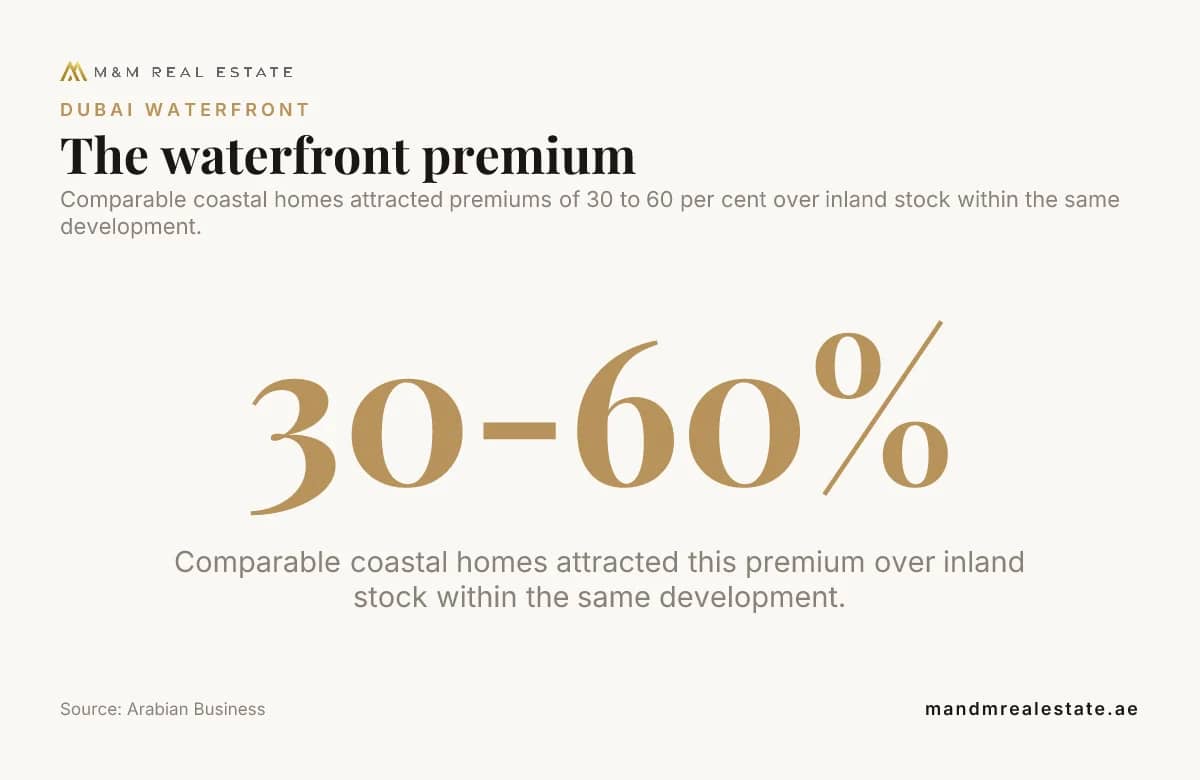
Comparable coastal homes attracted premiums of 30 to 60 per cent over inland stock within the same development.
Source: Arabian Business
That reported range gives context, not a rule for every listing. Scarce shoreline positions can support asking prices when buyer demand is strong, while the quality and usability of each frontage still determine whether a particular price is defensible.
Location, views and access change the comparison
Compare beachfront, marina, creek and lagoon settings as distinct property experiences. A view across water gives a visual connection; direct beach or promenade access gives residents a route to use the waterfront.
Dubai Marina’s completed towers sit around a marina and promenade, while Palm Jumeirah has different positions across its trunk, fronds and crescent. Area differences are set out in M&M’s Dubai Marina guide and Palm Jumeirah guide. Compare the exact building and route to the water, not just the community name.
Assess the view from inside the home. Floor, orientation and nearby buildings affect the outlook, privacy and amount of direct light. A high floor can change what a resident sees, while a lower floor may offer a shorter route to outdoor spaces.
Check how the location fits everyday routines alongside the water access. Public transport, shops and other regular destinations can affect a home’s usefulness to residents and tenants. For wider area comparisons, consult M&M’s Dubai area guides, including Jumeirah Village Circle and Dubai Hills Estate.
Build a like-for-like comparison from completed sales
To judge whether a waterfront listing is fairly priced, start with recent completed sales in the same building or development. A community-wide average can combine different property types, views and conditions, so it may offer little guidance for one specific home.
Compare price per square foot after matching property type and size. Then account for condition, floor, view, orientation and access. A larger home with a less useful layout may have a lower price per square foot and still suit a buyer less well.
Use several close comparables and note why each differs from the property you are assessing. An asking price records a seller’s expectation. A completed sale records an agreed transaction value.
We advise buyers to keep a short comparison record: the building, property type, size, condition, view and access for each sale. A wider project and delivery review can draw on M&M’s Dubai investment resources, developer profiles and developer comparison guide.
Property type, size and condition shape the asking price
Compare villas with villas, townhouses with townhouses and apartments with apartments. Each property type offers a different layout and use of space, so a price-per-square-foot comparison across unlike homes can mislead.
For apartments, assess bedroom count and arrangement, floor, aspect and view together. Two homes with the same number of bedrooms can function differently if one has a more practical layout or a clearer outlook.
Condition also affects the price of a ready home. Salt-laden air can accelerate corrosion on metal fittings and wear on external finishes, so inspect balconies, railings, sealants and exposed metalwork. Likely upkeep belongs in the valuation, alongside the building’s service charge and maintenance history.
M&M’s page for Al Jaddaf Waterfront provides a location reference.
Twelve chapters on what the regional war tested, the balance sheet and dollar peg behind the market, and how to pick the right side of this cycle.
Download free→Supply, construction and community investment matter
An established community with completed homes and amenities offers a different purchase timeline from an area where construction is still progressing. Delivery timing affects when a buyer can use the home and its surroundings, and it shapes which completed sales provide the closest comparison.
Compare the setting and facilities in each community. Different waterfront locations and development stages are covered in M&M’s Dubai Creek Harbour guide and Dubai Islands guide; its Bay Estate Investment Case gives a project-level reference for a developing island community.
Planned housing supply can change how scarce a position feels. New transport links and public amenities can improve convenience. Treat these plans as part of the location assessment, not as a promised change in the property’s price.
For an off-plan purchase, review the construction stage, payment schedule and developer information as separate parts of the decision. For an off-plan purchase, M&M’s off-plan buying guide, overview of off-plan properties in Dubai and article on a developer payment plan cover those topics. Its Dubai population analysis adds context on how the city plans for residents.
Assess rental potential alongside ownership costs
Gross rental yield is an initial comparison, not the income left after costs. Deduct service charges, maintenance and management costs, then allow for realistic vacancy periods when estimating net income.
Arabian Business reported that prime waterfront apartments and villas generated gross rental yields between 5 and 8 per cent during 2025. That is historical context for a category of homes, not a forecast for an individual property.
Keep rental yield separate from capital growth. A marina apartment may suit an investor who values rental income and exit flexibility, while a buyer focused on personal use may give more weight to access, layout and daily convenience. M&M describes its marina apartments as offering rental potential and exit flexibility.
Include transfer fees and other acquisition costs in the ownership budget.
Use your intended holding period and use of the home to decide which costs deserve the most attention. M&M’s guide to Dubai rental yields, costs and tax examines rental income, while its guide to tax on Dubai property covers a separate part of ownership planning.
Related guides for adjacent investment decisions
Some decisions sit beside price assessment. M&M’s guide to the property route to the Dubai Golden Visa covers residency planning. Its Dubai property crowdfunding guide covers pooled property investment.
For comparisons beyond residential waterfront homes, see the Investment Cases for The Yards Plaza by BEYOND and The Yards Plaza offices.
What to do before accepting an asking price
Build a shortlist of comparable completed sales, record the differences in access and view, and estimate service charges and maintenance alongside any rental income. For an off-plan home, add the construction stage and payment schedule to the same review.
An M&M advisor will go through your budget, timeline and shortlist with you. Speak with an M&M advisor about your waterfront property assessment.
Figures are past data from the sources named; this article is general information and not tax, legal or financial advice, and returns are not guaranteed.


Does a waterfront premium guarantee stronger capital growth?
No. A premium describes a price difference at the time of comparison, while the eventual sale price depends on the buyer and market conditions at exit. Set your assessment against your intended holding period and selling costs.
Can an off-plan asking price be compared directly with a completed waterfront sale?
Compare the total contracted price, payment timing and property specification before drawing a conclusion. A completed home can be occupied at transfer, while an off-plan home depends on construction and delivery.
How can planned construction affect a waterfront view after purchase?
Review the approved master plan and nearby development plots alongside the view from the home. A rendering describes a proposed design, while the surrounding construction schedule can change what is visible and when.
Can a waterfront property suit an owner who does not plan to rent it out?
Yes. The decision can rest on personal use, access, privacy and the layout that suits the household. For a home that may sit empty for periods, include property checks and maintenance arrangements in the ownership plan.


