


Rental yield compares a property’s annual rent with its purchase price, giving investors a clear measure of its income potential. If you are asking what rental yields are and why you should be paying attention, the answer is that they help you compare properties before assessing costs, occupancy and capital growth.
What rental yield measures and how to calculate it
Gross rental yield shows annual rent as a percentage of a property’s purchase price. Divide the annual rent by the purchase price, then multiply by 100.
Use a full year’s rent, not one month’s rent. Make sure the rent and purchase price refer to the same property, and that the period behind the rent estimate is clear.
Rental yield is an income measure. Future rent needs its own estimate, and overall investment performance also depends on costs, financing and any change in the property’s value.
For a first comparison, use the same calculation for every property. A rental yield based on an advertised rent and a different property’s sale price gives you no useful comparison.
Gross yield versus net yield: account for the costs
Gross yield uses rent before expenses. Net yield estimates the rental income left after vacancy and landlord-paid costs such as service charges, maintenance, leasing and management fees.
For one consistent comparison, decide whether the investment amount includes purchase expenses. If you include them in the denominator for one property, include them for the other as well. Add furnishing and repair allowances where the property needs them.
Model the expenses the owner is expected to pay under the lease. Do not deduct the same charge twice, and do not assume every operating cost falls to the landlord.
For a fuller breakdown of Dubai rental income, costs and tax, read our Dubai rental yield analysis.
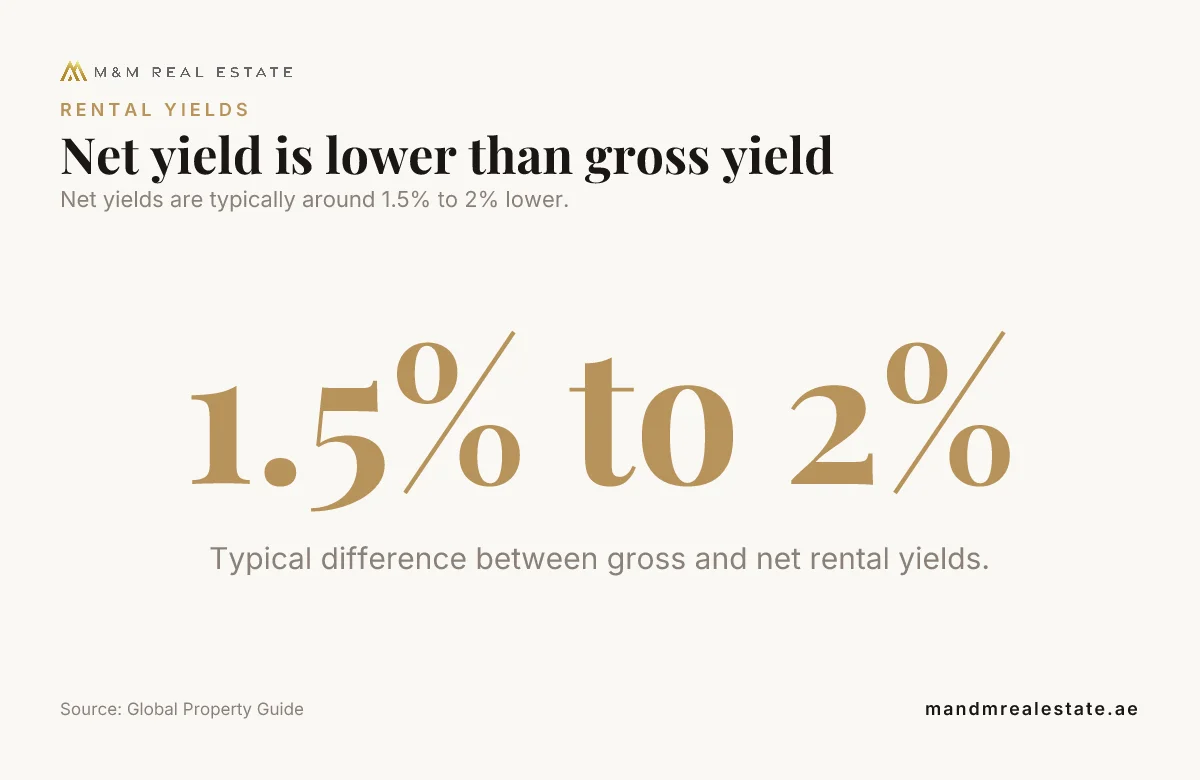
Net yields are typically around 1.5% to 2% lower.
Source: Global Property Guide
Yield is not ROI or cash-on-cash return
Rental yield compares rent with a property’s price. Return on investment (ROI) can also include capital growth or loss over a chosen holding period, so it measures a wider result.
Cash-on-cash return compares annual cash flow after financing and relevant costs with the investor’s cash invested. Mortgage payments affect cash flow and cash-on-cash return; they do not change a property’s gross rental yield.
| Measure | What it compares | What to keep separate |
|---|---|---|
| Gross rental yield | Annual rent and property purchase price | Operating costs and vacancy |
| Net rental yield | Rent after modelled vacancy and owner costs, against the investment amount | Financing and changes in value |
| Cash-on-cash return | Cash flow after financing and relevant costs, against the investor’s cash invested | Any change in the property’s value |
| ROI | The investment result across a chosen holding period | Use assumptions suited to the holding period |
Include transaction costs, financing and applicable taxes in the investor’s wider assessment. The result can differ from the property’s rental yield, so keep each calculation labelled and use assumptions that match the investment period.
Our guides to tax on Dubai property and the property route to a Dubai Golden Visa cover other questions that may sit alongside an income calculation. This is general information, not tax or legal advice.
For a view of property investment beyond rental income, compare the Dubai Islands investment case with the The Yards Plaza offices case. Our guide to Dubai property crowdfunding explains a different way investors can approach property exposure.
Compare like with like across Dubai locations and property types
Compare similar homes using the same assumptions for rent, purchase price, furnishing, lease type and occupancy. Separate achieved rent from asking rent: an advertised figure describes what an owner hopes to receive, while a signed lease shows the agreed amount.
Apartments can need less initial capital and may suit a broad tenant pool, while service charges can reduce net income. Villas and townhouses often require more capital and bring different maintenance needs and tenant profiles.
Compare absolute rent as well as percentage yield. A property with higher rent in AED can still have a lower yield if its purchase price is also higher.
Global Property Guide says net yields are typically around 1.5% to 2% lower than gross yields.
Use them as context for a like-for-like review, not as a ranking of every property in either area. M&M’s Dubai area guides cover locations with different tenant profiles and property types.
For a wider comparison of area characteristics, read which Dubai property area fits your investment goal.
What counts as a good rental yield?
There is no single yield that makes every property a sound investment. Compare the net figure with similar local properties and assess whether the rent, occupancy and costs fit the investment’s purpose.
Global Property Guide reports that the United Arab Emirates’ average gross rental yield stood at 4.94% in Q2. Use that UAE-wide figure as broad context, not as a target for an individual property.
A very good rental yield is one that remains attractive after realistic costs and fits the investor’s aims. An 8% gross yield can produce a lower net yield once vacancy and owner expenses are included, so the headline percentage alone does not settle the comparison.
We compare rental income with the capital required, then look at tenant demand, property condition, service charges and the owner’s likely costs. Our Dubai Hills area guide and Al Jaddaf Waterfront guide describe distinct location contexts for that kind of review.
Rental demand also changes with the people living and working nearby. Read our analysis of Dubai’s population growth and resident planning alongside a property’s own tenant profile.
Test the rent assumptions before relying on a yield estimate
Base a rental estimate on achievable rent and evidence of tenant demand. Compare similar homes with similar furnishing, occupancy and lease arrangements, and separate asking rents from rents recorded in signed leases.
For a new or off-plan property with limited rental history, model a conservative rent, some vacancy and realistic running costs. Then test whether the resulting net income still fits the investment objective.
Tenant demand, location and property type all affect occupancy. Assess possible capital growth separately from rental income, since the rent estimate alone does not measure a change in value.
For an off-plan purchase, examine the payment schedule, developer and handover terms alongside the rental estimate. Our Dubai developer profiles, developer comparison guide and explanation of how a 30/70 payment plan affects a purchase address parts of that review.
Our guides to Dubai property investment and buying off-plan property provide further context. You can also browse off-plan properties in Dubai and our Dubai investment resources.
For project-specific analysis, read our The Yards Plaza investment case and its Investment Case. These project reviews consider investment factors beyond a single advertised yield.
See also: JVC (Jumeirah Village Circle) Investment Guide 2026.
What to do before you commit
Ask for the rent evidence behind the estimate, list the owner-paid costs and model vacancy before comparing properties. Then assess the net yield beside tenant demand, financing, purchase costs and your expected holding period.
What are rental yields and why should you be paying attention? They give you a practical starting point for comparing income, provided you test the assumptions behind the percentage. An M&M advisor will go through your budget, timeline and shortlist with you. Speak with an M&M advisor.
this article is general information and not tax, legal or financial advice, and returns are not guaranteed.

What is the 2% rule, and does it apply to Dubai property?
The 2% rule is a screening shortcut that compares a property’s monthly rent with its purchase price. Treat it as a rough filter, not a Dubai benchmark or a substitute for a full annual cost calculation.
Should a refundable tenant security deposit be counted as rental income?
No. A refundable deposit is money held against the tenant’s obligations, not rent earned by the owner. Count it as income only if an amount is later retained under the tenancy terms.
How should I calculate yield if a property is vacant for part of the year?
Use the rent actually received during the full year for an actual-income calculation. Keep a separate full-occupancy figure if you want to compare the contract rent with other properties.
Can I compare a short-term rental yield directly with an annual lease yield?
Only after aligning the period and income basis. For a short-term let, account for booked nights, turnover, platform or operator charges and the costs of preparing the home between guests.


