UK residents can apply for a UAE bank mortgage secured on a Dubai property, or raise funds through borrowing against a UK home. The two routes have different regulators, loan currencies and UK tax considerations.
UK residence, British citizenship and expat status affect eligibility
A British passport confirms citizenship, not where you live or how a lender will classify you. Tell the bank whether you live in the UK, live elsewhere as a British expat, or hold UAE residence, because its rules for non-UAE residents may differ from those for UAE residents.
Make UK income easy to assess. Gather salary records, details of bonuses or commission, self-employment accounts and a clear list of existing debts. A lender may assess variable income differently from a fixed salary, so show how often it is paid and how it has changed.
The maximum debt burden ratio is 50% of gross salary and any regular income from a defined and specific source at any time, according to the Central Bank of the UAE (CBUAE). This ceiling does not set an individual borrowing amount: the bank still assesses income, regular commitments and its own affordability criteria.
M&M Real Estate also advises on luxury villas, branded residences, townhouses and commercial property across Dubai. This range is relevant because a lender’s eligible property types can affect which purchases it will finance.
For a UK-based buyer, our UK investor service covers the wider purchase process. Treat residency, income and the intended property as separate parts of the lender’s assessment.
Compare fixed, variable and Islamic home finance
A fixed-rate mortgage holds its rate for an agreed initial period. Ask how the lender calculates repayments after that period ends, since the loan may then move to a variable rate.
A variable-rate mortgage can change when its benchmark or lender margin changes. If the offer refers to EIBOR, the UAE interbank benchmark, ask how often the rate resets and model payments at a higher benchmark before comparing starting rates.
| Finance structure | What to compare |
|---|---|
| Fixed-rate mortgage | The fixed period, repayment after it ends, fees and early-settlement conditions. |
| Variable-rate mortgage | The benchmark, the lender’s margin, how often the rate can change and the effect on repayments. |
| Islamic home finance | How an arrangement such as Ijara or Murabaha sets payments, ownership and the total amount payable over the agreed term. |
Islamic home finance uses a structure such as a lease or a purchase-and-resale arrangement. Compare the contract’s payment schedule and ownership terms with a conventional mortgage, then ask how early repayment and required insurance affect the total cost.
A loan secured on Dubai property falls outside the FCA definition of a regulated mortgage contract, which covers loans secured on UK land. A remortgage secured on a UK home is regulated under the UK framework, as set out in the FCA’s mortgage guidance.
Work out the deposit and realistic borrowing limit
The deposit depends on the lender’s offer for the buyer and property. A bank can offer less than the applicable maximum.
Ask the lender to state whether it calculates the loan-to-value ratio against the purchase price or its own valuation.
For an off-plan purchase, build the deposit plan around the developer’s payment schedule and the lender’s written terms. Our Dubai off-plan buying guide explains how instalments and escrow, the account used for project payments, fit into the purchase process.
The CBUAE allows expatriates maximum financing of up to 7 years’ annual income, and the maximum mortgage tenor is 25 years (CBUAE). These are regulatory limits, not a personal borrowing estimate.
Mortgage loan providers must stress-test the loan at 2 to 4 percentage points above its current interest rate, depending on the interest-rate cycle, according to the CBUAE. A higher test rate can reduce the amount a lender approves.
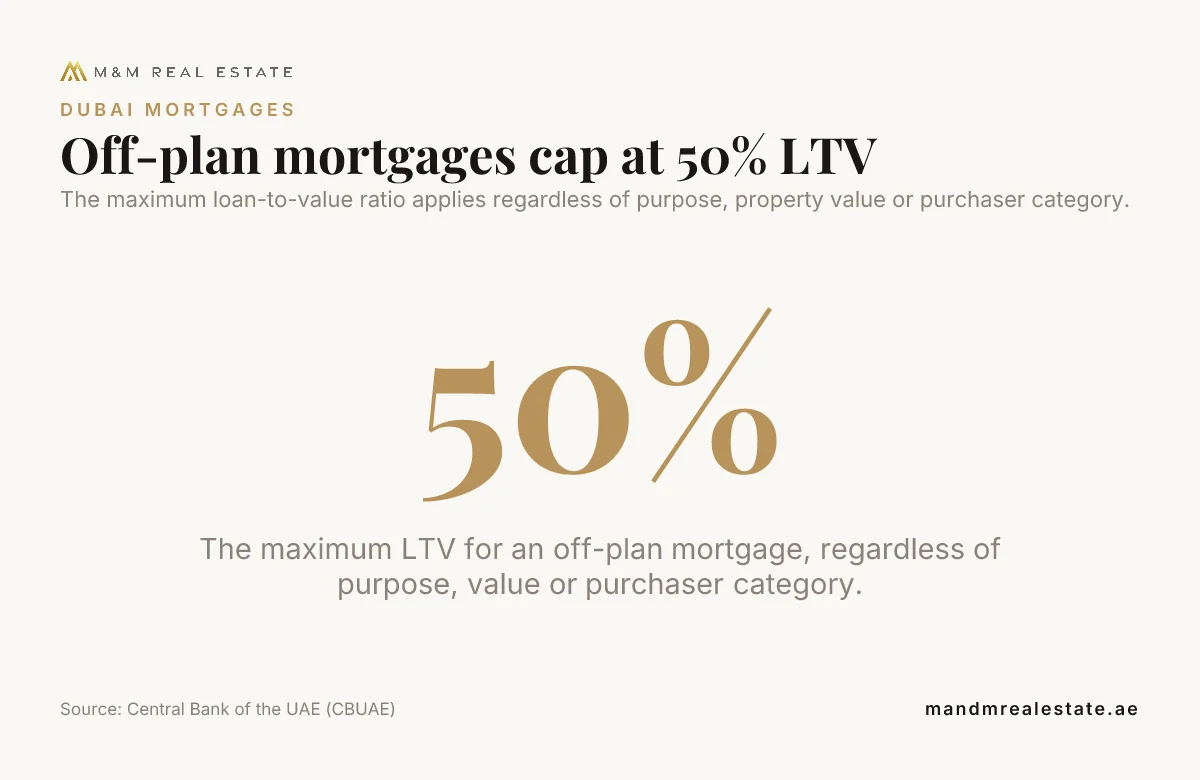
The maximum loan-to-value ratio applies regardless of purpose, property value or purchaser category.
Source: Central Bank of the UAE (CBUAE), verified October 2026.
Keep cash above the deposit for fees, valuation and exchange-rate movement. Buyers considering off-plan property can also review Dubai off-plan properties before deciding how a lender’s criteria fit a specific development.
Prepare a clear application file for UK income
Give the lender a consistent record of who is applying, where their money is held and how they earn it. Prepare identity and address evidence, recent bank statements and proof of employment or income.
- For employed applicants: Organise payslips and employment evidence. Show bonuses separately from base salary so the lender can assess their frequency and reliability.
- For self-employed applicants: Prepare business and personal financial records that show the source and history of income. Company drawings may be assessed differently from salaried pay.
- For all applicants: List loans, credit commitments and recurring costs accurately. Keep a documented trail for the deposit and any other funds being transferred.
Clear records of savings, sale proceeds or other funds help the bank understand the deposit’s source.
Follow the route from approval in principle to completion
- Request an approval in principle. It gives an indicative borrowing range while the lender reviews your finances.
- Check the property with the lender. Ask whether it accepts the property type, location and development before making a purchase commitment.
- Complete the property valuation. The bank uses its assessment of the property when it decides the final loan amount.
- Coordinate the purchase and mortgage steps. Align the application, lender conditions, purchase documents and completion date.
- For off-plan, match finance to the instalments. Check the development’s payment schedule and how the lender will fund the purchase at each stage.
An approval in principle is an early affordability assessment. The final offer depends on the lender’s review of both the applicant and the specific property, so avoid a commitment that depends on unconfirmed finance.
Budget for fees and sterling-to-dirham transfers
The deposit is only one part of the cash requirement. Budget separately for transfer fees.
Budget separately for mortgage-registration costs, valuation, lender fees and any required insurance.
Plan when to transfer the deposit, fees and completion funds. Exchange rates can change before a later payment, so compare the full exchange cost and transfer charges at each stage.
Items to include in a mortgage budget
A mortgage budget should account for the loan, monthly repayments, currency movements, registration charges and tax.
- Loan and deposit: The loan and deposit depend on the lender’s offer, valuation and purchase price.
- Monthly repayment: Compare the lender’s quoted payment with your budget, taking account of the loan term and rate.
- Sterling equivalent: The GBP cost of a monthly payment can change when the exchange rate moves.
- Mortgage registration: Budget for the applicable mortgage-registration and trustee charges.
- Day-one cash: Budget for the deposit, purchase fees and mortgage-registration costs.
- UK rental tax: Include the UK tax position in the cost assessment for a residential let.
HMRC’s guidance on residential property finance costs and its rules for overseas property income set out the UK treatment. Confirm the tax position with a UK tax adviser before choosing how to borrow. This is general information, not tax or legal advice.
A mortgage secured on a UK home and a UAE loan secured on Dubai property can create different obligations and currency exposure. Compare the GBP cost of UK borrowing with the AED repayments and the timing of each transfer.
Compare lenders on total cost, conditions and property fit
Compare the rate with the full repayment schedule, fees, any change after an initial fixed period, early-settlement terms and required insurance. Ask how each lender treats UK income, existing debts and bonuses, and whether its property rules fit the intended purchase.
A mortgage broker may help identify lenders whose criteria fit a non-resident buyer and coordinate applications. Compare the services and any broker charges with applying directly to a bank.
Property acceptance deserves its own check. A lender’s valuation and development rules can change the final amount even after an initial affordability review.
For residence planning, the Dubai Golden Visa through property sets out a property-based route to residence. A mortgage does not itself issue a residence permit.
Use property research alongside lender criteria. These M&M pages cover location, demand, developer and investment considerations that can help shape a shortlist:
- Location and demand: Compare the Dubai area investment guide, Dubai location guides, JVC, Dubai Hills Estate and Al Jaddaf Waterfront. The Dubai population analysis adds context on city planning and demand.
- Developer and project checks: Review Dubai developer profiles, the Emaar and DAMAC comparison, the Bay Estate Investment Case and the Yards Plaza offices case.
- Payment structure and project research: Read the 30/70 payment-plan analysis and the Yards Plaza Investment Case.
- Rental and portfolio planning: Use the Dubai rental-yield guide, Dubai property tax overview, Dubai investment guide and property crowdfunding guide. The wider Dubai investment resources bring related reading together.
These pages support property selection and investment planning; the bank still decides whether it will finance the buyer and the specific property.
What to do now
First, ask the bank how it classifies your residence, income and intended property. Then request written indicative terms, check the lender’s property criteria, and prepare a cash plan covering the deposit, fees and currency movement.
An M&M advisor will go through your budget, timeline and shortlist with you. Contact M&M.
This article is general information and not tax, legal or financial advice; returns are not guaranteed.

Can a British citizen buy a home in Dubai?
Yes. A British citizen can buy property in Dubai without holding UAE residence, subject to the ownership rules for the selected property. A mortgage application has its own lender criteria.
Does buying a Dubai property with a mortgage automatically give the buyer UAE residency?
No. Property ownership and residence-permit approval are separate decisions. The DLD assesses applications under the requirements for the relevant permit.
Can UK income be used to qualify for a Dubai mortgage if it is paid in pounds sterling?
Yes, a UAE lender may assess income paid in sterling under its overseas-income policy. Keep payslips and bank statements in their original currency so the lender can reconcile the amounts.
What happens if the lender’s valuation is lower than the agreed purchase price?
The bank calculates its lending against its own valuation, which can leave a gap between the approved loan and the price in the sale agreement. The buyer can discuss a revised price with the seller or arrange additional funds, subject to the contract.
Can a buyer repay a Dubai mortgage early, and what should they check first?
A buyer can request an early-settlement figure from the lender. Check the contract for the settlement charge, any notice requirement and how the bank calculates the final amount due.
What are the best mortgage options for expats in the UAE?
The main options are a fixed-rate mortgage, a variable-rate mortgage and Islamic home finance, such as Ijara or Murabaha. The best fit depends on how you prefer repayments to work, the contract terms and costs, and whether the lender accepts your income and chosen property.
Why UK money is choosing Dubai
Tax, yields and the buying process, compared side by side for UK investors. 27 pages. Free by email.