


A Dubai property can fall within UK inheritance tax if the owner is a UK resident, depending on the long-term residence rules that apply to their worldwide estate. The answer to whether a Dubai property counts for UK inheritance tax if I’m a UK resident turns on residence history, ownership and the rules that apply to the estate.
The short answer: location and residence both matter
Dubai real estate is outside the UK because the land and building are in Dubai. That location alone does not settle the UK inheritance tax position: the key question is whether the owner’s worldwide estate falls within the UK rules.
The Statutory Residence Test sets residence for income tax and certain other UK taxes. Inheritance tax uses long-term residence rules, so someone’s current status for income tax does not answer the inheritance tax question on its own.
UK inheritance tax can still apply to an estate that includes Dubai property. Local property tax context is covered in M&M Real Estate’s guide to tax on Dubai property; for the asset’s location, see M&M’s Dubai area guide.
The physical property and its location belong in the estate records. The UK inheritance tax test determines whether that non-UK property is within the taxable estate.
How residence history affects your worldwide estate
Long-term residence is separate from the Statutory Residence Test
This is a different test from the Statutory Residence Test used for income tax and other tax purposes.
According to Tax Adviser, an individual is generally long-term UK resident for inheritance tax after being UK-resident in at least 10 of the previous 20 tax years. In a continuous run, this can bring worldwide assets into scope from the 11th year; with gaps, count resident tax years in the rolling window, not consecutive years.
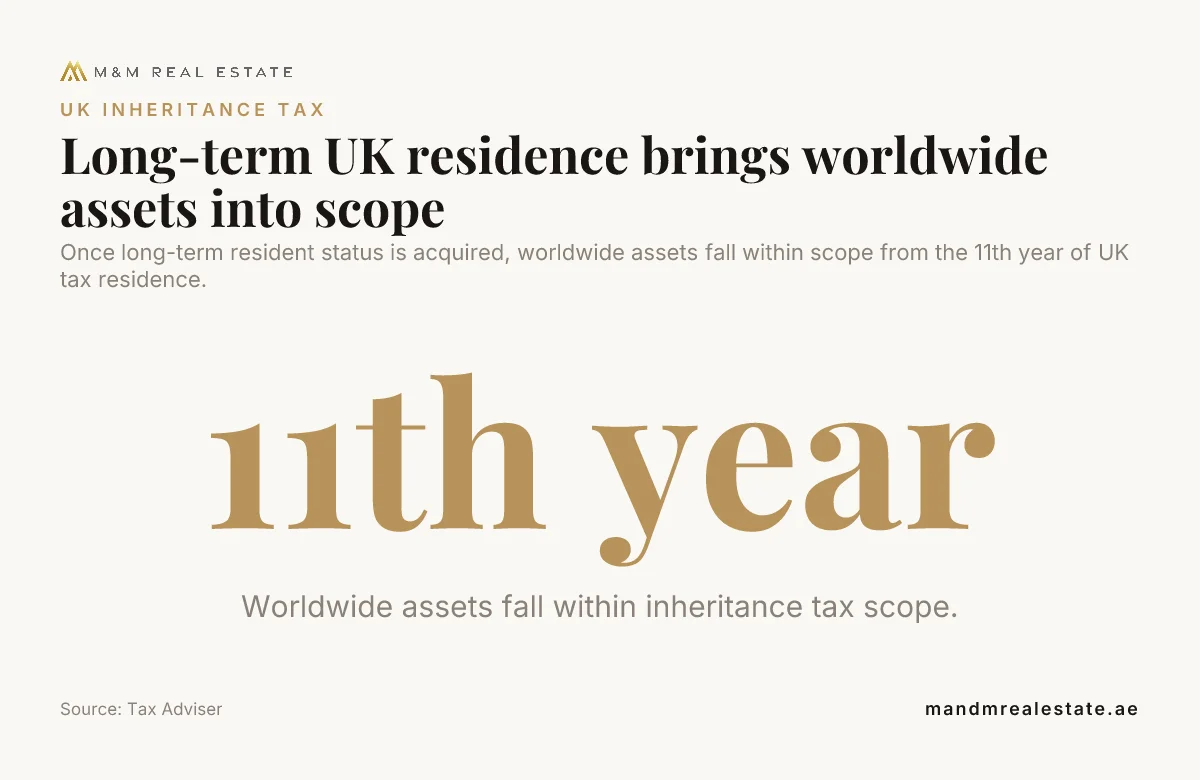
Once long-term resident status is acquired, worldwide assets fall within scope from the 11th year of UK tax residence.
Source: Tax Adviser
The 10-out-of-20 test is a general guide. The person’s year-by-year residence history and any transitional rules need to be considered, especially when residence or estate planning spans the change from the former domicile-based framework to the residence-based rules.
A Dubai Golden Visa and UK inheritance tax residence answer different questions; M&M’s Dubai Golden Visa through property guide covers the Dubai residence route.
Leaving the UK can leave an inheritance tax tail
Moving to Dubai does not immediately remove an owner’s worldwide estate from UK inheritance tax exposure. Tax Adviser reports that individuals who leave the UK will remain within the scope of inheritance tax for a period ranging from three to 10 years after their departure.
The length of that inheritance tax tail depends on the person’s residence history and the rules that apply to their case. Record the UK tax years spent resident, the departure date and any later return to the UK.
The tail is not fixed: the applicable period is linked to the number of UK-resident tax years in the 20-year look-back and falls within the three-to-10-year range. It lengthens in stages as residence history grows, so check the relevant band against the year-by-year record. If the owner returns, new UK-resident years enter the rolling count and earlier years may still count; leaving or returning does not automatically reset the position.
UK-situated assets can remain relevant to an estate even when the owner lives abroad. The inheritance tax tail is a separate question from income tax residence, so a move that changes one status may leave another in place.
Even after a person is no longer long-term UK resident and any tail has ended, UK-situated assets can generally remain within UK inheritance tax. A UK property does not leave the taxable estate simply because its owner lives abroad. The distinction is that non-UK assets, such as Dubai real estate, may fall outside scope when the worldwide-asset rules no longer apply.
What thousands of high-net-worth British residents are doing right now, the forces pushing them, and what Dubai offers in 2026.
Download free→Ownership structure changes what interest is assessed
For sole ownership, include the owner’s interest in the Dubai property when assembling the estate records. For joint ownership, establish the deceased owner’s share and whether the title records joint tenants or tenants in common, since the form of ownership affects how the interest passes.
Company or trust ownership changes the legal interest that needs assessment. Record the company’s ownership, the individual’s shares or other rights, and the trust’s terms, including the roles of settlor, trustees and beneficiaries.
The situs of directly owned Dubai real estate raises a different question from the situs and tax treatment of shares or other interests in an entity. Gather the title deed, purchase documents, finance records and any company or trust documents for a case-specific review.
Developer background is covered by M&M’s Dubai developer profiles, while its comparison of Emaar and DAMAC covers the property side of an investment file.
UK tax and UAE succession are separate processes
UAE succession or probate procedures deal with how property is transferred after an owner dies. UK inheritance tax deals with whether tax applies to the deceased’s estate, so a Dubai transfer process does not decide the UK tax position.
Ownership arrangements and estate documents can affect the local transfer process, so the executor needs to consider the UAE procedure alongside the UK estate assessment.
A will, joint ownership record, company documents or trust deed can each affect the route for transferring a Dubai property. Keep those documents with the title and purchase records so the executor can establish how the property is held.
Assemble the records for a UK inheritance tax assessment
A useful estate file sets out the owner’s residence history and the legal and financial details of the Dubai property. Organise these records before assessing the property in isolation from the rest of the estate:
- A year-by-year record of UK tax residence, including the years spent in the UK and any period since leaving.
- The title deed, purchase agreement, ownership shares and records of any company, trust or other arrangement.
- Valuation information for the property and documents showing associated borrowing or other debts.
- Details of other estate assets, lifetime gifts, available exemptions and allowances, including the nil-rate band and residence nil-rate band where relevant.
Allowances, exemptions and gifts form part of the wider estate assessment. A Dubai property’s treatment depends on the owner’s residence status, ownership interest and the rest of the estate.
M&M Real Estate’s British investor guide gives British investors a starting point for wider Dubai property questions while the inheritance tax assessment remains specific to the individual.
Rental and holding context is covered by M&M’s Dubai rental yield guide and investment resources. Area and purchase material includes guides to JVC and Dubai Hills Estate, alongside M&M’s analysis of Beyond’s 30/70 payment plan.
Investors reviewing different ownership routes can also read M&M’s guide to Dubai property crowdfunding and its The Yards Plaza Investment Case.
This is general information, not tax or legal advice.
See also: Off Plan Properties in Dubai.
What to do now
Start with the owner’s UK residence timeline, including years of residence and the date of any departure. Then assemble the property title, ownership structure, valuation and debt records, along with documents for any trust or company.
Assess the Dubai property as part of the estate, including other assets, gifts and any available allowances. An M&M advisor can go through the ownership file and residence timeline; ask a UK tax adviser to confirm the 10-out-of-20-year test, any departure tail, and the treatment of company or trust interests and gifts where the donor retained a benefit.
Contact M&M about the Dubai property and the records needed for an estate assessment.
this article is general information and not tax, legal or financial advice, and returns are not guaranteed.

Who is responsible for dealing with UK inheritance tax on a Dubai property after the owner dies?
The personal representative named in the will, or the administrator appointed where there is no will, handles the estate’s UK inheritance tax reporting and payment. They gather information about overseas assets as part of the estate administration.
How is a Dubai property valued when assessing a UK inheritance tax estate?
The estate assessment uses the property’s open-market value at the date of death. The executor records the value in sterling using an exchange rate that applies to that valuation date.
Does the UK-UAE double taxation treaty cover inheritance tax?
The UK-UAE double taxation agreement covers income tax matters and does not provide an inheritance tax route. Relief for tax on rental income or gains therefore answers a different question from whether UK inheritance tax applies to an estate.
Can a UK will determine how a Dubai property is transferred?
A UK will records the owner’s wishes, while Dubai’s local authorities apply their procedures to register a property transfer. The executor should establish whether the will is recognised for the Dubai property and which local probate process applies.


