


Yes. If you are a Dutch tax resident and own Dubai property privately, you generally report it among your foreign assets in Box 3; treaty relief is considered later when the tax is calculated.
- Reporting a Dubai property and working out Dutch tax due are separate steps.
- Your Dutch tax residency and ownership structure affect which assets belong on your return.
- For a 2025 return, use the relevant value and ownership position on 1 January 2025.
- A mortgage or unpaid instalment does not automatically qualify as a Box 3 debt.
- The Dubai property tax overview explains why a buyer’s home-country tax position belongs in the investment decision.
The short answer: report first, calculate tax relief afterwards
If you were Dutch tax resident for the tax year and held Dubai property privately, include your share of the property in your Box 3 reporting. Reporting the asset does not by itself decide the final Dutch tax due.
Do not leave the property off your return because the Netherlands-UAE tax treaty may provide relief, or because you paid a charge in the UAE. Those points can affect the later calculation, while the return still needs to show the relevant asset.
The answer for an individual return can change with tax residency, the ownership structure, the relevant tax year and the property’s legal status. A completed apartment, a company holding and an off-plan contractual right may need different treatment.
For a buyer weighing Dutch tax alongside purchase costs and ownership, the wider property decision is set out in M&M’s Dubai real estate investment guide.
Who reports foreign property in Box 3?
Dutch tax residency sets the starting point
Start by establishing whether you were Dutch tax resident during the relevant year. A Dutch tax resident generally reports worldwide assets, while a non-resident is generally taxed only on assets within the Netherlands’ non-resident tax scope.
Box 3 covers private assets and debts. If you own a Dubai apartment personally, the property is generally part of that private-asset review; if a company owns it, you may instead hold shares or another interest in that entity.
A 30% ruling does not settle the answer by itself
Having a 30% ruling does not, on its own, decide whether your Dubai property belongs in Box 3. Transitional partial non-resident taxpayer status depends on your circumstances and the rules for the tax year, so check your position for that specific return.
A Dubai residence permit also does not decide your Dutch tax residency. A qualifying buyer may apply for a renewable 10-year Golden Visa after buying property worth AED 2 million or more in their own name, and eligible applicants can sponsor family members.
The residence route is explained on M&M’s Dubai Golden Visa through property page. A visa may support a move, but it does not by itself establish that you have ceased to be Dutch tax resident.
Work out the value and ownership to report
Use the valuation date for the return year
For a 2025 return, the Dutch Tax Administration says to assume the value of your assets and debts on 1 January 2025. Use that date for the return rather than the purchase date or a later estimate.
Keep evidence that supports the property value and its status on the reference date. Depending on the facts, this may include the title or purchase documents, a valuation, and records of payments made; keep the conversion into euros consistent and retain the rate and method used.
Report your legal share, not automatically the whole property
For a jointly owned Dubai property, establish each owner’s legal share on the valuation date. Report your share rather than the full property value, and keep the ownership documents that support that split.
For off-plan property, establish whether you held ownership of immovable property or a contractual right on the reference date. That distinction can affect both Box 3 classification and the treaty analysis, so specialist review may be needed.
Purchase documents and payment-plan records a buyer may need to organise when the property is still under construction are covered by M&M’s off-plan guide. Its off-plan property information and Dubai developer profiles offer project context when identifying the asset and its developer.
Check each debt under the Dutch rules
A mortgage, unpaid instalment or other property obligation is not automatically a deductible Box 3 debt. Apply the debt rules and thresholds for the relevant return year to each liability, and keep the loan agreement and balance evidence for the valuation date.
The free investor guide is available to support your research.
What Dutch capital is doing in the window between Box 3 today and the Wwr tomorrow.
Download free→How the Netherlands-UAE treaty can affect Dutch tax
The Netherlands-UAE tax treaty’s treatment of income connected with immovable property informs which country may tax it. Apply any available double-tax relief in the tax calculation after reporting the property in Box 3.
That distinction is practical: the asset appears in the reporting step, while the relief calculation determines how the treaty affects Dutch tax payable. A treaty does not make the property disappear from the return.
A charge or tax paid in the UAE does not remove a Dutch reporting duty or determine the amount of Dutch relief, so it is not a substitute for checking the Dutch calculation.
If a company owns the property, or you hold off-plan contractual rights rather than completed immovable property, the treaty analysis may differ. An M&M advisor can discuss the Dubai property documents with you; a Dutch tax adviser can assess the treaty and return treatment.
This is general information, not tax or legal advice.
Why your other Box 3 assets can affect the result
Box 3 looks at the taxpayer’s relevant assets and debts as a whole. Dutch savings and investments can therefore affect the overall calculation and the relief attributed to foreign property.
The tax-free allowance in 2025 is €57,684 per person, according to the Dutch Tax Administration. The allowance and calculation rules are specific to the return year.
The return percentage for investments and other assets for 2025 is 5.88%, according to the Dutch Tax Administration. This is a tax-calculation input, not a Dubai rental yield or a measure of the property’s actual performance.
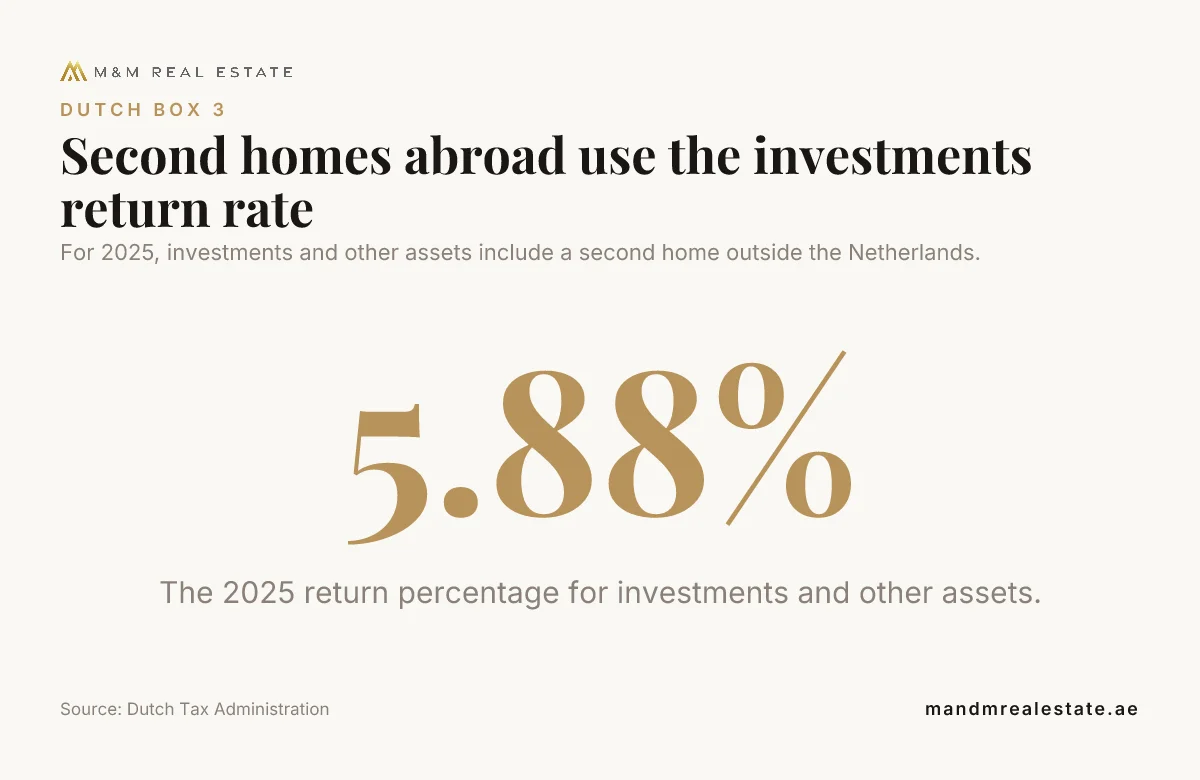
For 2025, investments and other assets include a second home outside the Netherlands.
Source: Dutch Tax Administration
Box 3 rules and procedures for using actual return figures can change. Use the calculation and relief process that applies to the tax year on your return, rather than carrying a previous year’s treatment forward.
For rental choices and yields, turn to M&M’s Dubai rental guide. For location context, see its guides to Dubai areas for investment, Dubai locations, Jumeirah Village Circle, Dubai Hills and Al Jaddaf Waterfront.
Renting out the property, moving, and other changes
Renting out a privately held property does not by itself remove it from the Box 3 asset review. Keep the property’s reporting separate from any treatment of rental income under the rules for the relevant tax year.
If you move away from the Netherlands, reassess your Dutch tax residency for the period covered by the return. A non-resident’s Dutch tax scope differs, and Dubai property is not automatically treated as a Dutch asset.
Where ownership is shared, held through a company or still under construction, identify the legal interest and your share before applying the ordinary approach for privately owned completed property. A change in residency, a 30% ruling or off-plan rights can alter the reporting and treaty analysis, so take the facts to a specialist tax adviser.
See also: Resources, Bay Estate by Nakheel, Dubai Islands: Investment Case, The Yards Plaza by BEYOND, City of Arabia Offices, Emaar Vs Damac Developer Comparison, 30/70 Payment Plan: What Beyond’s Offer Changes, Dubai Population Growth, Real Estate Crowdfunding In Dubai, The Yards Plaza.
What to do now about Dubai property in Box 3
For the return year, establish your Dutch tax residency, confirm who legally owned the property on the valuation date, gather the value and debt records, and separate the reporting step from the treaty-relief calculation. For an off-plan purchase or company-held property, include the contract or ownership structure in that review.
If you are asking, “Do I have to declare my Dubai property in Box 3 on my Dutch tax return?”, the practical starting point is to include the relevant privately held foreign property and then calculate any available relief. An M&M advisor will go through your budget, timeline and property questions with you. Speak with an M&M advisor.
this article is general information and not tax, legal or financial advice, and returns are not guaranteed.


Can I deduct Dubai service charges, maintenance costs or letting expenses from Box 3?
Do not enter routine service charges, maintenance or letting costs as Box 3 debts simply because you paid them. If you use an actual-return procedure, keep the underlying records and ask a Dutch tax adviser how the applicable year’s rules treat each cost.
Does an empty Dubai property still need to be reported?
Vacancy does not change who owns the property, so an empty property can still belong in the Box 3 review. Keep evidence of its condition and status on the valuation date, alongside the documents supporting its value.
Do I need to report a UAE bank account separately from my Dubai property?
Yes, review a UAE bank account as a separate financial asset rather than combining its balance with the property value. Use the account holder’s share and the balance relevant to the return’s valuation date.
What should I do if I have already filed a Dutch return without declaring my Dubai property?
Review the filed return and seek advice on correcting it for that tax year. Gather the property, ownership and valuation records first, and ask a Dutch tax adviser to assess whether the treaty relief calculation also needs correction.
What are the changes to Box 3 taxes in the Netherlands?
The applicable Box 3 method depends on the tax year, so check the rules for the year of your return before calculating the tax.


