


For Dubai offices for sale, start with the business that will use the space: its staff commutes, client access, work patterns and full occupancy costs. M&M Real Estate’s office options for sale include ready-to-operate, furnished, Grade-A and flexible commercial spaces.
Start with the occupier’s working day
Map where staff live, how clients reach the office and how often teams meet in person. A well-known address can still add friction to a working day if the route or client access is poor.
Then match the layout to the work. A client-facing business may need a clear reception, private meeting rooms and space for confidential discussions. A collaborative team may get more use from adaptable shared areas, quiet rooms and practical support space.
Size the office for expected headcount and peak attendance, with room for planned growth. This gives you a better fit than choosing solely by today’s staff numbers, which can leave the business short of space or paying for areas it rarely uses.
- List the routes staff and clients use most often.
- Mark the rooms and shared areas the team needs to do its work.
- Plan for expected attendance and growth over the period the business intends to occupy the office.
Use that list to create the shortlist. M&M’s Dubai area guides can support wider location comparisons, while the office shortlist should stay tied to the people who will use it.
Choose a district for access and daily convenience
Assess the actual trip to each building. Compare public transport, road access, parking and the routes that staff and clients use; a district’s reputation tells you little about how convenient a particular address will be.
Compare the nearby business community with your clients, suppliers and partners, then weigh those connections against location costs and daily travel. With a Red Line station at the district edge, Business Bay is described in M&M’s Business Bay guide as a mixed-use business address.
M&M identifies Grade-A business district offices as strategically located commercial spaces within established business hubs. They may suit an occupier whose clients and staff already work in those hubs, so assess actual access to the building alongside the address.
Business Bay also has a supply pipeline to consider. Knight Frank’s H1 2025 Dubai Office Market Review says Business Bay is set to deliver over 1.3 million sqft of office space through the build-to-sell model. Treat that pipeline as one supply factor alongside access and occupier demand when assessing a unit.
Match layout and handover condition to the business
A shell-and-core office provides the basic structure and services, leaving the internal fit-out to the buyer. It gives more control over the final plan, while requiring a budget and programme for partitions, finishes, lighting and mechanical and electrical work.
Ask a designer to check the proposed plan against building rules before committing to the works. The time and cost of fitting out can affect when the business can move in and how much capital remains available for its operations.
A fitted office can shorten the route to occupation. Review its room plan, cabling, meeting areas and finishes against the team’s needs, so the business can make use of the existing work instead of paying to change it.
M&M describes ready-to-operate office spaces as suited to immediate leasing opportunities and early income generation. They can fit an investor’s plan when reducing setup work is a priority, with the individual unit and its costs still requiring review.
Fully furnished commercial units include furniture and work areas, which can suit buyers looking for a more turnkey setup. M&M describes these spaces as designed to attract international tenants and corporate occupiers.
A furnished office gives a business a quicker start when its furniture and work areas fit the team. A serviced office is usually an occupancy arrangement; buying a unit is a property ownership decision.
Test the floorplate with a working plan that includes circulation, private rooms and shared work areas. Ready-to-operate space can suit a business prioritising speed, while a furnished unit can suit one seeking a more complete setup from the outset.
Compare buildings at unit level
Assess lift capacity and waiting times during the building’s busiest periods. Review the entrance, reception, loading access, parking allocation and shared facilities against the way staff and visitors use the building.
Check the unit’s title and status, building management, maintenance plans and service-charge basis. Review rules for signage, operating hours and fit-out, since each can affect how the company uses the space.
For a larger team or a business that needs room to expand, compare floor options and shared amenities against its space plan. In City of Arabia, BEYOND’s commercial development is described in M&M’s The Yards Plaza video as having 272 office units across four blocks, with half-floor and full-floor options, terraces, a gym and lounges. For further project detail, read M&M’s Investment Case for The Yards Plaza.
Calculate the full cost of occupying the office
Build an all-in budget that covers the purchase price, transaction costs, service charges, utilities, maintenance, parking and any building-specific obligations. Service charges are recurring fees for building management and shared facilities; ask what the charge covers and how the building sets it.
Include transfer costs in the initial budget.
Also budget for fit-out, design and approval costs, furniture, IT, utilities, maintenance, parking and service charges, using the actual terms for the unit and building.
Compare the total over the period the business expects to use the office. Include the time the space may be unusable during fit-out works, and account for changes in headcount or operations. Buying gives an owner-occupier control over its workspace, while also tying up capital and making the company responsible for the property’s ongoing costs.
Twelve chapters on what the regional war tested, the balance sheet and dollar peg behind the market, and how to pick the right side of this cycle.
Download free→Separate an owner-occupier decision from an investment decision
An owner-occupier is buying space for its own business. An investor is buying for a tenant or a future sale, so each buyer should assess a different set of practical questions.
| Owner-occupier | Investor |
|---|---|
| Does the unit support the business activity, staff access, layout and expected period of use? | Is there a plausible tenant pool for this location, layout and building type? |
| Can the fit-out and operating plan support the company’s start date? | What leasing costs, potential vacancy periods and competing supply should the budget allow for? |
| Will the space continue to work as the team’s needs change? | What exit options could suit the unit and likely buyer pool? |
Flexible commercial assets can suit investors comparing different tenant profiles. M&M describes these office spaces as suitable for a range of industries and occupiers; the investment case still depends on the unit’s layout, location and costs while it is vacant or occupied.
According to Knight Frank, the business services sector accounted for 38% of total office demand in H1 2025. That sector figure can inform tenant analysis, while the prospects for a specific office depend on its own features and costs.
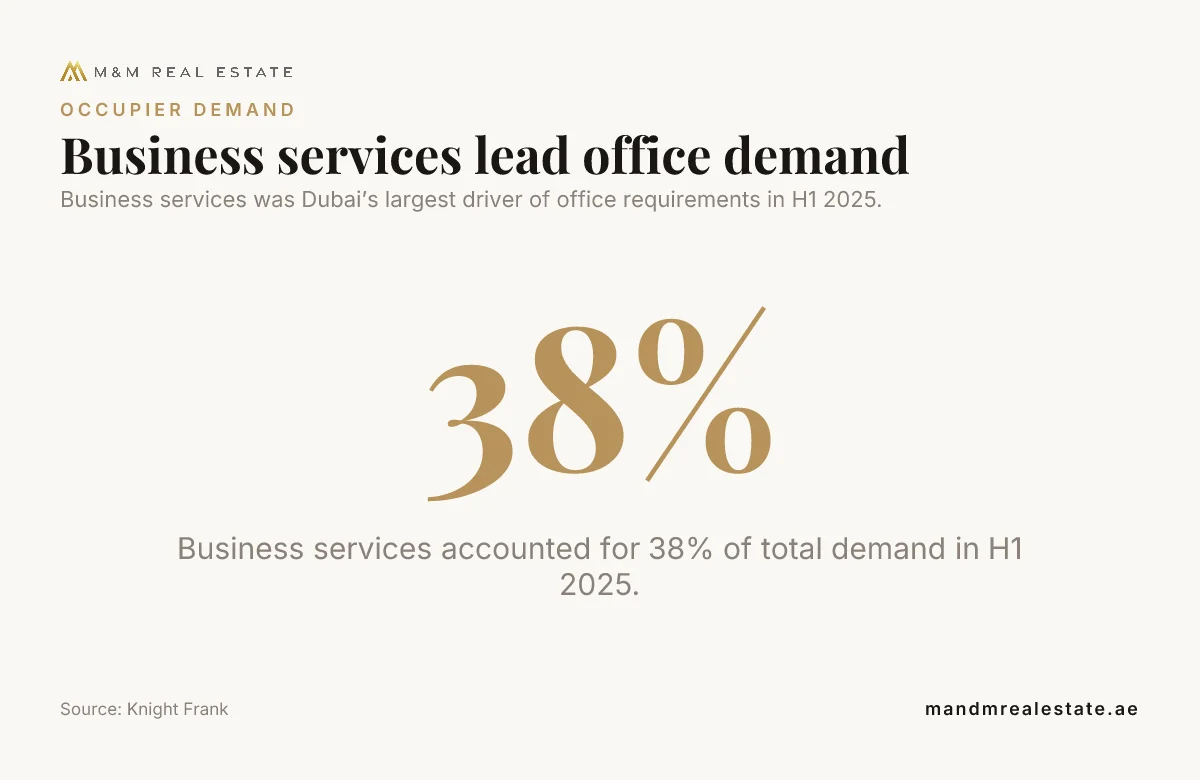
Business services was Dubai’s largest driver of office requirements in H1 2025.
Source: Knight Frank
For an investor, assess likely rent against leasing costs, service charges and possible vacancy periods. Office analysis needs unit-specific evidence about tenant demand and operating costs, whereas M&M’s Dubai rental-yield guide covers residential property.
Confirm legal fit and the purchase process
Property ownership and permission to conduct a business activity are separate checks. Confirm that the buyer’s ownership structure can hold the unit and that the intended activity can receive a business licence from the relevant authority; a free zone is a jurisdiction with its own business licensing authority.
Before committing, have an appropriate property or legal professional review the unit’s title and status, the seller’s authority, building obligations, fit-out rules and required approvals. Include any management or developer consents that apply to the proposed use.
Plan the transaction in order: agree terms, complete due diligence and required consents, sign the sale documents, settle the funds and register the transfer through the applicable Dubai process. An owner-occupier should align transfer and fit-out dates with the company’s operating start; an investor should allow time to prepare the office for leasing.
This is general information, not tax or legal advice.
Other property decisions can affect a wider allocation
An office can form part of a wider property allocation. These M&M guides cover other Dubai property, area and ownership questions:
- Area and city context: Dubai areas compared by investment goal, Dubai population growth, Al Jaddaf Waterfront, JVC and Dubai Hills Estate.
- Investment and ownership: Dubai property investment, Dubai property tax, the Dubai Golden Visa through property and property crowdfunding in Dubai.
- Developers and projects: Dubai developer profiles, Emaar and DAMAC compared, the Dubai off-plan buying guide, off-plan properties in Dubai, BEYOND’s payment plan, Bay Estate by Nakheel and The Yards Plaza Investment Case.
- Further material: M&M’s property investment resources.
What to do before you commit
Take a written brief covering staff and client routes, work areas, growth plans and the intended operating date. For each shortlisted building, compare unit status, building rules, shared facilities, service charges, fit-out needs and the full occupancy budget.
For an investor, add tenant demand, leasing preparation, possible vacancy and exit options to the unit review. For an owner-occupier, align the transfer and fit-out plan with the company’s start date.
An M&M advisor will go through your budget, timeline and shortlist with you. Contact M&M.
Figures are past data from the sources named; this article is general information and not tax, legal or financial advice, and returns are not guaranteed.


Can a small company buy a larger office and sublet the unused space?
A company can sublet surplus space when its ownership documents, building rules and licensing position permit that arrangement. Have a property lawyer review the proposed sublease terms and any required consents before marketing the space.
How should a buyer judge whether a building has enough parking for staff and visitors?
Ask the building manager for the unit’s allocated bays, visitor arrangements and any time limits on shared parking. Visit during the company’s expected arrival and departure periods to observe queues and the entrance access.
Can fit-out work begin before the office transfer is complete?
Early access depends on written approval from the seller and the building or developer, plus clear terms covering insurance, contractor access and responsibility for the works. Put those permissions in writing before booking contractors or ordering materials.
What should an owner-occupier consider if the business may outgrow the office?
Plan how the company could add space, move to a larger unit or sell the office if its needs change. Compare those options with the business’s likely time in the unit and the cost of changing premises.


