


A Dubai escrow account for off-plan property is a project-specific account into which buyer payments must be deposited for the development. It does not guarantee that construction will finish on time or that a refund will arrive immediately.
What a Dubai escrow account is and what it covers
A Dubai escrow account for an off-plan development is opened for that project. The developer arranges the account, and buyers pay their instalments into it under the formal purchase process. The account is administered within Dubai’s real estate regulatory framework.
The project name, developer and payment instructions should match across the sale documents and the account details. That connection matters: a bank account described as “escrow” on an invoice or message is not proof that it belongs to the registered development.
The project escrow account is for the development’s funds, separate from the developer’s general company funds.
This project account is different from the arrangements used to settle a ready-property resale. A ready resale does not automatically use the development’s escrow account, so buyers should follow the payment and transfer process set out for that specific transaction.
For a fuller explanation of buying before construction finishes, read M&M Real Estate’s Dubai off-plan property guide.
How payments enter the account and funds are released
The developer’s payment plan sets the dates and amounts a buyer owes. The project escrow account controls where those instalments go and how project funds are administered. Pay using the formal instructions in the purchase documents, then check each transfer against the relevant instalment.
The escrow agent administers the account. Keep the transfer confirmation and receipt so the amount, date, project and payment can be traced.
After the developer obtains a completion certificate, the law requires a completion-stage holdback. This is a project-level rule, not an automatic refund to each buyer.
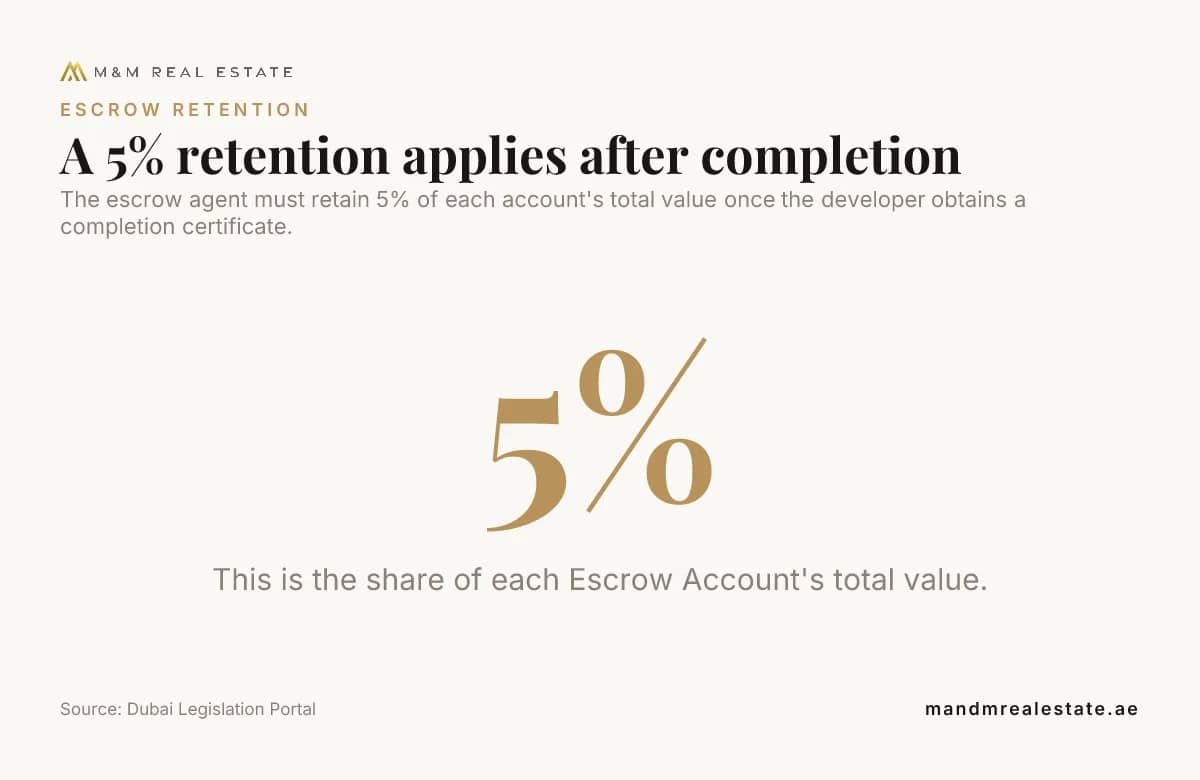
The escrow agent must retain 5% of each account’s total value once the developer obtains a completion certificate.
Source: Dubai Legislation Portal
Use the payment plan as a running record. For each instalment, match the amount due, transfer confirmation and developer’s receipt, then keep them with the signed sale agreement and project communications.
Dubai’s escrow law, the trustee’s role and project account applications
Dubai Law No. 8 of 2007 is the central law on escrow accounts for real estate development. The Dubai Land Department (DLD) and Real Estate Regulatory Agency (RERA) oversee relevant project registration and regulation. The developer applies for the project account; the buyer does not open it.
A recent technical report issued by the DLD must be no older than 3 months, according to the Dubai Land Department. That document timing is one application requirement; it does not mean an application will be approved.
The escrow trustee administers the account and its controls. The developer remains responsible for the project and buyer communications. M&M’s Dubai developer profiles explain how to assess a developer’s record alongside project-specific checks.
Buyers should check the project’s status through the DLD Project Status service.
This is general information, not tax or legal advice. The Arabic text of the legislation prevails.
A buyer’s checklist before transferring money
Before making an off-plan payment, match the project, developer and account details across official records and the purchase documents. Work through these checks before sending funds:
- Find the development in the DLD’s project records and compare its registered name and developer with the sale agreement and payment schedule.
- Check the named escrow trustee and account details against the registered project. The word “escrow” on an invoice does not establish that link.
- Verify changed or unexpected bank instructions using a trusted contact route you already hold. Pause payment while any mismatch remains unresolved.
- After paying, match the bank transfer, project account, instalment amount and receipt. Ask the developer to correct a discrepancy and keep the full record.
Check the relevant DLD Project Status service or Dubai REST record, then compare its details with the payment instructions you received.
For a step-by-step purchase process, read M&M’s guide to buying off-plan property in Dubai. Its guide to evaluating an off-plan investment covers project checks that sit alongside payment verification.
What foreign buyers get wrong in Dubai off-plan, what each mistake costs, and exactly what to do instead.
Download free→What escrow protects and what it cannot guarantee
It does not guarantee delivery by a particular date, prevent every dispute or provide an immediate refund when a project runs into difficulty.
If a project is delayed, cancelled or the developer becomes insolvent, follow official DLD or RERA notices and directions.
A delay alone does not trigger compensation from the escrow account. The sale and purchase agreement (SPA) governs the buyer’s contractual position, while the developer remains responsible for delivery and project updates. If a project is delayed, cancelled or the developer becomes insolvent, follow official DLD or RERA notices and directions.
A buyer’s payment obligations are set out in the SPA; escrow does not replace the need to follow its payment terms.
Article 16 of Dubai Law No. 8 of 2007 provides for a jail sentence and a fine of at least AED 100,000, or either penalty, for a person who steals or misappropriates money delivered for real estate development projects. Keep the SPA, payment plan, receipts, transfer confirmations and project communications together.
What to do if a payment or project record does not match
If payment instructions point to an account that does not match the registered project account, do not transfer money while the mismatch remains open. Ask the developer and trustee to resolve it through contact details you verify independently.
If you have already sent money to an unexpected account, contact the sending bank promptly. Notify the developer and the relevant DLD or RERA channel, and preserve the invoice, messages, account details and transfer confirmation.
For a delayed or cancelled project, keep dated copies of official notices alongside payment records. Where the next step depends on the SPA or an official direction, seek advice for your specific transaction.
See also: Dubai Golden Visa through Property: 2026 Guide, Which Dubai Property Area Fits Your Investment Goal in 2026?, Dubai Rental Yields in 2026: Gross Returns, Costs and Tax, What Investors Need to Know About Tax on Dubai Property, Dubai Property Investment in 2026, Off Plan Properties in Dubai, Best Areas to Invest in Dubai and Abu Dhabi, Dubai Investment Guides & Resources, Bay Estate by Nakheel, Dubai Islands: Investment Case, The Yards Plaza by BEYOND, City of Arabia Offices, Emaar and DAMAC: How to Compare Two Projects on the Public Record, Al Jaddaf Waterfront, 30/70 Payment Plan: What Beyond’s Offer Changes, JVC (Jumeirah Village Circle) Investment Guide 2026, Dubai Hills Estate Guide 2026: Prices and Yields, Dubai population growth is reshaping how the city plans for residents, How Dubai Property Crowdfunding Works: Shares, Returns and Risks, The Yards Plaza by BEYOND, City of Arabia Offices, M&M.
What to do before your next payment
Before transferring your next instalment, compare the DLD project record, developer, trustee and account details with your SPA and payment schedule. Keep the bank confirmation and receipt, and stop to resolve any mismatch through independently verified contacts.
An M&M advisor can go through your budget, timeline and shortlist with you. Contact M&M about your Dubai escrow account and off-plan purchase.
this article is general information and not tax, legal or financial advice, and returns are not guaranteed.


Is Oqood the same as a Dubai escrow account?
No. Oqood is the DLD’s off-plan registration, while escrow is the project account that receives buyer payments. They document different parts of the purchase.
Is a project escrow account held in each buyer’s name?
No. The account is held for the development; the buyer’s individual contractual rights are recorded through the signed SPA and the relevant off-plan registration. Keep those records with your payment receipts.
Does project escrow cover defects discovered after handover?
Project escrow is not an individual defect-claim account. Report defects through the developer’s handover or warranty process and keep dated inspection records and written notices.
Are service charges paid into the project escrow account?
No. Service charges relate to the operation and upkeep of a completed building, while the project escrow account is for the development. Use the building’s handover and management documents to identify the service-charge payment route.


