Selling Dubai property as a UK resident can create a UK capital gains tax bill. Selling Dubai property as a UK resident can raise UK tax questions.
When UK CGT can apply to a Dubai property sale
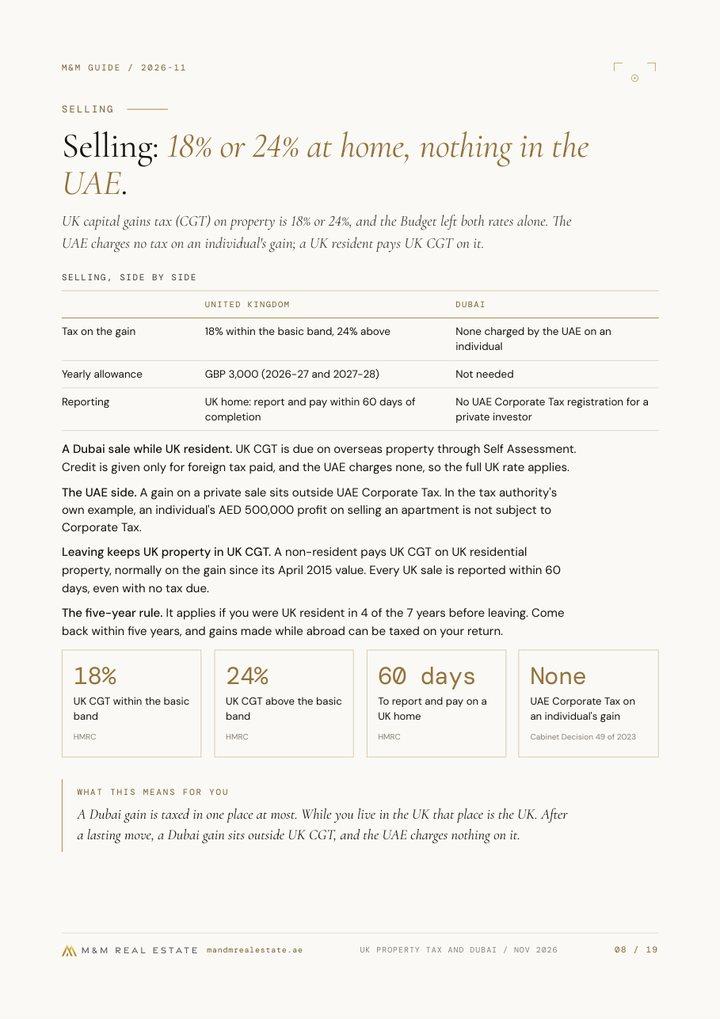
A UK tax resident can be liable to UK CGT on a gain from overseas property, including a property in Dubai. The relevant question is the seller’s UK tax residence when the disposal takes place, not simply where the property is located.
That is a different situation from a Dubai resident selling property in the UK. In each case, the seller’s tax residence and the location of the asset need separate consideration.
The possible UK tax position and the ownership structure both need consideration.
This is general information, not tax or legal advice.
The Investing in Dubai from the UK guide gives UK buyers context for decisions made before a future sale.
M&M Real Estate also explains the UAE and UK tax distinction in its guide to tax on Dubai property.
Calculate the gain in pounds, not just in dirhams
UK CGT is calculated in sterling. Translate the acquisition cost using an appropriate exchange rate for the acquisition date, then translate the disposal proceeds using an appropriate rate for the disposal date. A gain in AED can look different once currency movements are included.
The example below is hypothetical. It shows how the exchange rates change the sterling calculation.
| Calculation step | Amount |
|---|---|
| Purchase amount translated at the acquisition-date rate | Sterling acquisition cost |
| Sale proceeds translated at the disposal-date rate | Sterling disposal proceeds |
| Sterling disposal proceeds less sterling acquisition cost | Gain before allowable costs |
| Deduct allowable costs | Gain before reliefs and losses |
Allowable costs can include qualifying acquisition and sale costs, such as relevant legal or estate-agent fees. Capital expenditure that improves the property may also count; ordinary repairs and maintenance do not qualify as capital improvements.
When you paid costs or instalments in a foreign currency on different dates, translate each amount using a consistent, supportable method for its relevant date. Keep the exchange-rate source, invoices, payment evidence and completion statements with the calculation.
Apply reliefs, losses and the annual exempt amount
After calculating the sterling gain, deduct allowable capital losses under the rules that apply to them. Then account for the annual exempt amount available in the tax year of disposal. The amount and the rules in force for that year determine what remains taxable.
Residential property CGT rates depend on the applicable rate bands and your taxable income. Calculate the taxable gain alongside your other income for the year, rather than applying one flat rate to the whole sale.
Private residence relief can apply to an overseas home if the property and the owner’s occupation meet the qualifying conditions. Ownership alone, or occasional stays, do not establish that a Dubai property was the owner’s main residence.
For a UK resident’s Dubai property, consider the gain from acquisition alongside any specific relief or rule that applies.
Check who owns the property and how it was acquired
For jointly owned property, establish each person’s beneficial share. Each owner calculates and reports their share of the gain under the rules that apply to them, so the title documents and any evidence of beneficial ownership belong in the working file.
Company ownership changes the analysis. The company’s disposal is separate from any later payment or distribution to its owners, and personal CGT rules do not simply apply to the company’s sale.
For an inheritance, gift or transfer between spouses, check the applicable rules before using a value in the calculation.
Keep the purchase or transfer documents, ownership records and evidence of the acquisition value. For an inheritance or gift, retain the documents that establish the transfer and the valuation used for the calculation.
What thousands of high-net-worth British residents are doing right now, the forces pushing them, and what Dubai offers in 2026.
Download free→If you moved abroad, check temporary non-residence rules
Start by assessing your UK tax residence for the tax year of disposal under the UK residence rules. Moving overseas before completion does not automatically remove UK tax exposure, because the residence position and the disposal circumstances both need review.
If you sold while non-resident and later returned to the UK, check whether the temporary non-residence rules apply to your circumstances and the asset. Non-residents may have to pay UK tax on overseas property if they return to the UK within 5 years of leaving, according to HM Revenue & Customs.

Non-residents may have to pay UK tax on overseas property if they return within five years of leaving.
Source: HM Revenue & Customs
The rule has conditions, so the return period is a prompt to examine your residence history and the asset, not a universal test. Record when you left, your residence status for the sale year and any later return to the UK.
Report the foreign-property disposal and keep the working
A taxable gain on foreign property is generally reported through Self Assessment when required. A Dubai disposal does not use the reporting deadline that applies to a sale of UK land.
Keep the records that support both the ownership and sterling figures:
- Purchase and sale contracts, plus completion statements.
- Invoices and payment evidence for allowable costs and capital improvements.
- Ownership records and documents showing the acquisition value.
- The exchange-rate source and calculation for each translated amount.
Set out the calculation as an audit trail: sale proceeds in AED and sterling, acquisition cost in AED and sterling, allowable costs, losses or reliefs, and the resulting taxable gain. This makes it easier for your accountant to follow how each figure was reached.
Further Dubai investment reading
These M&M pages cover the wider investment decisions that can sit behind a later sale. They are background on buying, ownership, rental and Dubai market choices, not substitutes for the tax calculation above.
- The off-plan property guide, off-plan properties in Dubai and a Dubai off-plan payment plan.
- Dubai developer profiles and a comparison of Emaar and DAMAC.
- Dubai property investment, rental yields and property crowdfunding.
- Dubai areas for different investment goals, the locations overview, Al Jaddaf Waterfront, JVC and Dubai Hills Estate.
- Bay Estate by Nakheel, The Yards Plaza investment case and The Yards Plaza.
- Dubai population growth, the property Golden Visa and Dubai investment resources.
See also: 30/70 Payment Plan: What Beyond’s Offer Changes.
What to prepare before you sell
Before accepting an offer, assemble the acquisition and sale documents, confirm who owns the beneficial interest, and list the costs and improvement work you may claim. Prepare the sterling calculation using the relevant exchange rates, then ask your accountant to review residence, reliefs, losses and reporting for the disposal year.
An M&M advisor can go through your ownership records, sale timeline and Dubai investment position with you. Contact M&M.
this article is general information and not tax, legal or financial advice, and returns are not guaranteed.


Does paying off the Dubai property mortgage reduce the capital gain?
No. Repaying the mortgage changes the cash left after the sale, while the capital gain calculation compares disposal proceeds with the relevant acquisition cost and allowable costs. Keep the loan redemption statement for your sale records, but do not subtract the outstanding loan balance as a property cost.
What if the sale contract is agreed in one tax year and completion follows in another?
The date of disposal is usually the date an unconditional contract is made, not the date the proceeds arrive. A contract with conditions can produce a different result, so give your accountant the signed contract and the completion statement.
Can foreign tax paid on the same property gain be credited against UK CGT?
Potentially, if foreign tax was charged on the same gain and qualifies for relief under the rules that apply. Keep the foreign tax assessment and payment evidence, because the amount and type of tax affect whether a credit is available.
How can periods of letting affect private residence relief?
Letting can change the portion of a gain that qualifies for private residence relief, depending on when you lived in the property and which periods meet the qualifying conditions. Keep tenancy dates and evidence of occupation so the claim can be assessed against the actual timeline.
UK property tax changes and Dubai
What the 28 October Budget changes for UK landlords, set beside what Dubai charges to buy, own, let and sell. 19 pages. Free by email.