Moving tax residency from the UK to Dubai requires two separate checks: HMRC applies the Statutory Residence Test to your UK days and circumstances, while the UAE assesses tax residence under its own rules. The UK tax year runs from 6 April to 5 April, according to GOV.UK, so your departure date alone does not settle your UK position.
- HMRC assesses UK residence through automatic overseas tests, automatic UK tests and, if needed, the sufficient ties test.
- Your UK days, available home, family connections and work arrangements all form part of the assessment.
- Split-year treatment has specific conditions. Leaving part-way through the tax year does not establish it automatically.
- A UAE residence visa, UAE tax residence and a Tax Residency Certificate serve different purposes.
- UK rent and some gains can remain subject to UK tax after you move.
- Review pensions, National Insurance, inheritance tax and temporary non-residence separately.
How the UK Statutory Residence Test assesses your move
The Statutory Residence Test (SRT) decides whether you are UK resident for a tax year. HMRC applies the automatic overseas tests first, then the automatic UK tests, then the sufficient ties test if neither set of automatic tests settles the result.
GOV.UK says you may be resident under the automatic UK tests if you spend 183 or more days in the UK in the tax year. The graphic below states that threshold.
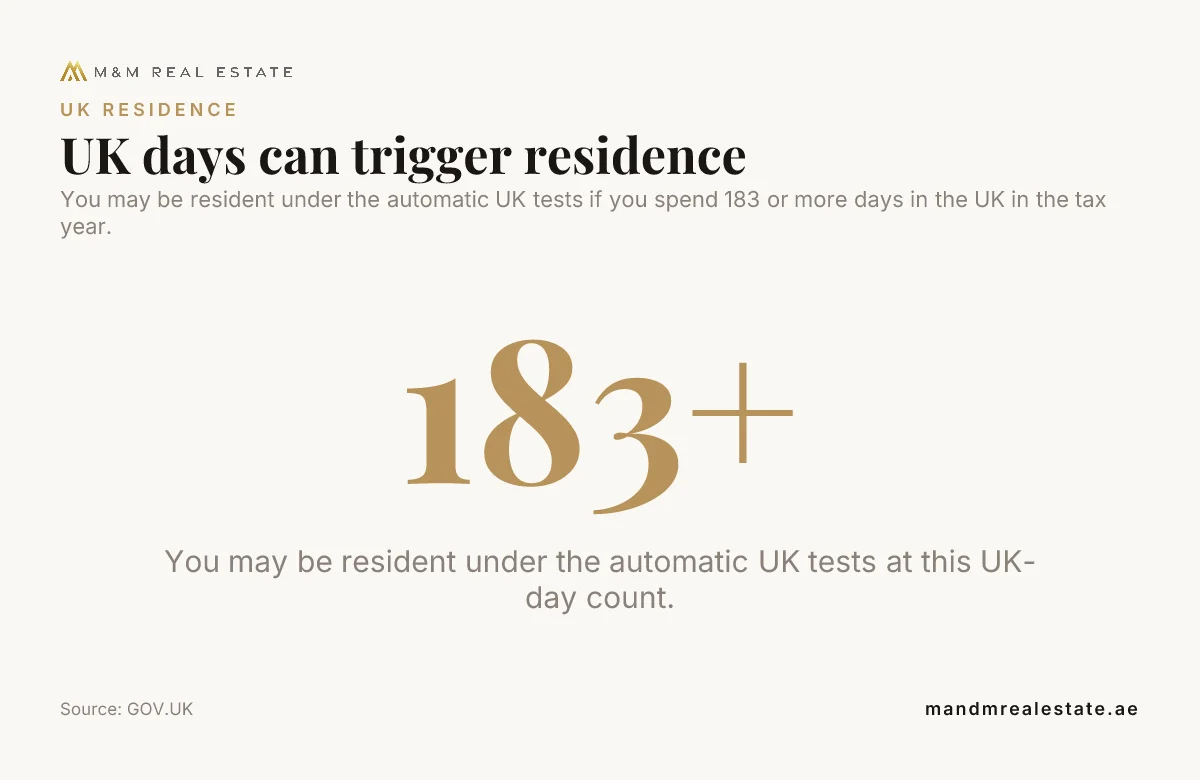
You may be resident under the automatic UK tests if you spend 183 or more days in the UK in the tax year.
Source: GOV.UK
A separate automatic UK test can apply if you work full-time in the UK for a 365-day period and at least one day of that period falls within the tax year being checked, according to GOV.UK’s residence guidance. Another test considers whether you have a UK home for 91 consecutive days and spend at least 30 days there, subject to the rules about an overseas home.
The automatic overseas tests include a fewer-than-16-days threshold for someone resident in one or more of the previous three tax years. The threshold is fewer than 46 days for someone who was not resident in any of those three years, under HMRC’s RDR3 guidance.
Full-time work abroad can also meet an automatic overseas test. If no automatic test determines your position, HMRC weighs your UK days against your UK ties.
HMRC counts family, accommodation, work, 90-day and country ties under the sufficient ties test. The country tie applies only to leavers, and the number of ties needed changes with UK days: for a leaver who was UK resident in one of the previous three tax years, 16-45 days requires four ties, 46-90 days requires three, 91-120 days requires two, and over 120 days requires one, under the same RDR3 guidance.
A UK home, a spouse or family in the UK, and UK workdays can all affect the result. Read M&M’s overview of tax on Dubai property separately from the UK residence rules, since the tax treatment of a Dubai asset does not decide your SRT position.
This is general information, not tax or legal advice.
Plan the departure year, split-year treatment and HMRC reporting
Split-year treatment can divide a tax year into a UK part and an overseas part, but only when you meet a qualifying case and its conditions. The SRT still determines your residence position for the year; the timing of your move and the facts of your circumstances affect how income is treated across it.
Under Case 3, the conditions include being UK resident in the year of departure and the previous year, being non-resident in the following year, and ceasing to have a UK home. You must spend fewer than 16 days in the UK for the rest of the departure year and, within six months, become tax resident in or have your only home in the new country, under HMRC’s split-year guidance.
The overseas part starts on the day you stop having a UK home in Case 3. Case 1 covers leaving for full-time work overseas, with conditions to confirm with a tax adviser.
Tell HMRC through the route that fits your tax affairs. HMRC Form P85 may apply if you are leaving and do not need to report through Self Assessment; if you file a Self Assessment return, report your departure through the return where required.
Keep a dated record of UK arrivals and departures, UK workdays, accommodation, travel documents, and changes to family or work arrangements. HMRC’s residence checker can help assess the relevant tax years, while your records support the facts behind your answer.
Separate a UAE residence visa from UAE tax residence
A residence visa gives permission to live in the UAE. UAE tax residence is a separate assessment, and HMRC still applies the UK SRT to your UK position.
UAE tax residence can involve factors such as physical presence, a usual home and personal or financial connections. The relevant test depends on the circumstances, so a visa does not settle the tax assessment.
A Tax Residency Certificate records tax-residence status for specified purposes. It can support a claim under the UK-UAE double taxation agreement, while the certificate and treaty evidence do not replace the underlying UK or UAE tests.
The Dubai Golden Visa through property concerns the immigration side of a move, while tax residence remains a separate question. It supports the immigration side of a move, while tax residence remains a separate question.
Identify UK tax that may continue after you leave
Becoming non-resident does not remove UK tax from every income source or asset. UK rent may remain taxable in the UK, and the non-resident landlord rules apply to rental income from UK property.
UK property, investment income and asset disposals each have their own rules. Non-residents can also remain within UK tax on gains from UK property, so the tax result depends on the asset, the transaction and your circumstances.
The UK-UAE double taxation agreement may provide relief in some cases. It does not settle every domestic tax question or exempt all UK income and gains.
M&M Real Estate’s Free investor guide for British investors covers UK-Dubai property investment, tax, currency, the Golden Visa and the process for moving capital and buying property. It gives property context for a move while your UK tax treatment still needs individual review.
Ask a tax adviser to review pensions, trusts, property and investments as separate areas. Their treatment can depend on the type of asset, how it is held and the relevant transaction.
What thousands of high-net-worth British residents are doing right now, the forces pushing them, and what Dubai offers in 2026.
Download free→Assess cross-border work and business arrangements
Where you perform your duties can matter even when your employer is based in the UK. The GOV.UK guidance says you worked abroad full-time (averaging at least 35 hours a week), and spent fewer than 91 days in the UK, of which no more than 30 were spent working.
Working for a UK employer from Dubai can still involve UK workdays and UK ties. Record where you work, the days you work in the UK, your duties and any changes to your role.
For a company interest, assess where you carry out work, who makes key management decisions and where the company is directed. Your personal residence position does not decide the company’s tax treatment.
Payroll, social security and corporate tax are separate from personal residence. A cross-border tax adviser can assess how those rules apply to your employment or business structure.
Review pensions, National Insurance and estate planning separately
UK pension payments can receive different tax treatment depending on the pension and the type of payment. Review each pension arrangement and any planned withdrawal or transfer on its own facts.
National Insurance contributions follow rules separate from tax residence. Check your position if UK employment, self-employment or voluntary contributions continue after the move.
The UK inheritance tax test can depend on long-term UK residence.
Leaving the UK can leave a period of inheritance tax exposure. The length of that period can depend on your UK residence history and other circumstances. Review your residence history and asset location with an estate-planning adviser.
Keep pension, National Insurance and estate-planning records with your wider relocation file. Advice becomes more important when your assets or residence history span several countries.
Consider temporary non-residence and a later return
Temporary non-residence rules can bring certain income or gains into charge when you return to the UK. Under HMRC’s RDR3 guidance, the rules can apply when someone was solely UK resident in four or more of the seven tax years before departure and their non-residence lasts five years or less.
The rules depend on the type of income or gain and your circumstances. If you expect to return, review transactions before departure and keep records that let an adviser assess the years involved.
Reassess UK residence under the SRT for the year you return. GOV.UK says its residence checker covers the current tax year and any of the previous six tax years.
Keep evidence of your departure, time abroad, UK visits and relevant transactions. HMRC’s residence guidance is a starting point for checking the years before and after your move.
What to check before you move
Before departure, map your UK days, home, work and family ties against the SRT. Ask a UK tax adviser to review split-year treatment, retained UK income, pensions, inheritance tax and any plan to return.
If your move includes buying a Dubai property, M&M’s property resources cover the purchase process and local market separately from UK tax residence. Start with the off-plan buying guide, off-plan properties in Dubai, Dubai developer profiles, Dubai locations and investor resources.
For area and market context, read about Dubai areas by investment goal, Dubai rental yields, Dubai property investment and Dubai population growth.
Project and financing research includes the Bay Estate Investment Case, The Yards Plaza by BEYOND Investment Case, Emaar and DAMAC project comparison, Al Jaddaf Waterfront, the Beyond 30/70 payment plan, JVC, Dubai Hills Estate, Dubai property crowdfunding and The Yards Plaza Investment Case.
An M&M advisor will go through your budget, timeline and shortlist with you. Contact M&M.
this article is general information and not tax, legal or financial advice, and returns are not guaranteed.


Does owning a home in the UK automatically make me UK tax resident?
No. The SRT considers the home alongside your use of it, your days in the UK and your other ties, so ownership alone does not settle your status.
Can I keep a UK bank account after moving to Dubai?
Keeping a UK bank account does not by itself decide your SRT status. Tell the bank when your address changes and ask about its account terms for customers living overseas.
Does my spouse’s UK residence affect my own Statutory Residence Test position?
It can, because a spouse who is UK resident may create a family tie for your assessment. That tie is considered with your own UK days and other circumstances.
How long should I keep records of UK days, workdays and travel after moving?
Keep records for every tax year affected by your departure and any later return. Ask a UK tax adviser to set a retention period that fits your filing history and the records relevant to your position.
Can I apply for a UAE Tax Residency Certificate before completing a full tax year there?
There is no single answer for every certificate request, because the application route and the period you need certified determine the evidence required. Ask a UAE tax adviser to assess the relevant FTA requirements before applying.
How do I change my tax residency to UAE?
Establish your residence in the UAE and assess whether your physical presence, usual home and personal or financial connections meet the UAE tax-residence rules. A residence visa alone does not establish tax residence, and you must also assess your UK status separately under the Statutory Residence Test.
Can an UK resident move to Dubai?
Yes. A UK resident can move to Dubai if they meet the UAE’s immigration requirements and obtain permission to live there; their UK tax residence is assessed separately under the Statutory Residence Test.
The Golden Visa guide
The rule, the steps and the documents, explained for buyers who live abroad. 16 pages. Free by email.