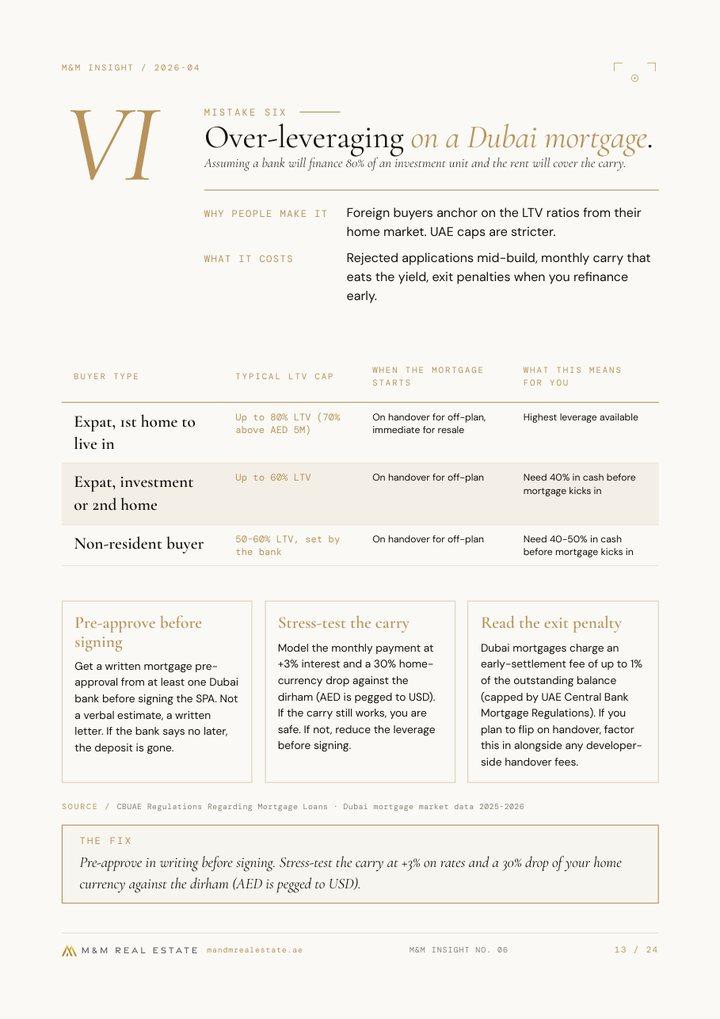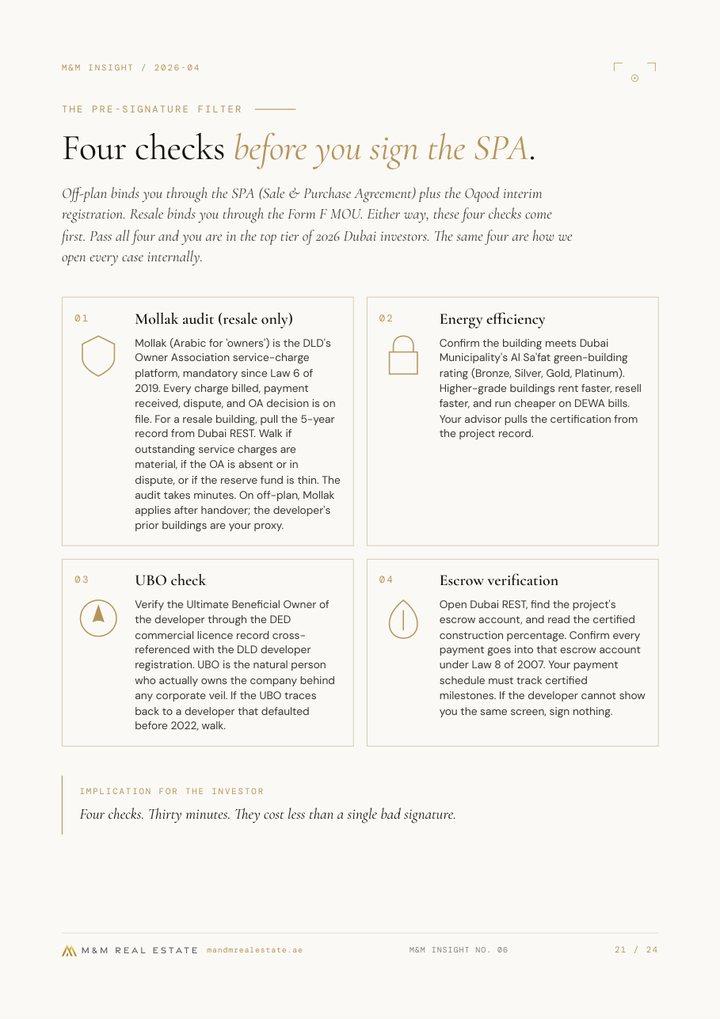
For Dubai SPA signing from abroad, first separate the Sale and Purchase Agreement from a Special Power of Attorney: one sets the purchase terms, while the other gives a representative authority to act. Review the contract against the transaction type, payment instructions, completion terms and signing requirements before you sign.
- Check that the Sale and Purchase Agreement names the correct property, parties, price and payment terms.
- For off-plan purchases, compare the SPA with the booking form and payment plan, including the project escrow arrangements and Oqood registration.
- For a resale, confirm the seller, outstanding amounts, transfer conditions and agreed handover condition.
- Use a Special Power of Attorney only when someone needs authority to take specified actions for you.
- Ask the receiving party to confirm the required signing method, format, language and document formalities before arranging them.
- Keep the executed agreement, supporting documents, payment records and written clarifications together.
Know which SPA you are reviewing
SPA can refer to two different documents. A Sale and Purchase Agreement records the buyer’s and seller’s or developer’s obligations, so review it for the property details, price, payment terms, completion and remedies.
A Special Power of Attorney authorises a representative to carry out specific acts for the buyer. It does not replace the sale contract or complete a property transfer by itself.
If someone will sign or handle steps on your behalf, list the exact acts they need authority to perform and identify the property or transaction. A broad mandate can grant authority beyond the tasks required.
Keep the contract and the power of attorney as separate signing tasks. They may have different signatories, execution formalities and acceptance requirements. For an overview of off-plan contract terms, the Dubai Off-Plan Guide covers SPA rights, payment mechanics, escrow and buyer protections.
Before sending either document, ask who must sign it and who must receive it. Record each answer against the specific document.
Match the review to an off-plan purchase or resale
An off-plan purchase and a resale have different milestones. Review the documents against the transaction you are making, not a general checklist alone.
For an off-plan purchase
Compare the SPA with the booking form and payment plan. Check that the unit description, price, instalments and stated milestones match, and list any differences for written clarification before signing.
Check how the contract describes the project escrow account, a project-specific account for eligible project payments, and who handles the related steps. Oqood is the DLD’s off-plan registration, so check what the SPA says about registration and responsibility for completing it.
Keep payments to the project separate from payments to other parties. Each amount should have a clear contractual purpose and a payment route that matches the agreed terms.
For a resale
Check the exact property and seller details, the agreed price, any outstanding amounts and the conditions that must be met before transfer. The contract should make clear which party must complete each step and when.
Read the service charge terms alongside the transfer conditions. Confirm how the parties will handle outstanding charges and other obligations at completion, so the handover record reflects what each side has agreed to settle.
Use the signed SPA as the record of agreed terms. If the booking form, payment plan or a side document conflicts with it, ask for written clarification and a clear contractual resolution before signing.
Check the money clauses and payment instructions
Match every instalment in the SPA to its amount, due date and trigger. For a milestone payment, check how the contract defines the milestone and what evidence confirms that it has occurred.
Compare the payment instructions with the project’s stated escrow arrangements and the contract. Resolve any mismatch through a verified written channel before sending money, and keep the confirmation with the transaction file.
For a resale, check the applicable transfer fee and how the contract allocates it.
Read the late-payment, charge and default clauses beside the payment schedule. A summary of the payment plan cannot explain every consequence of a missed due date, so identify the relevant SPA clause for each instalment.
Read side documents with the same care. If a separate promise appears to change a payment obligation, ask the parties to record the agreed term clearly in the signed contract.
Pin down completion, handover and remedies
Check how the SPA defines completion and handover, including the event that starts the timeline and the wording that allows an extension. An estimated date and a contractual deadline have different meanings, so identify which date the agreement makes binding.
Read the delay, notice and remedy clauses together. Note how a notice must be sent, when it must be sent and what the agreement allows each party to do if the stated process is not followed.
For off-plan property, compare the unit specifications with the permitted-changes clause. Identify which changes the agreement allows and what remedy it describes if a stated specification changes.
Check the defects liability process, including how to report a defect, the deadline for reporting it and the remedy described in the SPA. Keep the inspection notes and any submitted defect report with the contract record.
For a resale, focus on the agreed handover condition and outstanding obligations. Record any items the parties have agreed to complete or settle before transfer, rather than applying off-plan defect wording to a resale.
Read cancellation, default and dispute terms together
Find the circumstances in which either party may cancel and the steps the agreement requires. Record the notice method and timing, since an informal message may not meet the contract’s notice rules.
Check what happens to amounts already paid after cancellation. Separate the refund terms from any deductions or other consequences stated in the SPA.
Compare the buyer-default clauses with the payment schedule. This shows which missed payment or other breach may trigger a remedy, and which notice or opportunity to remedy the breach the agreement describes.
Read the governing-law, dispute-resolution and notice clauses as a set. Keep a copy of the agreed notice address and delivery method with the signed documents.
Confirm overseas signing and document formalities first
Ask the developer, seller or relevant authority what it will accept for each document. Confirm the required language, format, notarisation, translation and any attestation or legalisation route before arranging signatures.
One overseas notarisation process may not suit every document or receiving party. Ask the party that must accept the document to confirm the route and wording for that specific transaction.
Ask whether each receiving party accepts an electronic signature for the particular agreement. If it requires wet signatures, establish how to sign, courier and return the papers before sending originals.
If a representative will act for you, confirm that the power of attorney names the specific acts required and that the receiving party accepts its wording, execution and form. A document can be correctly signed and still fail the receiver’s requirements.
Prepare the identity, transaction and source-of-funds documents requested for the purchase. Keep a copy of every version submitted and a record of how it was delivered.
This is general information, not tax or legal advice.
Use a pre-signing workflow to close the gaps
Request the final SPA and compare it line by line with the booking form, payment plan and side documents. Send unclear or conflicting wording to the relevant party in writing and keep the reply with the contract file.
Before signing, confirm the correct signatories, signing method, document formalities and return route with each receiving party. This is the time to arrange any required translation, notarisation or attestation.
After execution, obtain the fully signed and dated SPA and the completed supporting documents. Keep them with payment records and written clarifications, so the transaction record shows which version the parties accepted.
The Dubai Off-Plan Guide covers legal protections, payment mechanics, escrow, SPA rights, costs and investment considerations. For a transaction-specific review, an appropriately qualified professional can interpret the legal effect of the clauses in your agreement.
An M&M Real Estate advisor can go through your budget, timeline and shortlist with you. Contact an M&M advisor to discuss your next steps.
Related investor checks alongside the SPA
The contract review sits alongside decisions about the project, location and investment plan. These M&M resources cover those related questions:
- Project and developer context: review off-plan properties in Dubai, Dubai developer profiles, and the Emaar and DAMAC comparison.
- Investment cases: read the Bay Estate by Nakheel case, the Yards Plaza investment analysis and the Yards Plaza Investment Case.
- Areas and location: browse Dubai locations, compare areas by investment goal, and read about Al Jaddaf Waterfront, JVC and Dubai Hills Estate.
- Other investment questions: review the 30/70 payment plan analysis, Dubai rental yields, tax on Dubai property, the Dubai Golden Visa property guide, Dubai population growth and property crowdfunding in Dubai.
- Further reading: use the Dubai property investment guide and the Dubai investment resources for wider investment planning.
What to do before you sign
For Dubai SPA signing from abroad, first identify whether you are reviewing a purchase contract or granting authority to a representative. Then reconcile the final SPA with the transaction documents, confirm payment and completion terms, and obtain the receiving party’s signing requirements in writing.
An M&M advisor will go through your budget, timeline and shortlist with you. Contact an M&M advisor about the purchase process and the questions to raise before signing.
this article is general information and not tax, legal or financial advice, and returns are not guaranteed.

Can a buyer amend a Dubai property SPA after it has been signed?
The parties can record an agreed change in a written amendment signed by the required parties. Check the agreement’s amendment process and keep the signed amendment with the original SPA.
Can an overseas buyer appoint a UAE-based lawyer as their representative?
A buyer can appoint a UAE-based lawyer under a power of attorney that authorises the required acts and meets the receiving party’s requirements. The appointment does not make the lawyer the purchaser or transfer ownership to them.
Do I need to be in Dubai in person for an off-plan handover inspection?
Ask the developer whether it will accept an authorised representative for the inspection and what authority it requires. Request a written inspection record that identifies any items raised and the next agreed step.
What should I do if the receiving party rejects an overseas notarised document?
Ask the receiving party to identify the specific reason for rejection and the format it will accept. Use that written response to arrange a corrected document or revised formalities before resubmitting it.
Should I keep the original signed agreement as well as a digital copy?
Keep the original if it is returned to you, and store a complete digital scan in a secure location with a separate backup. Retain related amendments and delivery records alongside it so you can identify the executed version.
Ten off-plan mistakes
The ten mistakes overseas buyers make most, and how to check each one before you sign. 24 pages. Free by email.