


Dubai townhouses sit between apartment and villa living: they usually place the home across multiple floors, often with shared walls, and may include a private garden. The right comparison depends on the individual home’s layout, title, boundaries and upkeep, because the townhouse label does not define these details.
What makes a home a townhouse?
A townhouse is typically a multi-level home in a row or cluster. It often shares one or more walls with neighbouring homes, while an apartment sits within a larger building and a detached villa stands apart from neighbouring homes.
The word townhouse describes a broad property type. It does not set a standard plot, floor plan, boundary or ownership arrangement, so we compare the title details with the plot plan and the structures around the home.
Shared walls, gardens and parking areas can have different ownership and maintenance arrangements from one community to another. Read the title details and plot boundaries together to establish which areas belong to the home and which are shared. M&M Real Estate’s townhouse listings in Dubai provide a place to begin comparing the type of homes available.
Before comparing price or room count, identify the exact property boundary and any shared structures in the title and plan documents.
Compare space, privacy and outdoor living
Townhouses commonly spread living space over more than one floor. This can separate bedrooms from shared living areas, while the stairs may be less practical for a household that prefers a single-level layout.
A private garden can add useful outdoor space, though its size and privacy depend on the plot, orientation and neighbouring homes. Detached villas usually provide greater separation and more control over outdoor areas; apartments keep daily life within one building and may share facilities such as a gym or pool.
| Property type | Layout and privacy | Outdoor space and facilities |
|---|---|---|
| Apartment | Living space is usually arranged within one building, often on one floor. | Building facilities may be shared, with upkeep reflected in service charges. |
| Townhouse | Rooms commonly span multiple floors, with one or more shared walls. | A private garden may be included. Its privacy and upkeep depend on the plot and community arrangements. |
| Detached villa | The home stands apart from neighbouring properties, giving greater separation. | Owners usually have more control over their outdoor area and its upkeep. |
Compare usable indoor space, storage, parking and access to outdoor areas, not bedroom counts alone. Those details show whether a layout works for the household’s daily routines.
Compare the full cost of owning each type
A purchase budget should include the price, transfer costs, service charges, insurance, routine repairs and any community fees. A lower purchase price can still come with higher ongoing costs, so compare the full ownership budget over the intended holding period.
Include any applicable transfer fee in the initial cash budget.
For a worked example, a buyer pays AED 2M for a home:
- Purchase price: AED 2,000,000.
Add any other purchase costs that apply to the transaction before setting the available budget.
Townhouse and villa owners should allow for private garden upkeep and any equipment they maintain. Apartment owners may pay service charges towards shared facilities, while owners in townhouse communities should establish which structures, boundaries and amenities the community maintains collectively.
For a rental property, budget for repairs, periods without a tenant and the costs of preparing the home for a new tenant. We compare these expenses with expected rent before treating the property as affordable to hold.
A study in Behavioral Sciences reports that housing consumers place importance on housing price and rent, and investment value.
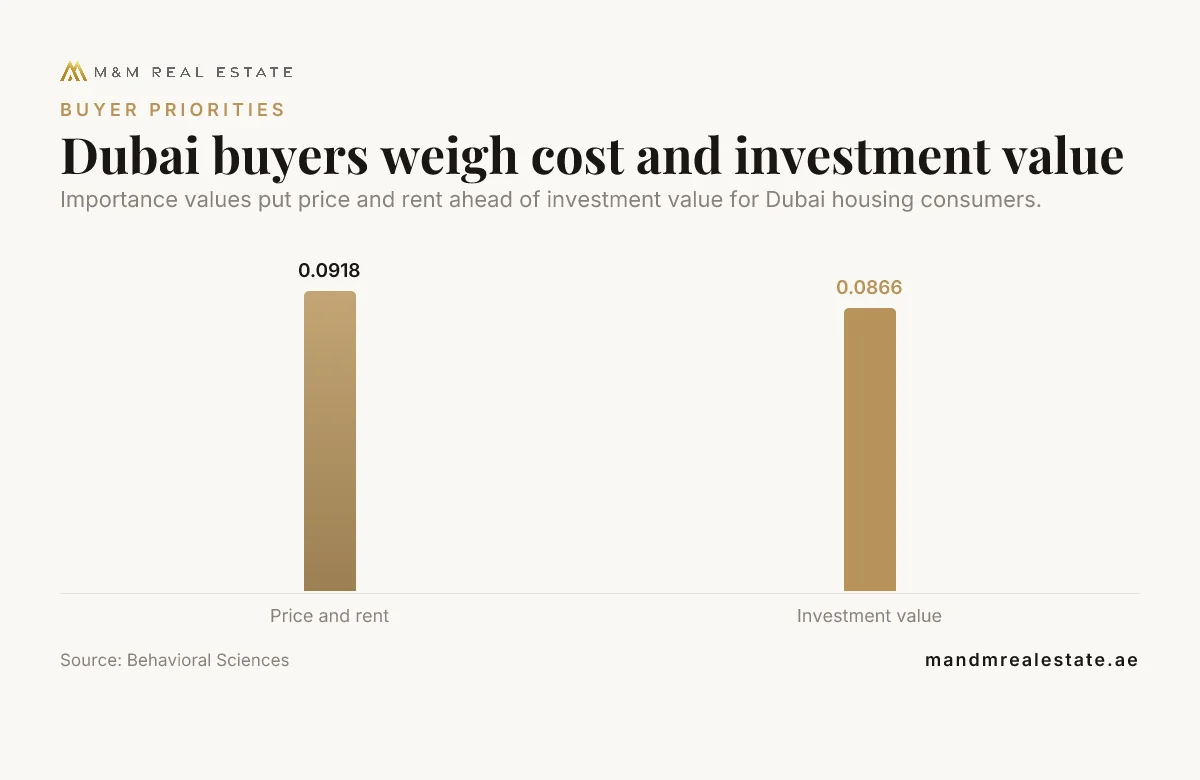
Source: Behavioral Sciences
Ask the developer or community manager to set out which parts of a townhouse are maintained collectively and which are the owner’s responsibility.
Match the home to the household and community
A townhouse can suit a household looking for more room and a domestic layout than an apartment, with shared walls and community rules as part of the arrangement. A villa can suit a buyer who places greater weight on separation from neighbours and private outdoor space.
Test the commute at the times household members travel. Compare the route with public transport, schools, shops and healthcare access, and establish which nearby facilities are operating and which remain planned.
Community amenities shape daily life, though the route to work or school still needs to fit the household’s routine. Read community rules alongside the floor plan to see how they affect alterations, outdoor use and shared facilities.
Use the commute, the home’s boundaries and the community rules together to judge whether a particular townhouse fits the household.
Assess rental prospects and investment returns
Rental prospects depend on the home and its community. A multi-bedroom layout or access to outdoor space may appeal to some households, so compare the likely tenant profile with local rents and the cost of maintaining the property.
Gross rental yield compares annual rent with the purchase price. Net income accounts for costs such as service charges, maintenance, insurance, vacancy and letting fees, giving a clearer view of the cash the property may produce.
Yield is one part of an investment decision. We also assess purchase costs, assumptions about capital appreciation, resale liquidity and the intended holding period; past performance in one Dubai community does not establish prospects in another.
Compare sales and rental evidence from the same community and a similar property type. M&M’s guide to Dubai rental yields, costs and tax explains how to assess gross yield alongside running costs.
Use local comparable rents and sales to test tenant demand and resale prospects before relying on a headline yield.
Use a practical checklist before choosing
Compare apartments, townhouses and villas over the period you expect to own the property. A consistent checklist helps an end-user buyer weigh daily use alongside the investment case.
- Estimate the total cost of ownership, including service charges, private garden or pool upkeep, repairs, insurance and possible vacancy or tenant-turnover costs.
- For a townhouse, establish the plot boundaries, shared structures, title details and maintenance responsibilities, then read the community rules.
- Compare the actual floor plan, privacy, outdoor area, parking and access to amenities to assess how the home works.
- For an investment, test local comparable rents and sales, tenant demand and resale prospects against the intended holding period.
For a location-led comparison, pair M&M’s guide to Dubai areas by investment goal with the specific location and property type you are assessing.
Related M&M guides for a wider property decision
- For local context, browse the Dubai location guides, including the guides to Jumeirah Village Circle, Dubai Hills Estate and Al Jaddaf Waterfront. The Dubai population growth analysis adds context on how the city plans for residents.
- Off-plan buyers can start with the off-plan buying guide and browse off-plan property in Dubai. To assess the companies and terms, compare developer profiles, the Emaar and DAMAC comparison and this guide to payment-plan structures.
- Ownership questions are covered in M&M’s Dubai property investment guide, its guide to tax on Dubai property and the property route to a Dubai Golden Visa.
- For examples across property allocation, consider the Bay Estate by Nakheel Investment Case, the Yards Plaza office Investment Case, the Yards Plaza Investment Case and M&M’s guide to property crowdfunding in Dubai. More material is available in M&M’s Dubai investment guides and resources.
Before shortlisting, collect the floor plan, title and plot details, community rules, service-charge schedule and comparable rent and sale evidence.
Plan your next step with an M&M advisor
Before choosing between Dubai townhouses, apartments and villas, set out your budget, holding period and household needs. Gather the title and plot details, full cost schedule, community rules, commute route and local rental evidence for each shortlisted home.
An M&M advisor will go through your budget, timeline and shortlist with you. Contact M&M.
this article is general information and not tax, legal or financial advice, and returns are not guaranteed.

Are townhouse prices always lower than villa prices in Dubai?
Dubai has no fixed townhouse-to-villa price order. Compare recent sales in the same community and similar bedroom layouts, since location, plot and condition shape the price.
Can I buy an off-plan townhouse with staged payments?
Yes, a developer may offer staged payments tied to the construction schedule or handover, with terms set for each project. The DLD records an off-plan purchase through Oqood, the DLD’s off-plan registration.
Can a Dubai townhouse be rented as a furnished property?
Yes, an owner can offer a furnished townhouse for rent. Furniture, replacement costs and the tenant profile then form part of the letting plan, so compare rents for furnished homes with a similar layout in the same community.
What should a first-time buyer budget for when taking ownership of a townhouse?
Allow for the deposit, transfer and registration costs, any mortgage-related charges, and the cost of preparing the home for use. Keep a separate reserve for early repairs, garden care and service charges after handover.


