For a Dutch tax resident, Dutch tax on Dubai property starts with Box 3 reporting: privately owned foreign property can belong in the Dutch return even when it earns no rent.
- Start with your Dutch tax residence for the relevant period. Citizenship and a UAE residence permit alone do not settle it.
- For private ownership, include Dubai property in the Box 3 review and establish the valuation basis for the return year.
- Keep the applicable year’s deemed-return rules separate from an actual-return route or a proposed reform.
- Treat treaty relief as a Dutch tax calculation. The property still has to be reported.
- Keep valuation, rental, cost, sale, mortgage and ownership records together for your Dutch tax adviser.
Start with Dutch tax residence and the property’s ownership
First establish whether you were a Dutch tax resident during the period covered by the return. Citizenship or a UAE residence permit does not settle that question on its own; the circumstances of your life and move determine the tax-residence analysis.
If you are a Dutch tax resident and own Dubai property privately, include it in your Box 3 review. The fact that the property is abroad, vacant or producing no rent does not by itself remove it from the Dutch return.
Keep private ownership separate from ownership through a company. A UAE company brings its own tax, reporting and administrative questions, so the private-owner analysis cannot simply be transferred to the company structure.
M&M Real Estate’s free investor guide for Dutch investors is a useful starting point alongside your personal circumstances.
Identify the Box 3 method that applies for the tax year
Box 3 is the Dutch tax system for savings and investments. For each return, establish which rules apply to that tax year before comparing rent, costs, a change in value or sale proceeds.
Real estate classified as an investment or other asset can be subject to a deemed return under the provisional assessment.
The provisional calculation also considers bank balances, investments, other assets and debts, with applicable thresholds and allowances.
The provisional calculation works through deemed returns, the return base after deductible debts, the allowance, the owner’s share of the return base and the resulting Box 3 income. The rules for an actual-return route or claim can differ, so identify the method that applies before using rent, expenses or appreciation in a calculation.
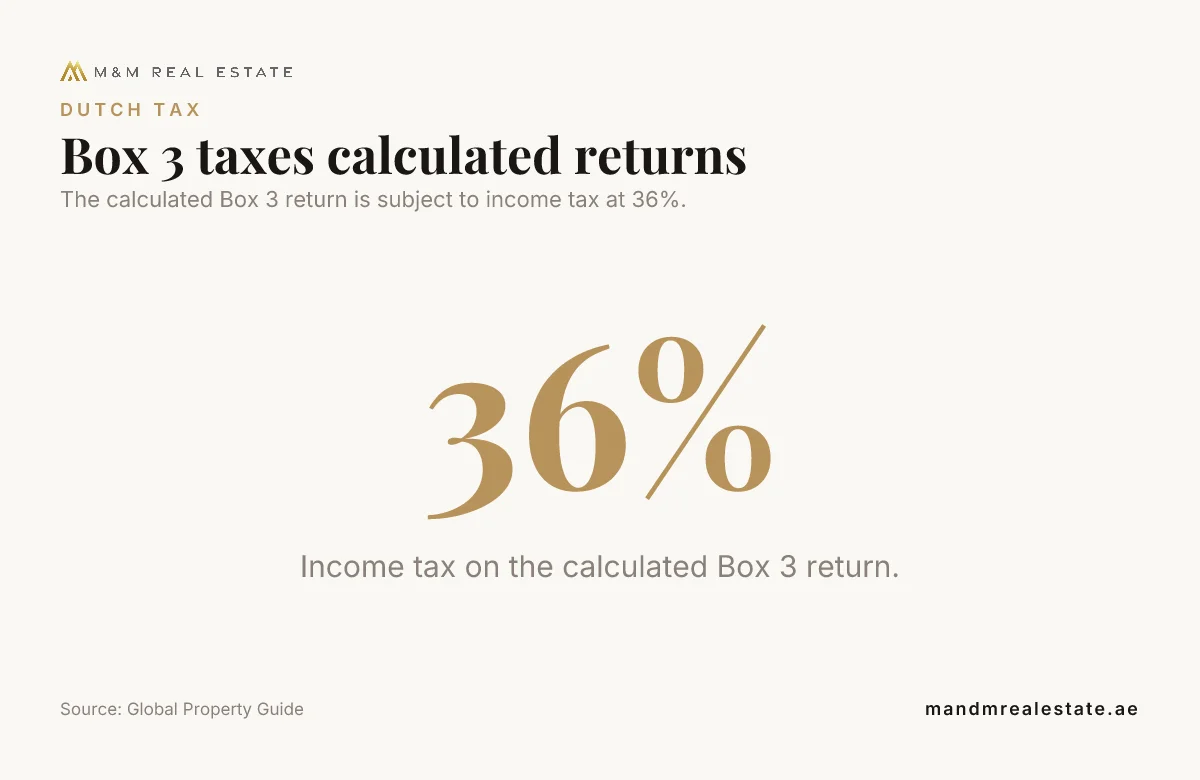
The calculated Box 3 return is subject to income tax at 36%.
Source: Global Property Guide
What the calculation considers
For a personal calculation, identify the deemed returns, debts, allowance and share of the return base that apply to the relevant tax year.
M&M’s guide to tax on Dubai property gives further context on Dubai ownership costs. Use it alongside the Dutch tax-year rules, since the Dutch calculation determines how the property enters the return.
Your own name, a company or a foundation: what each one gives you in Dubai, in 20 pages. Who DLD lets on the title deed, the 4% on every route, Corporate Tax and the free zone myth, why the Golden Visa, a permit DLD issues for 10 years, needs your own name, wills and foundations, and a worked example on one AED 2.5 million flat. Checked October 2026.
Download free→Understand how treaty relief affects Dutch tax
The Netherlands-UAE tax treaty covers income and gains from immovable property. Under its provisions, the UAE may tax income and gains connected with property there, while the Netherlands provides relief through a reduction in Dutch tax under Dutch law.
The Netherlands-UAE treaty text sets out the treaty’s property provisions; Dutch rules for reporting a resident’s Box 3 position address a different part of the tax calculation.
The Belastingdienst says the exemption method applies to real estate in Box 3. It calculates the reduction using the ratio between income the Netherlands may not tax and total income; unused relief can be carried forward following a formal decision, as explained in its information on tax relief.
The Dubai property remains reportable in Box 3, and relief is claimed through the return. The UAE’s treatment of an individual’s rental income is a separate question: UAE Cabinet Decision No. 49 of 2023 provides for no UAE tax on an individual’s rental income, while the Dutch return still applies.
The exact reduction follows the Dutch calculation for the individual return, so have a Dutch tax adviser assess the figures and the relevant treaty provisions.
Keep rent, costs and a sale separate
Record rental receipts separately from operating costs, financing costs and one-off purchase or sale expenses. Their relevance can change with the Box 3 method that applies to the return.
Rent received is different from unrealised appreciation, which is a change in value before a sale. A gain realised on sale is a separate amount again, and the rules for each can differ between a deemed-return calculation, an actual-return route and future legislation.
Keep completion statements, sale documents, transaction dates and expense records together. This gives your adviser a clear account of proceeds and costs instead of one combined rental figure.
Build a valuation and records file for the return
The Dutch Tax Administration says a second home abroad is reported at its value in the economic market in an unoccupied state on 1 January of the year before the return year. A let home is reported as overige onroerende zaken, meaning other immovable property, under the Belastingdienst’s guidance on a second home.
For a let property, the Belastingdienst’s 2025 information describes a possible valuation of 73%-100% of the vacant value where the country has comparable tenant protection. A temporary let stays at 100%; whether Dubai meets the test should be confirmed with a Dutch tax adviser.
Keep dated valuation evidence, purchase and completion documents, rental statements, invoices, sale records and the dates the property was rented or sold. Those records allow the figures to be assessed under the relevant year’s rules.
Keep mortgage statements and debt balances with the property file. Record the currency and date of each balance, since the amount and timing may affect how the debt is assessed for the owner’s circumstances.
The compliance step in M&M’s Dutch investor service covers declaring foreign property on the annual Dutch tax return, with M&M providing documentation for the investor’s tax adviser. It fits this section because the valuation and transaction records give that adviser the supporting information for the filing.
Treat mortgages and company ownership as separate questions
For a mortgage, retain the lender’s statements and the balance information for the relevant period. Debt rules and their effect on the Box 3 calculation can change by tax year, so the owner’s loan should be assessed under the rules for that return.
For personal ownership, identify the legal owner and any co-owners from the title and purchase documents. If a UAE company owns the property, assess the company’s own tax, reporting and administration requirements separately from the private-owner calculation.
M&M’s Dutch investor service also covers legal setup for personal or UAE company ownership and coordination with Dutch notaries and UAE legal partners. Bring the ownership documents, financing details and Dutch tax-residence facts together before assessing the return.
What the planned Box 3 reform could change
Box 3 reform proposals concern a move towards taxing actual returns; see the government’s Box 3 reform information.
Keep records of rental income, costs, value changes and sale proceeds to support the method that applies.
See also: Buy Off-Plan Property in Dubai: 2026 Guide, Dubai Golden Visa through Property: 2026 Guide, Which Dubai Property Area Fits Your Investment Goal in 2026?, Property Developers in Dubai: Profiles and Track Records, Dubai Rental Yields in 2026: Gross Returns, Costs and Tax, Dubai Property Investment in 2026, Off Plan Properties in Dubai, Best Areas to Invest in Dubai and Abu Dhabi, Dubai Investment Guides & Resources, Bay Estate by Nakheel, Dubai Islands: Investment Case, The Yards Plaza by BEYOND, City of Arabia Offices, Emaar and DAMAC: How to Compare Two Projects on the Public Record, Al Jaddaf Waterfront Guide 2026: Prices and Metro, 30/70 Payment Plan: What Beyond’s Offer Changes, JVC (Jumeirah Village Circle) Investment Guide 2026, Dubai Hills Estate Guide 2026: Prices and Yields, Dubai population growth is reshaping how the city plans for residents, How Dubai Property Crowdfunding Works: Shares, Returns and Risks, The Yards Plaza by BEYOND, City of Arabia Offices, M&M.
What to prepare before filing
Start with the return year, your Dutch tax-residence position and the legal owner shown on the documents. Then assemble the valuation, rental, cost, mortgage and sale records, and ask your adviser which Box 3 method applies and how treaty relief should be claimed.
This is general information, not tax or legal advice. An M&M advisor can go through your ownership documents, return year and Dubai property records with you. Speak with an M&M advisor.


Does a Dutch non-resident have to report Dubai property in Box 3?
A non-resident of the Netherlands is taxed in Box 3 only on Dutch real estate, according to the Belastingdienst’s 2025 information. Whether a move has ended Dutch tax residence depends on the facts of the person’s life and move; confirm with a Dutch tax adviser.
Does an empty Dubai property still need to be reported by a Dutch tax resident?
Yes, a privately owned Dubai property can remain part of the Box 3 return while it is empty. Zero rental receipts do not remove the property from the valuation and reporting process.
How should co-ownership with a spouse or another person be reflected in the return?
Keep the title documents and any ownership agreement showing who owns the property and their respective shares. Give those records to a Dutch tax adviser together with information about any spouse or fiscal-partner status, so the return allocation can be assessed for that tax year.
What should I consider if I inherit or receive a Dubai property as a gift?
Keep the inheritance or gift documents, transfer date and valuation evidence with the property file. Ask a Dutch tax adviser to assess how the transfer affects the relevant return and whether separate Dutch tax questions apply.
Why Dutch capital is moving to Dubai
Box 3, yields and how Dutch buyers structure a Dubai purchase. 26 pages. Free by email.