


High-Yield Asset Selection and Market Intelligence starts with the credit cycle, then tests each issuer’s cash generation, debt terms, refinancing needs and bond price. The Federal Reserve Board’s May 2021 asset valuation review included high-yield and unrated corporate bonds, a useful reminder to separate broad market signals from issuer-level evidence.
Read the credit cycle before comparing bonds
Growth, employment, inflation and lending conditions work together. When business activity weakens, an issuer may generate less cash just as lenders become more cautious about extending credit. That combination can raise default risk and make refinancing harder.
Separate interest-rate risk from credit risk. Government bond yields affect a bond’s price through its duration, while a credit spread reflects the additional compensation investors demand for issuer, default and liquidity risk.
Compare a bond’s spread with its own history and with the issuer’s current finances. A wide spread can reflect deteriorating credit quality, a weaker refinancing path or poor trading liquidity. It signals relative value only when the compensation fits the risk.
Investor demand and new issuance are market technicals. Strong demand can support prices, while a wave of new bonds can draw buyers away from existing issues. Neither condition proves that an issuer can meet its obligations.
The M&M Real Estate Dubai area guide offers area context for property investors. Property yields and bond yields measure different assets and risks, so compare them as separate inputs when assessing portfolio allocations.
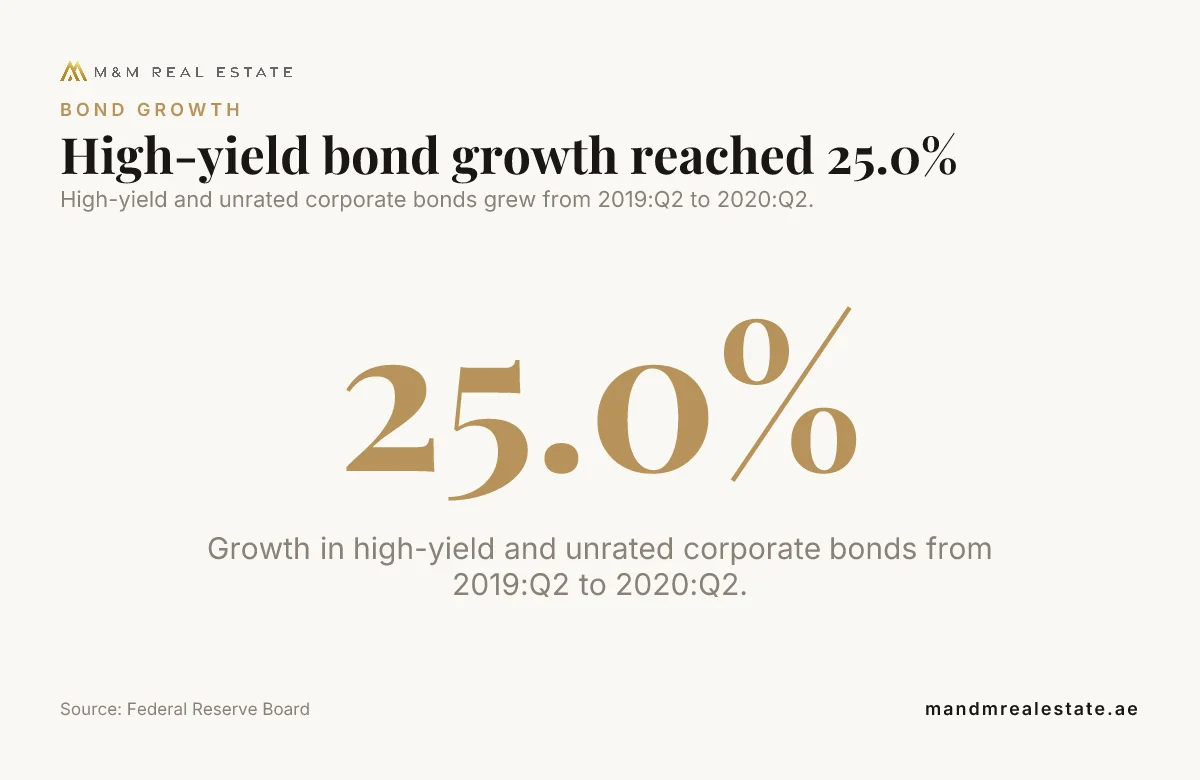
High-yield and unrated corporate bonds grew from 2019:Q2 to 2020:Q2.
Source: Federal Reserve Board
The Federal Reserve figure describes a past period. It does not show current issuance conditions or the credit quality of any individual bond.
Screen issuers from business resilience to refinancing
Bottom-up security selection starts with the company’s business, not its bond rating. Ask how stable its revenue is, how much it depends on a small group of customers or suppliers, and how sharply demand could change during an economic or commodity cycle.
Then test whether the issuer can service debt from recurring cash flow. Compare cash generation with interest expense and scheduled debt payments. Review leverage and available liquidity alongside those figures, since one headline ratio cannot show the full ability to pay.
Map upcoming maturities against cash on hand, committed credit facilities and realistic access to new funding. A company may carry manageable debt overall yet face acute pressure when a large repayment falls due and refinancing options narrow.
Management’s capital-allocation record also affects creditor protection. Borrowing, acquisitions, dividends and asset sales can change the amount of cash and assets available to bondholders.
Credit ratings provide an initial risk classification. A low rating alone does not establish that a bond is mispriced or that the issuer will miss a payment. Fundamental credit research connects the rating to the business, debt structure, cash flow and market price.
Check creditor protections and recovery prospects
Read where each bond sits in the capital structure. Secured or unsecured status, seniority and subordination determine a creditor’s place in the repayment order if the issuer restructures.
Review covenants that limit additional debt, asset transfers or distributions to shareholders. Then examine the exceptions. A covenant may offer less protection when the issuer can move assets or add borrowing through permitted subsidiaries and transaction baskets.
Build recovery scenarios from the value of the issuer’s assets, secured claims, the cash needed to keep the business operating and the claims of other creditors. A default does not mean every bondholder receives full repayment.
To distinguish a temporary credit dislocation from deteriorating fundamentals, track cash generation, liquidity and refinancing access through time. Improvement in those measures supports a recovery case. Continued weakness points to a deeper credit problem, even if the bond price has fallen sharply.
Compare relative value and likely sources of return
Compare credit spreads across bonds with similar maturity, seniority, rating and sector. A spread difference may reflect issuer-specific risk, lower liquidity or market pressure from supply. Issuer dispersion can create useful comparisons, but the reason for each difference needs to be clear.
Quoted yield is a starting measure, not an expected total return. Default losses, recovery value, spread changes and price moves caused by interest rates can all change the result.
Break the investment case into three sources: coupon income, or carry; changes in the bond’s market price; and potential credit losses. This makes the assumptions visible. A bond with a high coupon can still produce a poor result if its price falls or the issuer cannot repay its debt.
Consider duration and call terms alongside yield. A longer-duration bond is more sensitive to changes in market yields. A callable bond gives the issuer the right to repay early under its terms, which can shorten the period in which an investor receives the stated coupon.
Foreign capital is hesitating. The 3.9 million people inside the UAE have not. The asymmetry that defines 2026, and what it tells you to do about it.
Download free→Stress-test holdings, liquidity and exit plans
Model recession, interest-rate, commodity-price and refinancing shocks separately, then assess how they could interact. Each scenario can affect cash flow, default probability, recovery value and bond price in a different way.
For every holding, set out a base case and a downside case. The downside case should include weaker earnings, reduced access to refinancing and a lower recovery value. Record which assumptions change the result most.
Liquidity can fall during market stress. Trades may become less frequent and the gap between buying and selling prices may widen, so a quoted price may not be available for a large sale. Position size should reflect the time and price needed to exit.
Set exposure by issuer, sector and likely downside loss. An index can hold many bonds while still concentrating risk in highly indebted sectors. Review the underlying issuers and shared business exposures, not only the number of positions.
Build a portfolio across issuers and fixed-income types
Diversify across issuers, sectors, maturities and sources of business risk. Different company names can still depend on the same commodity price, customer group or funding market, creating correlated losses when conditions change.
Compare high-yield bonds with leveraged loans and higher-quality fixed income by looking at security, seniority, rate sensitivity, liquidity and possible loss. Headline yields leave out these differences and cannot show how each holding may behave under stress.
For a UAE-based investor accessing global markets, identify the currency of each bond. An unhedged holding can gain or lose value as exchange rates change against the investor’s spending currency. Hedging can reduce some currency exposure, while adding costs and its own risks.
Review spread exposure, interest-rate sensitivity, default risk and refinancing needs together. Several individually plausible bonds can still create too much correlated risk when they respond to the same market shock.
Research a separate Dubai property allocation
Investors comparing global credit with Dubai property can use property-specific evidence for that separate part of their portfolio. M&M Real Estate publishes area, developer, rental and project material for buyers considering Dubai property.
- For local market context, compare the best Dubai investment areas, JVC, Dubai Hills, Al Jaddaf Waterfront and Dubai population trends.
- For developer and project review, see the Dubai property developers directory, the Emaar and DAMAC comparison, the Bay Estate Investment Case, and the The Yards Plaza case with its project analysis.
- For purchase structures and rental analysis, read the off-plan buying guide, browse Dubai off-plan properties, and review Dubai rental yields and the 30/70 payment plan analysis.
- For wider planning, consult the Dubai property investment guide, Dubai property tax overview, property Golden Visa guide, Dubai real estate crowdfunding overview and investor resources.
Choose an approach and keep the evidence current
Active selection lets an investor assess individual issuers and compare bond prices with credit risk. Results depend on research quality, disciplined trading and the ability to manage liquidity when markets are under pressure.
Passive exposure provides broad market access through an index or fund. Review issuer and sector concentrations inside that exposure, since an index can carry large weights in a small number of industries.
Systematic credit analysis screens issuers consistently for changes in leverage, cash flow, spreads and refinancing risk. Fundamental research helps explain unusual results and the business conditions behind a change in the numbers.
Refresh each investment case when financial results, debt terms, management decisions, ratings or trading liquidity change. Reduce or sell a holding when its risk-adjusted case no longer fits the portfolio.
What to do next
Before selecting a bond, write down the issuer’s cash sources, debt-service capacity, maturity schedule, creditor protections, expected return components and downside case. Then check how the position changes portfolio exposure to rates, spreads, defaults, currency and liquidity.
High-Yield Asset Selection and Market Intelligence is a repeatable process: connect market conditions to issuer evidence, then test the bond’s price against the risks it carries. If you are also assessing a Dubai property allocation, speak with an M&M advisor. An M&M advisor will go through your budget, timeline and shortlist with you.
Figures are past data from the sources named; this article is general information and not tax, legal or financial advice, and returns are not guaranteed.


What happens to a high-yield bond if its issuer misses an interest payment?
The bond’s legal documents set out the process, including any grace period and the steps available to the trustee or bondholders. If the missed payment remains unresolved, creditors may seek remedies that can lead to restructuring or insolvency proceedings.
Do high-yield bonds usually pay interest monthly or twice a year?
Many corporate high-yield bonds pay interest twice a year, though the payment schedule depends on the bond’s terms. Some instruments use another schedule, so investors should plan cash flows from the payment dates in the bond documents.
Can a high-yield bond’s credit rating change after I buy it?
Yes. A rating agency can raise or lower a rating as it reassesses the issuer’s finances and ability to repay. A rating change can affect investor eligibility rules and trading demand as well as the market price.
How does accrued interest affect the price paid when buying a bond between coupon dates?
The buyer usually pays the seller the interest that has accumulated since the previous coupon date, in addition to the bond’s quoted clean price. This total payment is known as the dirty price, and the buyer receives the full next coupon under the bond’s payment terms.


