


Is Dubai property a good investment for a Kuwaiti family looking for rental income? It can fit a family that plans around net rent, vacancy and ownership costs, instead of relying on a headline yield.
Savills reported that Dubai’s prime rental values increased by 23.5% over 2024. That is historical market context, not a forecast for a particular home or a family’s net income.
Source: Savills
Start with the income the family actually needs
Set the target as money available to the family after operating costs, vacancy and transfers. Rent collected is one part of the calculation. The balance after paying the property’s bills is the amount to compare with the family’s income needs.
Rental income and capital appreciation are separate possible returns. Make the rental case work on its own, then assess any potential price growth as a separate part of the decision.
Choose a holding period that can accommodate an empty unit and the costs of a future sale. A property may take time to sell, so a family that needs quick access to its capital has a different investment test from one that can hold for longer.
Compare gross yield with other options, then calculate the likely net yield for the specific unit.
Our Dubai investment resources give families a starting point for comparing ownership routes and investment questions. The first test remains the same: can the property’s rent support the family’s plan after costs?
Calculate net rental yield, not just gross yield
Gross rental yield is annual rent divided by the purchase price, multiplied by 100. Net rental yield uses rent actually collected after vacancy, service charges, maintenance, leasing and management costs.
| Worksheet line | What to include |
|---|---|
| Rent collected | Contract rent, adjusted for any time the home is vacant or rent is unpaid. |
| Operating costs | Service charges, repairs, leasing costs and property management. |
| Purchase and finance | Registration, mortgage costs if relevant, furnishing and initial repairs. |
| Sale and transfer | Likely sale costs, bank charges and the cost of converting or transferring money to Kuwait. |
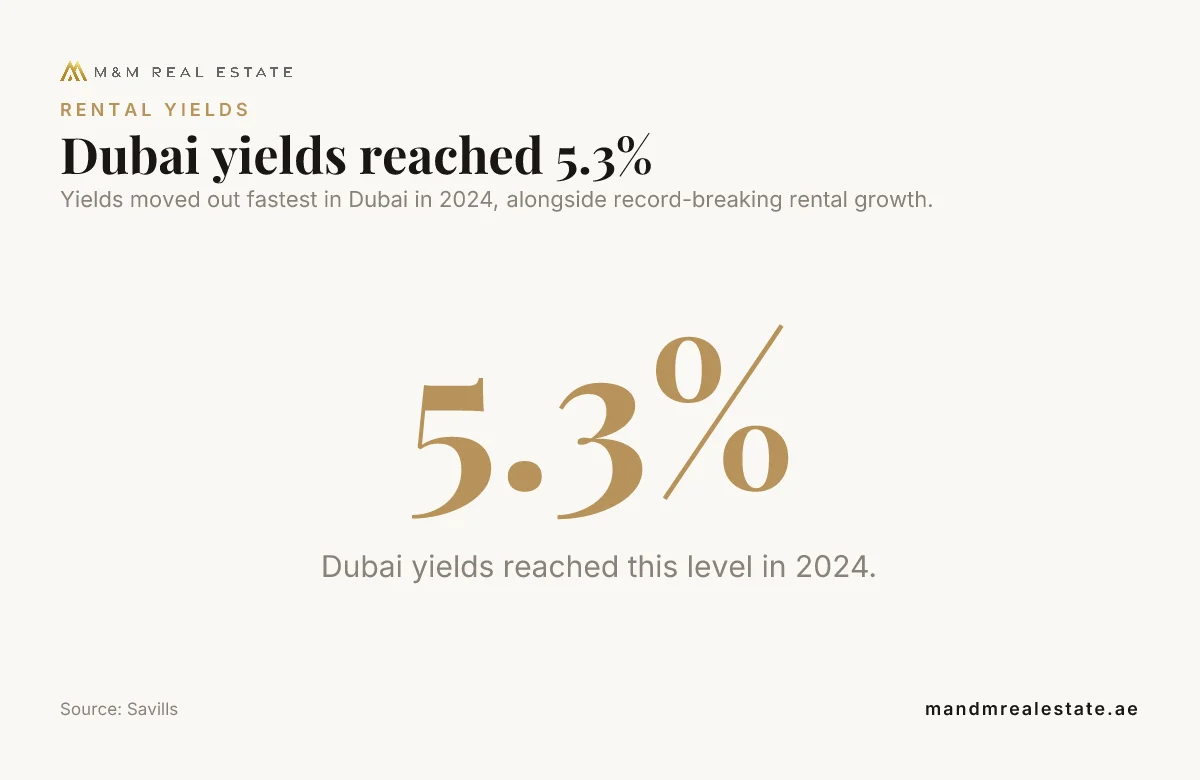
The 5.3% shown in the market card is market context, not an expected return for this unit. Before comparing a quoted yield, check whether it is gross or net and whether vacancy and costs are included. For a worked case, divide annual rent by purchase price for gross yield; subtract expected vacancy and operating costs, then divide the remaining rent by purchase price for net yield. You can also compare net rent with all-in cash invested to see how purchase costs affect the family’s return.
Ask for an itemised current estimate of registration and transfer costs, including related trustee or administration charges. The buyer usually pays the full fee in practice, so budget for it upfront.
Model a vacancy period and an unexpected repair. If a weaker rental year would force the family to sell or borrow, the purchase price or income plan needs another look.
Keep AED rent and costs separate from the KWD amount the family plans to spend. Bank transfer fees and exchange-rate movements affect the amount received in Kuwait, so include both in the cash-flow worksheet.
At M&M Real Estate, our advisors compare the same cost lines across shortlisted homes. Families weighing direct ownership against pooled exposure can also read our guide to real estate crowdfunding in Dubai, which describes a different ownership route.
Match the community to its likely tenants
Start with the likely renter. Professionals and expatriates may value access to employment and transport, while households may look for schools, parks and everyday services. A home that fits its likely tenant has a clearer letting case.
Dubai Marina can be compared against the family’s likely tenant, expected rent, vacancy and purchase costs.
For Jumeirah Village Circle, compare the likely tenant, expected rent, vacancy and purchase costs before deciding.
Use comparable rents, expected vacancy, transport access and resale prospects together. Population trends can provide useful context, while the specific building, unit layout and competing homes determine the rental case; see our review of Dubai population growth.
Test each area against evidence from the kind of tenant you want, rather than relying on its reputation. In Dubai Marina, check whether the unit’s size, commute and furnishing fit the intended renter; in Jumeirah Village Circle, assess family-suitable layouts, nearby schools and parks, and competing homes. For either area, ask for documented leases for comparable units, matching building or location, condition and lease type. Asking rents and short-stay rates are not reliable substitutes for achieved long-term rents.
Foreign capital is hesitating. The 3.9 million people inside the UAE have not. The asymmetry that defines 2026, and what it tells you to do about it.
Download free→Compare tenant appeal and letting workload
Business Bay can be compared against the likely tenant, expected rent, vacancy and purchase costs.
Short-term stays can bring more frequent guest communication, cleaning and repairs. Compare that workload and its operating costs with the potential income before choosing a letting model.
Long-term letting usually means fewer turnovers and a more predictable tenancy cycle. Assess the unit layout against the renter the family wants to attract.
Family-oriented demand can favour access to community facilities and a practical home layout. Al Jaddaf Waterfront is another area to compare against the family’s transport and tenant priorities.
For a broader view of tenant and area choices, compare the property-level details with the district’s likely renters. A headline yield alone cannot show vacancy, service charges or the work required to let a home from abroad.
Choose between a ready home and an off-plan purchase
A ready property can be rented after transfer, depending on its condition and tenancy arrangements. An off-plan property produces no rent before handover, and a delivery or leasing delay can extend the time before income starts.
For an off-plan purchase, review the developer’s delivery record, construction progress, escrow account and payment terms. Understand how the project is registered and when each payment falls due.
Check whether the family can meet payments without rental income, and assess the competing supply likely to reach the market around handover. When similar homes complete at the same time, tenants have more options, so compare nearby projects and the building’s likely position at completion.
For a ready home, inspect the unit and building, review service charges and maintenance needs, and compare the current tenancy with rents for similar homes. A payment plan or a developer’s projected return does not replace this property-level due diligence.
Read our profiles of Dubai property developers alongside the project documents. Our Emaar and DAMAC comparison and the Investment Cases for Bay Estate by Nakheel and The Yards Plaza by BEYOND offer examples of project-specific analysis. The Yards Plaza Investment Case concerns office property, which calls for a separate tenant and leasing assessment.
Compare each payment date with the family’s cash available. Our analysis of a 30/70 payment plan explains why payment timing needs to sit alongside delivery and rental timing.
Plan how ownership will work from Kuwait
Before funds move, confirm the ownership status and registration steps with the Dubai Land Department. Check the property’s title and transaction documents with the relevant parties.
Agree who will screen tenants, manage the tenancy contract, collect rent, approve repairs and respond when the home is vacant. A local property manager or representative can handle day-to-day tasks, while written spending limits give the family control over larger costs.
Set an escalation process for urgent repairs and keep rent records, invoices, contracts and decisions in a shared file. This gives family members a clear record of the property’s income and costs while they are outside the UAE.
Plan cross-border transfers with the family’s bank and qualified advisers. The family’s home-country tax and reporting obligations require separate advice from a tax adviser. This is general information, not tax or legal advice.
For an individual who owns a residential rental property directly, rental income is generally not subject to UAE personal income tax. That does not settle every case: company or business ownership, commercial property and serviced accommodation may involve different UAE corporate-tax or VAT treatment. Ask a UAE tax adviser to check the property and letting arrangement, and separately confirm any Kuwait tax or reporting obligations for the family’s circumstances. Our Dubai property tax guide covers the UAE context.
If residency is part of the family’s plan, check the applicable requirements with the Dubai Land Department; our Dubai property Golden Visa guide explains the route.
Agree on family ownership and the eventual exit
Decide who will own the home, who can approve a tenancy or sale, and how the family will agree major spending. Record ownership shares, payment responsibilities and decision-making in writing, then keep the documents together.
Discuss inheritance and succession with qualified advisers familiar with the family’s circumstances and the relevant jurisdictions. A clear plan gives the family a way to handle ownership decisions if circumstances change.
Set an exit test before buying. Consider the likely buyer pool, the home’s condition, outstanding finance and sale costs, then review the plan if family needs or rental demand change.
Compare Al Furjan and MBR City / Sobha Hartland against the family’s likely tenant profile, purchase budget and exit plan.
Compare those tenant characteristics with the family’s ownership and exit plan. The Dubai Hills Estate guide provides another family-community reference for the shortlist.
See also: Off Plan Properties in Dubai.
What the family should do before choosing a property
Set the required net income in AED and KWD, then compare ready and off-plan homes against the same cost worksheet. Ask the developer or seller for the payment schedule, service charges, tenancy details and documents needed for registration.
Shortlist communities by likely tenant, comparable rent, transport access and resale prospects. Then agree who will manage the home, approve repairs and make future sale decisions.
An M&M advisor will go through your budget, timeline and shortlist with you. Speak with an M&M advisor.
This article is general information and not tax, legal or financial advice, and returns are not guaranteed.


Can a Kuwaiti family buy a Dubai property jointly?
Agree the proposed ownership structure and confirm how to document it with the Dubai Land Department before the family commits.
Can a non-resident Kuwaiti buyer get a mortgage for Dubai property?
Ask prospective lenders to assess the intended borrowers and ownership arrangement before the family commits to a reservation.
In what currency is Dubai rent usually paid, and how does that affect income sent to Kuwait?
Dubai rent is usually stated in AED in the tenancy contract. The amount credited in KWD depends on the receiving account and the exchange rate and charges applied when the family transfers or converts the rent.
What should a remote landlord do if a tenant stops paying rent?
Keep a dated record of missed payments and communications, then follow the tenancy contract and applicable Dubai process. Seek qualified local legal advice on the formal next step for the specific case.


