


With a post-handover payment plan, the buyer receives the keys while part of the agreed purchase price remains due on a written schedule. To assess the commitment, identify the balance, match each payment trigger to the sale and purchase agreement (SPA), then test the instalments against the costs of owning the property.
- Subtract payments already made from the contract price to find the outstanding balance.
- Check each instalment’s amount, due date, trigger and final payment date against the SPA.
- Budget for service charges, utilities, maintenance and insurance alongside developer payments.
- Assess rental income after vacancy and operating costs, and keep cash available before rent begins.
- Compare the full contractual price and payment timing with cash, a mortgage and a ready property.
- Questions and documents can be prepared with M&M’s Dubai investment resources.
How a post-handover payment plan works
A post-handover payment plan spreads part of the purchase price across instalments due after the developer hands over the property. The balance is still part of the agreed purchase price, so begin with the SPA’s total price and subtract the payments already made.
Read the payment schedule line by line. For every instalment, record the amount or percentage, the due date, the event that triggers payment and the date of the final instalment.
A handover trigger can fall on a different day from a fixed calendar date. The signed SPA and the schedule should set out how the developer treats that difference; ask for a written correction before signing if they do not match.
For illustration only, if the contract price is AED 2,000,000 and 20% remains due after handover:
- AED 2,000,000 × 20% = AED 400,000 outstanding.
- AED 400,000 ÷ 12 equal monthly instalments = about AED 33,333.33 per month.
Compare the written schedule with the SPA before you reserve. M&M’s off-plan buying guide covers the wider purchase and payment process, while its payment-plan analysis gives a separate example of how a developer’s schedule can affect the timing of payments.
What happens between the handover notice and the keys
A handover notice is the developer’s formal communication about the next contractual steps. Read its deadline and requested actions alongside the SPA, because receiving the notice alone does not complete every payment or ownership step.
Arrange an inspection and record defects in writing. Follow the developer’s process for snagging, which means documenting items that need repair or completion, and agree how those items will be handled before or at key collection.
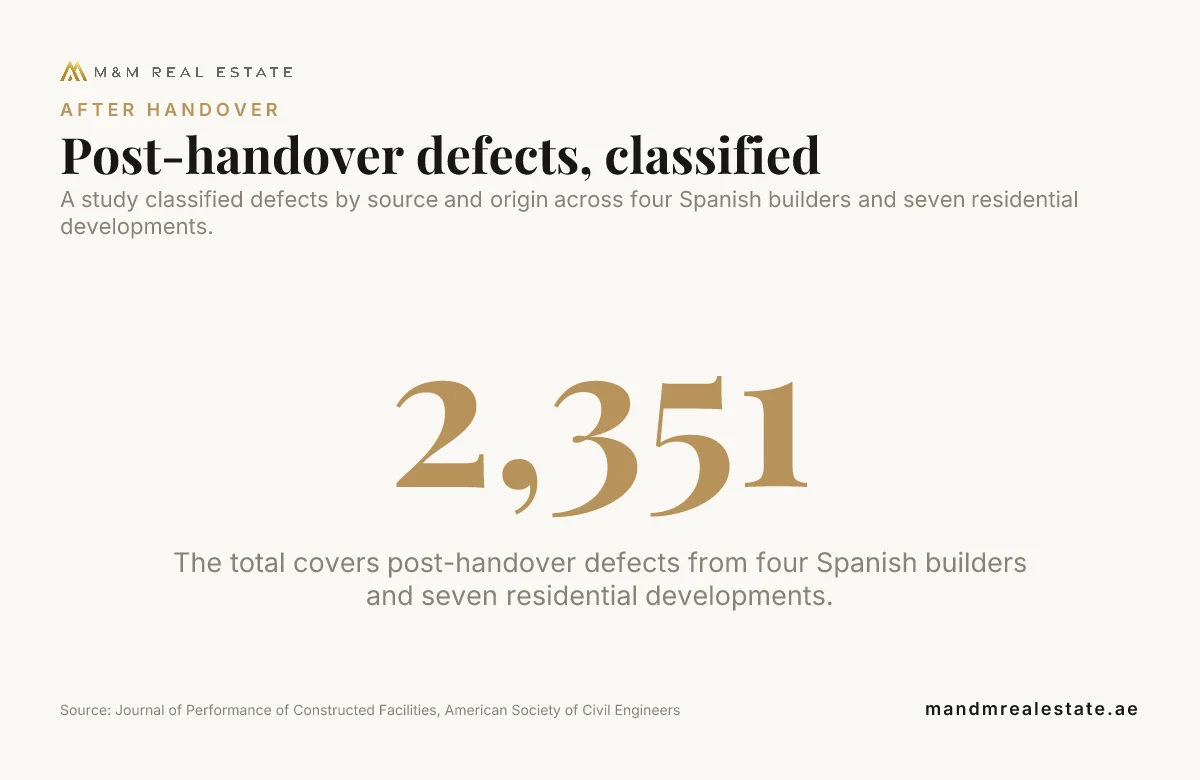
A study classified defects by source and origin across four Spanish builders and seven residential developments.
Source: Journal of Performance of Constructed Facilities, American Society of Civil Engineers
Keep the completion notice, inspection record, handover documents and payment receipts together. Check the title-registration position through the applicable Dubai process; the keys alone do not establish that every registration step is complete.
Arrange utility activation and move-in separately. The contract or developer’s handover instructions may set payments or documents that must be in place first.
For residency decisions alongside a property purchase, the separate process is covered in M&M’s Dubai Golden Visa through property guide.
Build a full cash-flow picture, not just an instalment total
Build a month-by-month worksheet that places developer payments beside the costs of owning and operating the property. Service charges, utilities, maintenance and insurance sit outside the purchase-price schedule unless the contract expressly includes them.
| Cash-flow line | What to record |
|---|---|
| Developer instalment | Amount, due date and contractual trigger |
| Service charges | Expected billing dates and the amount due |
| Utilities and insurance | Activation or renewal dates and expected payments |
| Maintenance | Known work and a reserve for unexpected repairs |
| Rental income | Rent received, less vacancy, letting and management costs |
For a rental property, use expected net rent in the worksheet, not the headline rent. Allow for vacancy, letting and management costs, maintenance and the time between paying an instalment and receiving rent.
Build the estimate around the chosen area and property type. M&M’s guides to Dubai areas for different investment goals, JVC and Dubai Hills Estate provide location context for that assessment.
Keep a separate cash reserve for instalments and expenses that fall due before occupation or the first rent payment. Test the plan with lower rent, a longer vacancy and an unexpected repair; the schedule should remain manageable without uninterrupted rental income.
For cross-border investors, include home-country tax advice when working out the cash available after expenses. Topics to discuss with a tax adviser are set out in M&M’s Dubai property tax guide. This is general information, not tax or legal advice.
Compare the full cost with cash, a mortgage and a ready property
Compare the full contractual purchase price first. A longer schedule can come with a higher price, so delayed payments have value only when you weigh them against the amount payable overall.
| Purchase route | Compare across the same time period |
|---|---|
| Cash purchase | Total price, payment dates and cash remaining for ownership costs |
| Developer plan | Total price, each instalment date, running costs and any price difference |
| Mortgage | Eligibility, deposit, interest, fees, repayments and lender conditions |
| Ready property | Total price, time to occupy or rent, and when ownership costs begin |
For a mortgage, match lender timing and conditions to the developer’s remaining schedule. Mortgage eligibility, the required deposit and repayment affordability all affect whether a loan can meet the balance when it falls due.
Compare an off-plan property with a ready property on total cost, timing and intended use, not by monthly instalment alone. For a like-for-like review, M&M’s Al Jaddaf Waterfront guide offers one location reference.
The comparison between direct property ownership and pooled exposure is also covered in M&M’s guide to property crowdfunding in Dubai. The structure and the investor’s rights differ, so compare the terms and exit route in each case.
Stress-test delays, missed payments and changing circumstances
Test whether you can meet each instalment if handover is delayed. The contractual payment dates may not move in line with the date you can occupy the property or start receiving rent.
Read the SPA’s missed-payment procedure before committing. It should tell you what notice the developer must give, whether you have a cure period to fix a missed payment, whether late charges apply and what remedies the developer can use.
Keep enough available cash to meet a due instalment without relying on a future sale, refinancing that a lender has not approved or rent that has not arrived. Revisit the cash-flow test when your income, borrowing costs or rental prospects change.
Review the developer and its written terms as part of the decision. Project-level review can start with M&M’s Dubai developer profiles.
Check resale, assignment and refinancing rights before signing
Find the SPA clauses for resale and assignment. They may set a payment threshold, require developer consent or charge a fee while the outstanding balance remains.
Check how the balance is handled on transfer. The contract may require the seller to settle it, or set conditions for a new buyer to take over the remaining payments.
Handover alone does not establish that a lender will refinance the property. Compare the lender’s requirements with the title position and the remaining amount owed to the developer.
Use the payment schedule alongside entry timing and resale liquidity when reviewing an opportunity. M&M Real Estate’s off-plan advisory provides structured cross-border support and evaluates opportunities for entry timing, product differentiation and resale liquidity.
Project-level review can help frame the questions about developer terms and resale. A specific investment assessment is illustrated by M&M’s Investment Case on The Yards Plaza and its The Yards Plaza project review.
Ask an adviser to assess the schedule alongside resale and assignment terms before you sign. This is general information, not tax or legal advice.
Decide whether the schedule fits your plans
An owner-occupier should compare instalments with household commitments and the costs of moving in. Set the move-in budget against the contractual handover steps, then allow for the time needed to complete them.
An investor should test a conservative rental scenario and keep funds available for instalments during vacancy or before the first rent payment. Rental-demand context can come from M&M’s Dubai population growth analysis, while the cash-flow plan still needs to work without immediate rent.
Choose a schedule only when its total price, dates and transfer conditions fit your time horizon and available cash. Smaller instalments can preserve cash now while leaving a larger commitment in place for later.
M&M’s 30-minute portfolio review considers a client’s goals, budget and timeline, then recommends opportunities that fit.
What to check before you commit
The answer to Post-Handover Plans: What Buyers Still Owe After the Keys is the balance recorded in the SPA, plus ownership costs that sit outside the payment schedule. Before reserving, get the signed price and instalment schedule, match every trigger and date, model the running costs, and read the missed-payment and transfer clauses.
An M&M advisor will go through your budget, timeline and shortlist with you. Contact M&M Real Estate about the payment dates, cash reserve and resale terms.
this article is general information and not tax, legal or financial advice, and returns are not guaranteed.

Can a buyer pay off a post-handover balance early without a fee?
The SPA or the developer’s settlement terms determine whether an early payment carries a charge. Ask for a written payoff statement showing the amount due, the date it remains valid and how the developer will record the settled balance.
Can the instalment dates be changed after the sale and purchase agreement is signed?
A change should be recorded in a formal amendment accepted by the parties. Request an updated schedule that matches the amendment and retain it with the signed SPA.
Does a handover notice mean the buyer must accept the keys immediately?
The notice sets out the developer’s requested actions and deadline, while the SPA and applicable process govern the buyer’s position. If a different inspection or collection appointment is needed, request it in writing and keep the developer’s response.
Who is responsible for defects found after the buyer moves in?
Responsibility depends on the defect, the applicable contract terms and the relevant legal protections. Record the issue with dated photographs, report it through the developer’s written process and keep copies of the report and response.
What are the steps involved in the process of property handover in Dubai?
The process generally involves reviewing the handover notice and any required payments or documents, inspecting the property, and recording defects in writing before agreeing how they will be addressed. After completing the contractual handover steps, collect the keys and documents, confirm the ownership-registration process is complete, and arrange utility activation separately.


