For Dubai off-plan apartments, match each payment date and trigger to reliable income, available savings and existing commitments, then carry handover and ownership costs as separate lines. For each project, include the payment schedule and expected completion point in the forecast.
- Build the forecast from the Sale and Purchase Agreement (SPA), the contract that sets the purchase terms, and the payment schedule. Record each amount, due date and payment trigger.
- Compare plans against the same income, savings and commitments, then identify the month with the lowest projected cash balance.
- Keep rent, mortgage funding and resale proceeds in separate scenarios until their timing and availability are clear.
- Keep a liquidity buffer for emergencies and ownership costs. Do not assign every available dirham or pound to instalments.
- Assess the payment schedule as one part of the wider investment decision. M&M’s Dubai property investment guide sets out that broader context.
- If your property decision also relates to residency or another way to allocate capital, read M&M’s guides to the property Golden Visa and real estate crowdfunding.
Understand when each off-plan payment falls due
An off-plan apartment is bought before construction is complete. The booking fee or initial payment starts the purchase and forms the first cash commitment, so check in the SPA how it is credited against the price.
Construction-linked instalments fall due when the developer reaches a stated project milestone. Fixed-date instalments fall due on named calendar dates, so a construction delay does not by itself move a calendar-based payment.
Read the SPA alongside the payment schedule. For every instalment, record the amount, the trigger or due date, and the account that receives payment.
Use the stated completion date as a planning input. It does not provide cash for the handover balance or confirm when rental income can start.
To understand the purchase process and payment schedule, see M&M’s off-plan buying guide. Buyers comparing available projects can also review off-plan properties in Dubai.
Build a month-by-month cash-flow forecast
Create one row for every month from booking to the final scheduled payment. Enter the instalment due, reliable income, savings available and existing commitments, then calculate the cash left at the end of each month.
| Forecast line | What to enter |
|---|---|
| Payment | Amount due and the date or project milestone that triggers it |
| Available funds | Reliable income and any planned savings draw |
| Other commitments | Existing loan payments, household costs and other known obligations |
| Closing cash | Opening cash plus income and savings used, less the instalment and commitments |
For variable income, base the main forecast on the lower amount you can plan around. Run another scenario for reduced or late receipts, and keep bonuses or a planned asset sale out of the core forecast when a fixed payment depends on them.
Keep a separate liquidity buffer for emergencies and ownership costs. If your income is in another currency, estimate each future AED payment using both the current conversion and a more cautious exchange-rate scenario; this shows how currency exposure could affect the cash left after an instalment.
For a forecast, Orise can be assessed by entering the project’s purchase value and payment schedule.
Use the project’s purchase value and payment plan as inputs, then enter the actual instalment amounts and dates from the SPA.
The agreed schedule supplies the due dates and any instalment breakdown. For more project options, use the linked Dubai off-plan property listings.
Compare the full schedule, including the handover balance
Compare the booking amount, every instalment date, construction milestones, handover balance and any post-handover payments side by side. A small first payment can leave a larger amount to fund later.
A handover-heavy schedule concentrates the funding need near completion. A post-handover payment plan carries some payments beyond completion, changing when the buyer pays rather than the purchase price itself.
Test each option against the same assumptions for income, savings and existing commitments. Compare the lowest projected cash balance and the month when it occurs, then check whether the buyer can meet that month’s obligations without using the emergency reserve.
Stress-test a delayed construction milestone, late income and a mortgage that is not ready at handover. If a construction-linked instalment comes due before expected funds arrive, contact the developer before the due date and ask for written instructions; check the SPA to see which calendar payments remain due on their stated dates.
A further schedule to consider is set out in M&M’s 30/70 payment plan analysis. For wider capital allocation across different property types, see the separate Bay Estate investment case and The Yards Plaza office case, alongside the The Yards Plaza Investment Case.
Plan the handover balance and any mortgage funding
Treat the handover balance as a committed cash need until funding is arranged. A future mortgage, resale or other source belongs in a separate scenario until its feasibility and timing are clear.
Ask a lender early about off-plan mortgage financing. The lender can explain its requirements for the project and your financial position, and whether its approval and release process can match the developer’s payment date.
Build a fallback for a mortgage that arrives late or covers less than expected. The forecast should show the extra cash required and whether the purchase remains affordable if that cash has to come from savings.
Put lender charges and transaction costs in separate lines from the developer’s schedule. They can fall due at different points, so a forecast that includes only developer instalments understates the cash required.
Test post-handover payments against a realistic rental plan
For a post-handover payment plan, model the instalments from existing income and savings first. Treat future rent as a separate scenario because completion and the first rent payment may fall at different times.
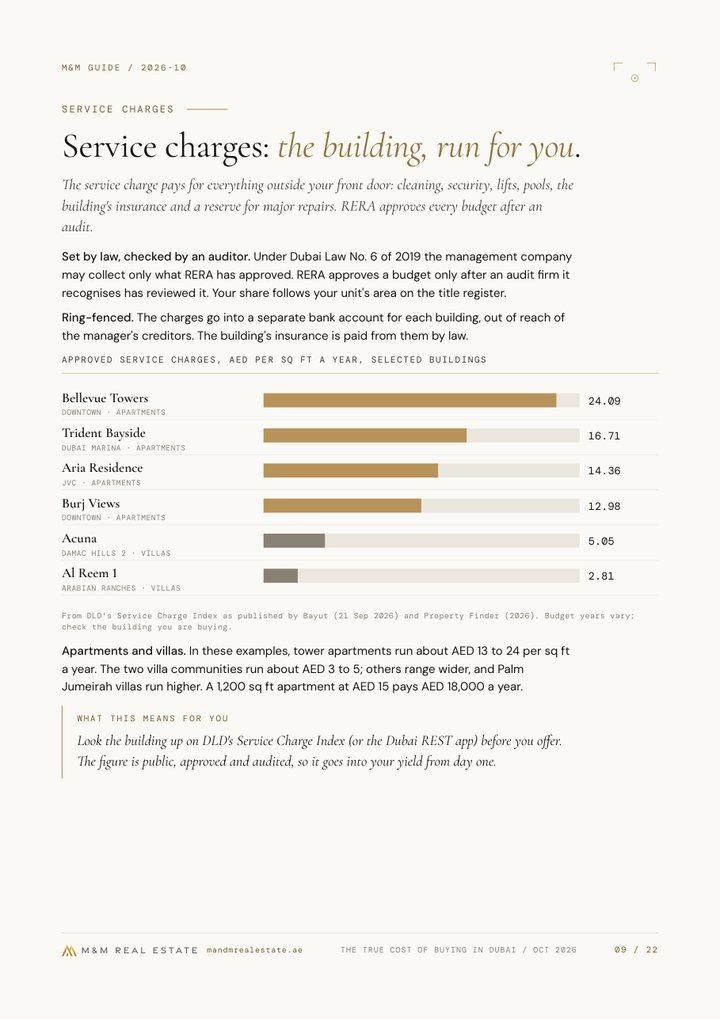
Allow time to prepare and furnish the apartment, find a tenant and receive rent. Include service charges and other ongoing ownership costs alongside each post-handover instalment.
Compare expected net rental cash flow with instalments and recurring costs. If rent falls short, the forecast should identify which other income or savings will fund the difference.
If the plan depends on selling before handover, include the uncertainty around resale timing and check the SPA and transfer process. A sale is a possible source of funds only after its contractual requirements and timing have been assessed.
Off-plan can suit an investor with a long-term case and a schedule they can carry. Developer background is one part of that review: use M&M’s Dubai developer profiles and developer comparison alongside the project, funding exposure and intended holding period.
To compare an intended tenant and unit against location, consult M&M’s Dubai area investment guide and location guides. Area-specific context comes from the Al Jaddaf Waterfront and Dubai Hills pages; broader city planning is covered by M&M’s Dubai population growth analysis.
Rental assumptions and costs that affect rent after expenses are covered in M&M’s Dubai rental guide.
Budget for costs outside the developer’s schedule
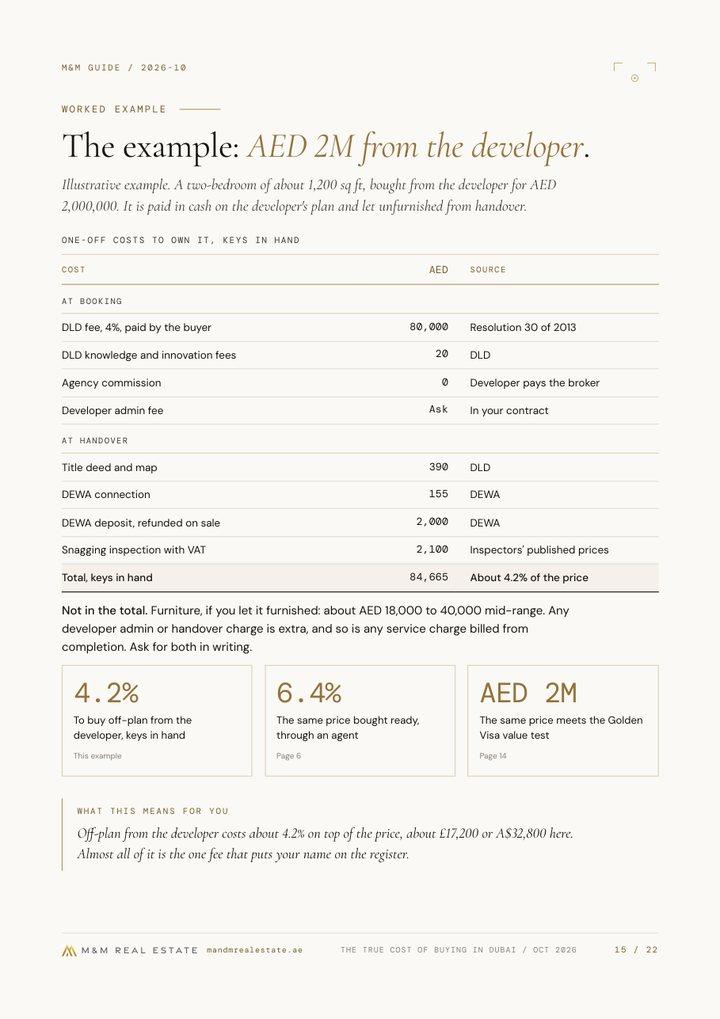
Add registration, financing, furnishing, service and other ownership costs as separate forecast lines. Budget for these costs alongside purchase payments, separately from the developer’s instalment schedule.
Before transferring funds, verify the project, payment destination and contractual schedule. The project escrow account, a project-specific account for buyer payments, should match the arrangements stated for the development.
Keep contingency funds available for delays, unexpected costs and changes in income. Review the forecast whenever a due date, income assumption or funding source changes, so the next decision uses the current position.
Tax considerations for investors are covered in M&M’s Dubai property tax overview. A tax adviser can assess how your home country treats the investment. Related planning topics are available in M&M’s Dubai investment guides and resources.
This is general information, not tax or legal advice.
What to do next
Put the SPA schedule into a month-by-month forecast, then add reliable income, savings, existing commitments, handover funding and ownership costs. Compare the lowest projected cash balance with the reserve you need for other obligations.
To match a Dubai off-plan apartment payment plan to cash flow, ask the developer to clarify each payment trigger and ask the lender when any mortgage funds could be released. An M&M advisor will go through your budget, timeline and shortlist with you. Contact M&M.
this article is general information and not tax, legal or financial advice, and returns are not guaranteed.



Can I change an off-plan payment plan after signing the Sale and Purchase Agreement?
A change needs the developer’s written agreement and a revised schedule or SPA addendum that records the new terms. Keep the signed document with your payment records.
What should I do if I miss a scheduled instalment?
Contact the developer promptly and ask for a formal statement of the amount due, any charges and the process for bringing the account up to date. Keep the notice, payment confirmation and all written correspondence together.
Can I pay an instalment early, and will that change the later payment schedule?
Ask the developer to confirm in writing how an early payment will be allocated. Get a revised statement showing whether later due dates or amounts change.
Can I sell a Dubai off-plan apartment before handover?
A resale can depend on the SPA, the developer’s transfer process and the buyer’s outstanding balance. Ask the developer for its resale requirements and obtain a written account statement before relying on sale proceeds in a cash-flow forecast.
The true cost of buying in Dubai
Every fee from reservation to resale, with a worked example on an AED 2 million home. 22 pages. Free by email.